
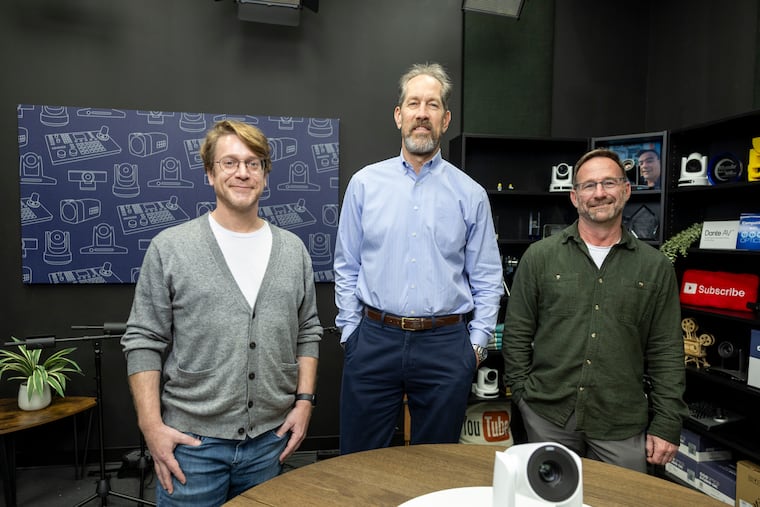
Toward the end of last year, Shane Riley and his coworkers at Haverford Systems in Downingtown learned that the company’s founders might sell the business.
“You start hearing little things here and there,” said Riley. “There was just little whispers.”
The new owner, they soon learned, wasn’t some investment entity or a competitor looking to grow. It was Haverford Systems’ own workforce. After nearly 40 years in business, the audiovisual services company, transferred ownership to its 78 full-time employees in January.
“It was exciting knowing that ownership trusted us enough to make a change like this,” said Riley, an integration operations manager who has been with the company nearly 20 years. The alternative, like selling to an outside party or other business, “would be scarier to me,” Riley said.
Haverford Systems’ new structure is known as an employee stock ownership plan, or ESOP.
Only a few hundred companies in the region operate this way — Pennsylvania had 290 and New Jersey had 109 in 2022, according to the Rutgers Institute for the Study of Employee Ownership and Profit Sharing. Out of millions of businesses across the United States, 6,411 had an ESOP as of 2023, according to the National Center for Employee Ownership.
With an ESOP, “workers who might not otherwise have had access to significant forms of financial wealth … can accumulate very significant savings,” said Adria Scharf, assistant professor at the Rutgers School of Management and Labor Relations.
Across the U.S., more than half of all businesses are owned by people aged 55 or older, and 17% of them planned to sell in the next five years, according to a Gallup survey in late 2024.
Forming an ESOP is one of their options, and Scharf is leading a new initiative at Rutgers to help demystify the process. Rutgers researchers have identified 137,000 U.S. companies that might benefit from the ESOP structure.
Occasionally one might hear of a truck driver or grocery store employee who became a millionaire through an ESOP, said Scharf, though that’s not a typical situation.
“It’s one of the best kept secrets in the private sector,” said Scharf. “In the context of the wealth inequalities we see, and the crisis of economic insecurity we see, and so many Americans struggling to build a nest egg for retirement, it is just a really powerful tool.”
Why transition to an ESOP? How does it work?
In 2020, during his first year on the job, Haverford Systems sales manager Shawn Thornton worked on roughly 50 projects for religious institutions that wanted to livestream mass, baptisms, funerals, and more.
“I’ve done everything from Presbyterian to Catholic to Lutheran to Episcopal, to Quakers,” he said. “You name it, I think we’ve covered it.”
Business at Haverford Systems boomed during the pandemic as remote communications became essential.
“We grew the business by four-plus times,” said company president Joseph Mulcahy, though he declined to share last year’s revenue.
Even ignoring the pandemic-related peak in demand, which eventually receded, the company has grown its revenue roughly 9% annually since 2019, Mulcahy said.
The company’s founders, Hugh and Eileen Richards, were already hands-off owners by that time, said Mulcahy, who is their brother-in-law. The success during the pandemic nudged them along to figure out their succession, he said.
They considered selling to private equity or a strategic buyer already in the industry, but that didn’t feel right, said Mulcahy — it wouldn’t have been in the best interest of the employees or the company.
The ESOP model allows employees who helped build the company to benefit from its success, he said, while the original owners get market value for it.
A common way to transition to an employee-owned company is for a trust representing the ESOP to borrow money from a bank to buy out the owner. The owner can also agree to partially finance the sale and get paid back over time, explained Scharf.
The company then puts money toward the ESOP to pay off the loan. As the loan is repaid, the company shares then get allocated to the individual employee accounts over time, said Scharf.
From the employee perspective, the model is essentially a retirement plan. But unlike a typical 401(k), the ESOP typically requires no financial contribution from the employee, she said.
“It’s a powerful tool for long-term wealth creation when the company is stable,” said Scharf, adding that ESOP companies often outperform others.
Haverford’s sales manager, Thornton, who has three children, said he’s not planning his retirement any differently now that he’s part owner of the company, but it does bring him “more peace of mind.”
“I know I’m gonna be here for the long haul,” he said. “I’m gonna be rewarded for the effort that I put in. It’s a very calming, very peaceful thing.”
Wawa and other local ESOPs
Haverford Systems is just the latest company in the Philadelphia area to adopt an employee-ownership model.
Wawa, which formed an ESOP in 1992, has said its workers own over 40% of the company.
Renova Environmental Co., which does environmental remediation and is based in Ocean Township, launched in 2006. It adopted a partial-employee-owned model and reports that a typical employee’s ESOP shares were valued at around $100,000 in 2023.
American Reading Co., which offers literacy solutions and is based in Blue Bell, transitioned fully to an ESOP in 2022. And Horsham-based Benjamin Obdyke Inc., which sells construction materials, adopted a 100% ESOP model in 2023.
Some of these local firms are among 23 companies surveyed in a recent Rutgers study on why company owners pursue employee ownership.
“It enabled them to meet their financial goals without compromising their other values and priorities,” said Scharf, who coauthored the report. “It enabled them to cash out, meet their financial goals, but also preserve the jobs of the workforce, see the company continue operation, and not have to sacrifice the work that they had invested.”
What changes at the company?
Once employees become owners of the company, that doesn’t mean the way the firm functions changes overnight.
“There can still be a CEO, there’s still a boss, there can still be top-down management,” said Scharf. “It’s not like the workers are taking the decisions over, but just … that the ownership stake is now broadly held.”
Nothing really changes about the work they do day to day at Haverford Systems under the new model, said president Mulcahy, adding that “is one of the best parts about it.”
Becoming a part-owner reinforced how integration operations manager Riley feels about his job.
“I’d like to think of myself as a self-motivated person anyways, but it definitely gives you a little extra incentive,” said Riley. “You’re a little bit more vested in the success of the company.”