
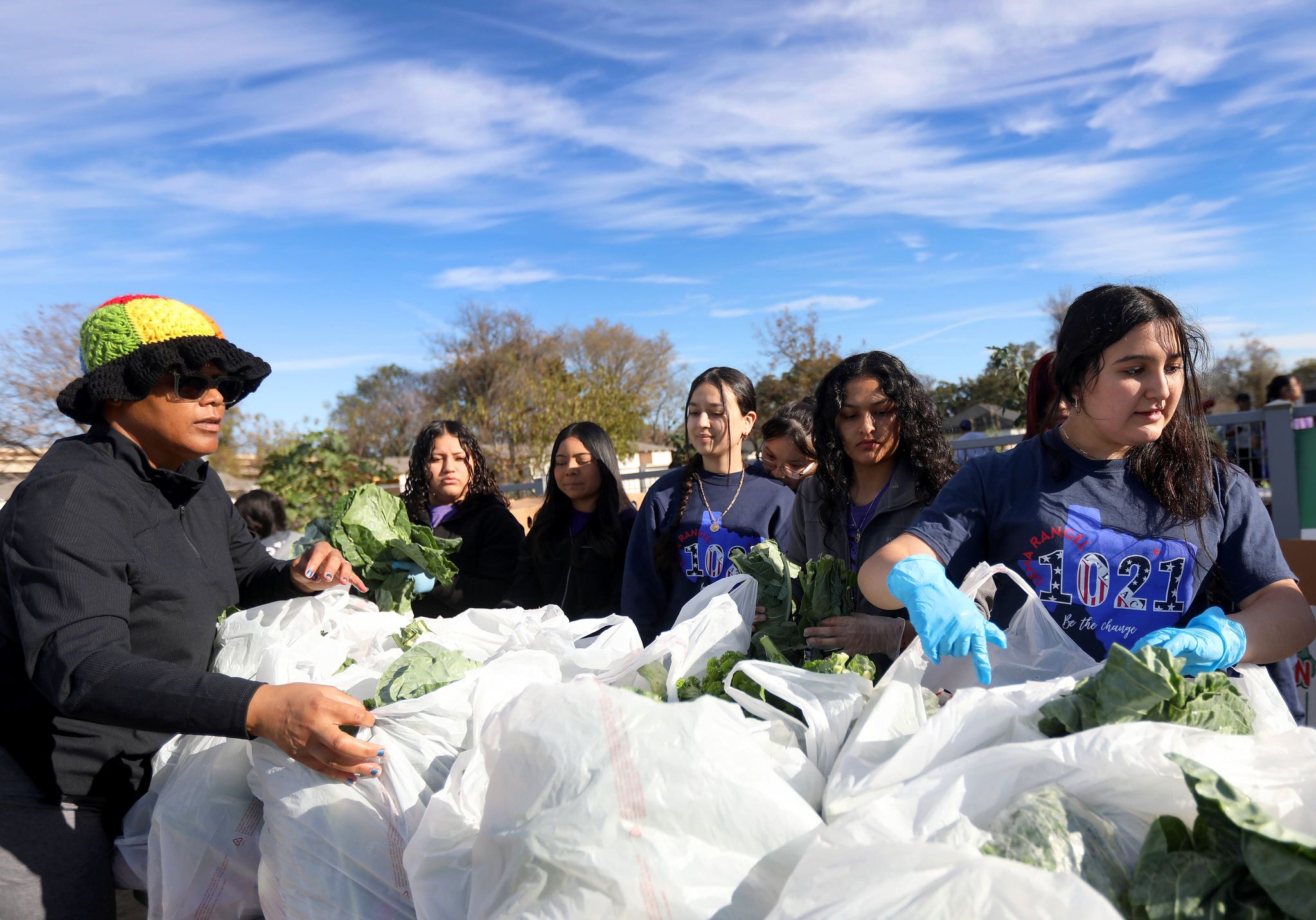
Leaders in Dallas’ vast food system are working to make North Texas more resilient as the region expects booming growth and deals with increasing hunger.
Whitney Strauss, who is spearheading the effort, briefed the City Council’s committee on parks, trails and the environment on Monday. The new plan could turn scattered efforts into real accountability and benefits like closer, healthier and more affordable grocery options, according to her presentation.
The city is part of that planning: If the new effort is eventually adopted by city and county leaders, Dallas would join the ranks of several other cities with similar plans, including Austin, New York and Boston.
Related: Amid booming growth and increasing hunger, does Dallas need a plan for its food system?
Recent events like the pandemic, federal funding cuts and a pause on food assistance could heighten vulnerabilities in North Texas’ vast food system. Community leaders are looking at ways the landlocked region can sustain itself.
Food insecurity rates have trended upward since the COVID-19 pandemic, and they are higher in Dallas County than at the national level. The southern half of the county experiences the larger share of hunger.
Data shows that in 2023 and 2022, children in Dallas County faced food insecurity at a rate of around 25%, compared with 19.8% in 2021. Overall, the food insecurity rate was 17.4% in 2023 and 15.6% in 2022, compared with 13.1% in 2021.
Related:
Strauss answered questions from council members about how local growers in southeastern Dallas would be included, whether the plan will address food access in places like South Dallas and if it would duplicate work. It would add to current efforts, she said.
“The plan is an ‘and’ not an ‘or,’ ” Strauss said, adding, “Actually, I see it as a best practice, from what I’ve seen in other cities.”
Strauss launched the Dallas-Dallas County Food Plan Collaborative last year after gathering dozens of leaders from across the food system.
The Dallas-area plan is expected to focus on local food production,emergency food preparedness and the idea that food is medicine, among other facets. Its steering committee includes members from the city, county, North Texas Food Bank, United Way of Metropolitan Dallas, the DFW Hospital Council, area colleges and universities, grocers and nonprofits aiming to supply food across the region.
When counties and cities step in to support the plans, there are material impacts, according to the presentation. For example, the Chicago Region Food Plan led to an increase in healthy food at stores in underserved neighborhoods. In the Portland, Ore., area, stronger partnerships were forged between the county health departments and local food producers, resulting in measurable reductions in food insecurity, according to the presentation.
Strauss said she wants to hear from communities who have ideas to add to the plan. There will be a series of meetings and community engagement over the summer, with the collaborative aiming to publish its findings in October.
“If they have ideas, or there’s something going on in their neighborhood that they want to bring up into this plan, please reach out,” Strauss said. “We’re going to be intentional about going out and engaging. But this is their opportunity to put it into the plan.”
Those interested in the plan can email info@dallasfoodplan.org.
This reporting is part of the Future of North Texas, a community-funded journalism initiative supported by the Commit Partnership, Communities Foundation of Texas, The Dallas Foundation, the Dallas Mavericks, the Dallas Regional Chamber, Deedie Rose, Lisa and Charles Siegel, the McCune-Losinger Family Fund, The Meadows Foundation, the Perot Foundation, the United Way of Metropolitan Dallas and the University of Texas at Dallas. The News retains full editorial control of this coverage.