
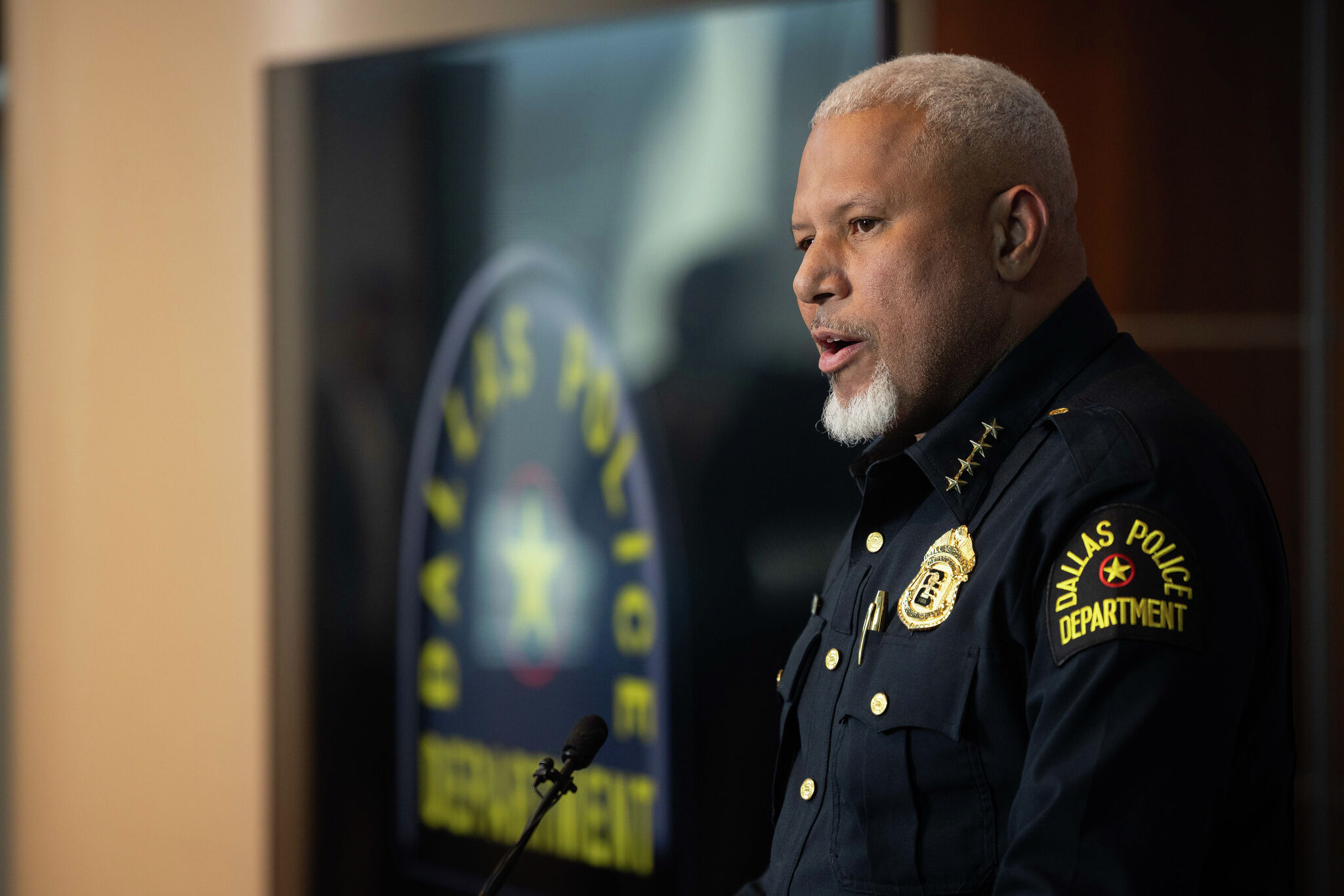
Dallas Police Chief Daniel Comeaux said Wednesday the department supports Gov. Greg Abbott’s move this week to send a state police “repeat offender” task force into the Dallas-Fort Worth area.
Expanding the Texas Department of Public Safety initiative, first launched last fall in Houston, would build on Dallas police’s ongoing efforts to target violent offenders alongside the U.S. Marshals Service — a strategy the chief often calls a key element in the department’s crime-fighting plan.
“We’ve been doing this since day one,” Comeaux said in an interview after an unrelated news conference at Jack Evans Police Headquarters.
The Republican governor, who is running for a fourth term, wrote to the DPS director on Tuesday, directing the agency to expand the effort to the Dallas-Fort Worth, San Antonio and Austin metropolitan areas and deploy “intelligence-driven operations” to make arrests.
Abbott described the initiative as a partnership between DPS and local and federal law enforcement agencies aimed at cracking down on what he called a “revolving door of repeat violent offenders.”
“Targeting these dangerous perpetrators reduces crime, increases safety, and better protects Texans,” Abbott said in a news release. “We will unapologetically back law enforcement, bring dangerous criminals to justice, and keep our communities safe.”
How the DPS effort would fit into existing operations in D-FW was not immediately clear. DPS did not respond to a request for comment or a list of questions Wednesday.
The DPS task force launched in Houston in the months after Abbott signed into law a package of legislation reforming the state’s bail system after years of resistance from Democrats. They cast the move as an unfair overreach disproportionately targeting marginalized communities, with longer jail stays and increased punishment for pretrial defendants who, by law, are presumed innocent.
The package included a constitutional amendment approved by voters in November that allowed judges to deny bail for people accused of certain serious crimes. Abbott and supporters say it improves public safety and keeps defendants from being released on bond and moving on to violent crimes, such as murder. Backers have included elected prosecutors, both Democrats and Republicans.
Reports of violent crime in Dallas fell in 2025 compared with the year before, marking the fifth consecutive year of declines in the city and mirroring broader national decreases.
Sean Malecha, acting U.S. marshal for the Northern District of Texas, said he also welcomed Abbott’s move to bring the DPS task force to D-FW. The federal agency counts fugitive apprehension among its core responsibilities.
Malecha described the collaboration between the marshals and Dallas police as representing the “essence of what the governor wants to be done across the state.”
“While this applies to us, it’s not necessarily something we have to start,” he said in an interview. “We’re already doing it.”
In Texas, most defendants have a constitutional right to bail, which allows them to leave jail while awaiting trial by paying money up front or using a bail bond company, though judges can also release some on a promise to appear in court.
State law already allows judges to deny bail in limited cases, including capital murder and some repeat offenses. The constitutional amendment approved last year expanded that authority to include certain violent felonies — such as murder, aggravated robbery and aggravated sexual assault — if prosecutors show a defendant is a flight risk or poses a danger to the public.
States with Democratic-leaning legislatures have pursued bail reform for different reasons, driven by concerns that cash-based systems favor wealthy defendants while keeping poorer ones jailed before trial.
Dallas City Council member Cara Mendelsohn, who chairs the city’s Public Safety Committee, said targeting violent repeat offenders is critical to public safety and that she was “thrilled” to hear the DPS task force was coming to Dallas.
“Too many dangerous criminals are repeatedly arrested and released while residents are left dealing with the consequences,” Mendelsohn said.
Neither Dallas Mayor Eric Johnson nor his spokesperson responded to requests for comment. Johnson has made public safety one of his signature issues.
Spokespeople for the district attorneys in Dallas and Tarrant counties did not comment on Abbott’s directive to DPS when reached Wednesday. Spokespeople for Fort Worth police did not respond to a request for comment.
Abbott said the DPS task force has yielded results in Houston.
In the news release Wednesday, Abbott said the operation has arrested 728 repeat offenders, including 445 people the governor called “high-threat offenders.”
The task force has made 225 drug seizures, including more than 225,000 doses of fentanyl, 115 pounds of methamphetamine, 7 pounds of cocaine and 415 pounds of marijuana.
Comeaux, a former Drug Enforcement Administration special agent in charge who was last assigned to oversee the agency’s Houston Field Division, said he was not familiar with how the task force had worked in Houston.
The chief said he had not known Abbott would expand the task force, but said he had been in discussions with Jeremy Sherrod, DPS’s director over the agency’s North Texas Region, about how they could work together to take the “worst of the worst” off the streets.
While details of how the DPS task force would operate in North Texas were unclear, Comeaux said he hopes the expansion would bring additional resources to support local law enforcement efforts.
“What I am looking for is for them to come on with us, bring some extra manpower and go out and get violent offenders,” he said.