
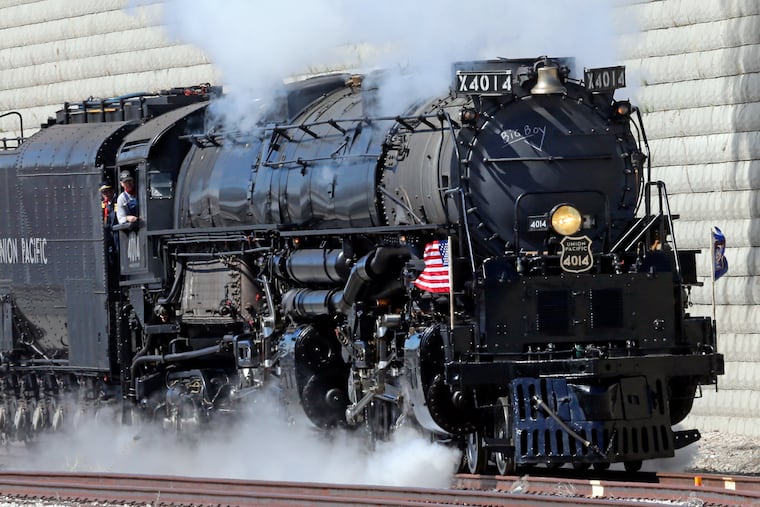
Union Pacific’s Big Boy No. 4014 will arrive in Philadelphia in time for Fourth of July celebrations, completing its journey from the West Coast. The legendary locomotive has already drawn thousands to tracks across Pennsylvania, according to the railroad.
The Big Boy is scheduled to arrive in Philadelphia for a Fourth of July display at Intrepid Avenue and League Island Boulevard in the Navy Yard, where it will be open to public viewing from 8 a.m. to 2 p.m. Saturday and again on Sunday from 9 a.m. to 3 p.m. before heading west. Admission is free.
The stop is part of Union Pacific’s coast-to-coast tour marking the nation’s 250th anniversary, a commemoration neatly suited to the locomotive itself: enormous, industrial in purpose, and now preserved as national memory.
On Thursday, the locomotive is scheduled to stop shortly in Reading (1:30 to 2:15 p.m.) and Pottstown (3:30 to 3:45 pm.) for public viewing before traveling to King of Prussia, from where it will depart at 9 a.m. Friday for Philadelphia. It will leave Philly at 9 a.m. Monday.
The Big Boys — 133 feet long and weighing 1.2 million pounds — are the world’s-largest steam locomotives. Big Boy No. 4014 was part of a fleet of 25 locomotives designed to haul heavy freight over the mountains between Ogden, Utah, and Cheyenne, Wyo., as rail traffic surged around World War II.
“There is something romantic about it,” said Robynn Tysver, a spokesperson for Union Pacific. “It echoes back to a time that you and I do not remember. Maybe it’s just the size of it.”
The restoration project that put Big Boy 4014 back on the track has been called one of the most significant locomotive restoration projects in recent memory by railroad experts. The restoration began in 2013. The locomotive was taken down to its bolts and rebuilt using graphics from 1941, according to Union Pacific.
Union Pacific’s history reaches back to the Pacific Railway Act of 1862, when President Abraham Lincoln chartered the railroad to help build the eastern portion of the first transcontinental line. Built largely by immigrant labor, the railroads that followed connected markets and cities, transformed the West, and made the country feel physically continuous.
Big Boy No. 4014 carries some of that history with it. It is both machine and symbol: of movement, expansion, industry, memory, and the complicated national faith that bigger could mean better.
Union Pacific reports that crowd sizes have increased as the locomotive has traveled from California to the East Coast. Though modern locomotives are more durable and have enhanced safety features — for example, AI software to scan tracks for debris — something inarticulable draws people to the Big Boy.
“You just have to see it to understand what captivates people,“ Tysver said. When you see it, you’ll understand what captivates people. It’s a living, breathing piece of history.”