
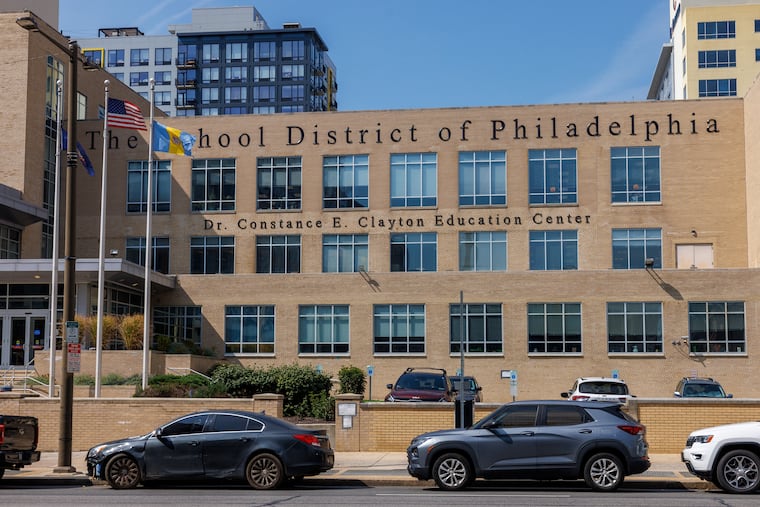
The president of Philadelphia Montessori Charter School, two parents and two students sued the Philadelphia School District in federal court Tuesday, alleging civil rights violations over what it says is an “unlawful and fundamentally unfair charter renewal process.”
Separately, the Southwest Philadelphia school also asked Commonwealth Court judges this week to bar the school board from taking a non-renewal vote against the school. That vote is now scheduled for a special meeting on Thursday.
The federal suit was filed in Philadelphia against the district, school board, and Peng Chao, the district’s chief of charter schools.
Board president Reginald Streater in May directed the charter office to prepare notices of nonrenewal for Philadelphia Montessori and another charter, Global Leadership Academy Charter School Southwest at Huey. Streater and other members of the board had concerns about academics, operations, personnel, and finances at both schools.
The federal suit was filed by Christopher Smith, the president of Philadelphia Montessori’s board of trustees, parents Donnaye Noland and Maria C. Rios, and their children, students at the school. The parties also asked a federal judge for an emergency order stopping the board from taking any action around nonrenewal until the case is heard.
“This case is not about educational policy or the wisdom of charter schools,” the suit reads. “It is about whether a public school district may employ an arbitrary, internally developed, and concededly flawed evaluation process to recommend the closure of a public charter school serving predominantly Black or African American students and a significant population of students with disabilities, notwithstanding its own acknowledgment that the process lacks transparency, consistency and objective standards.”
Wanda Motley Odom, a spokesperson for the school board, said the board does not comment on pending litigation, but that the filing “does not change our agenda for Thursday’s action meeting, or the board’s responsibility to carry out its statutory duty to consider matters properly before it. The board is reviewing the filing, and will continue to act in accordance with applicable law.”
U.S. District Court Judge Joshua D. Wolson has scheduled a Wednesday conference call on Philadelphia Montessori’s application for the federal emergency order.
A charter nonrenewal vote does not mean a school closes, but triggers a lengthy, formal nonrenewal hearing, and eventually a second board vote on nonrenewal.
Schools remain open during the nonrenewal hearing process, and can appeal nonrenewal decisions.
Harm that can’t be undone
Philadelphia Montessori, the only public Montessori school in the city, serves 250 students on its Island Avenue campus.
At the board’s May meeting, officials flagged longstanding concerns about the school, including its underperforming both a similiar-schools group and the district as a whole in academics.
They also cited personnel problems at the school.
But Smith, Noland, and Rios say students have “enrolled and remained at PMCS because traditional district placements were unsuccessful,” and say that the methodology the district uses to evaluate charter schools “disproportionately disadvantages charter schools serving predominately Black or African American student populations by relying on metrics and comparator methodologies that produce racially disparate outcomes.”
The suit seeks not just to halt the district from implementing the nonrenewal, but also asks for compensatory damages for the student plaintiffs.
Mark Seiberling, a lawyer for Philadelphia Montessori and the plaintiffs in the federal suit, said the school is not seeking special treatment, but equal treatment.
“Once the school district initiates the nonrenewal process, the resulting harm to students, families, and the school community cannot be fully undone,” Seiberling said in a statement. “We look forward to presenting the evidence in court. Our clients simply seek a fair, transparent, and lawful renewal process that complies with the Constitution and federal civil rights laws.”