
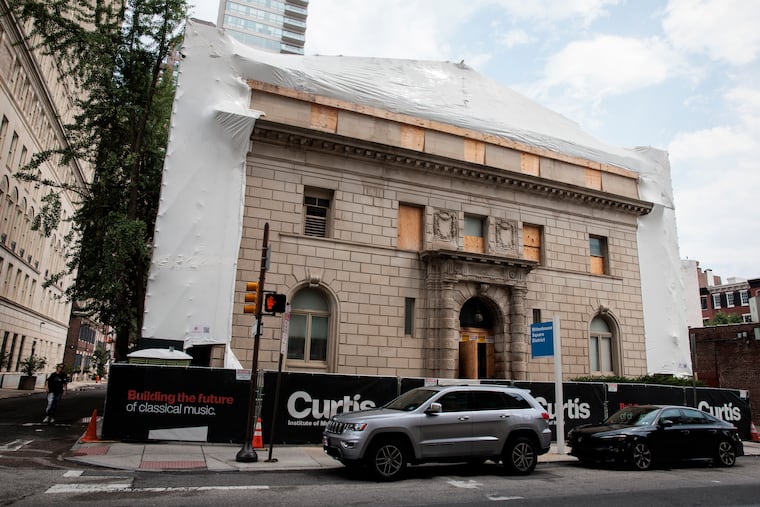
It is hard to imagine, given the charred smell, wrecked plaster, and thick web of scaffolding and structural supports evident these days inside the Art Alliance on Rittenhouse Square. But a year after a devastating fire, the Curtis Institute of Music is closing in on a vision for the historic building’s next act as the new home of the music conservatory’s vocal and opera department.
“My hope has always been that we could use this space to do for the vocal department what we did for the rest of the school or the orchestral program, certainly, with Lenfest,” says Curtis president and CEO Roberto Díaz.
Lenfest Hall, on the 1600 block of Locust Street, opened in 2011, providing the school with 105,000 square feet of dorms, rehearsal studios, a dining hall, a light-filled rehearsal hall large enough to accommodate a full orchestra, and other spaces.
The Art Alliance was gutted by fire and water damage in July 2025, and plans for its restoration are now being worked out by the school with Philadelphia firm VSBA Architects & Planners.
The first floor is envisioned as having two 1,000-square-foot event spaces for master classes or lectures. The second floor will feature six teaching/coaching rooms and a student lounge. In the basement will be a catering kitchen, a costume shop/dressing room, and storage.
The major new space in the Art Alliance building will be a rehearsal room on the third floor whose 2,900 square feet roughly equal the size of the orchestra rehearsal hall in Lenfest.
“We could open it up for the neighborhood to come in and participate,” Díaz says, “but it gives the vocal department something that they just don’t have anything even remotely like.”
The vocal and opera department currently occupies a series of spaces in Curtis’ main historic building on the 1700 block of Locust Street.
While the restored and reconfigured Art Alliance building is primarily intended as the home of opera and vocal music, it will also likely host instrumentalists as space and scheduling allow. The school — with a student body of about 160, all on full scholarships — expects to open up events like master classes, informal workshop performances, and lectures to the public, but the frequency of public events has not been determined.
“In addition to supporting the work of our students and faculty, we look forward to ensuring that the Art Alliance is a welcoming place for our neighbors, communities, and partners,” Curtis spokesperson Patricia Johnson said. “At this stage, we’re exploring ways this could take shape.”
The building could open in about three years, Johnson said.
Among the issues still to be resolved is the eventual height of the Italian Renaissance Revival building, the onetime Wetherill mansion dating from 1906. Curtis would like to make the ceiling height on the third floor high, the better for acoustics in spaces like the large rehearsal room.
“That’s a work in progress,” Díaz said. “When we were in the design stages of Lenfest Hall, we had to get a lot of permissions from the architectural folks and the [Philadelphia] Historical Commission and so forth. So that would be part of the process here. Obviously the more volume we have in this room, the more things we can do in it.”
The building’s attic was destroyed in the fire, and a new one will not be built.
A number of historic elements of the building have, however, been saved — the stained glass windows on the landing between the first and second floors, and a frieze honoring Art Alliance founder Christine Wetherill Stevenson, among them.
Most of the demolition planned for the building’s interior has been completed, said Scott Kahan, senior project manager with construction management and general contracting firm C. Erickson & Sons.
As the exact programmatic elements of the building are developed, Díaz said, a total project cost will emerge. A rough estimate is around $25 million.
And then there is the matter of paying for it all.
The school’s insurance claim is still unresolved, Díaz said, and philanthropy will be a part of the funding mix.
Curtis has “lots of angels interested in opera and vocal music,” and while none has stepped forward yet, Díaz suggests the building will have naming opportunities.
“The idea is very much like what we did with Lenfest, where Gould Rehearsal Hall has its name and we have the Locks Board Room and we have the teaching studios and rehearsal spaces that are named and so forth.”
Curtis bid for the Art Alliance building in January 2025, acquiring it for $7.6 million from the bankruptcy estate of the University of the Arts, and was in the process of cleaning it out when the blaze struck. A report from the city’s fire marshal categorized the cause as “undetermined.”
The school was exploring potential uses for the facility at the time.
In its days as an arts institution and restaurant location, the Art Alliance lodged itself in the memories of many for its exhibitions, as well as weddings, parties, and other events.
One element of the building that went unscathed in the fire now seems elegiac. It is a floor mosaic just inside the entrance with the University of the Arts logo rendered in red-and-white tile.
Historic as the logo has become, that detail, Curtis leaders say, will go.