
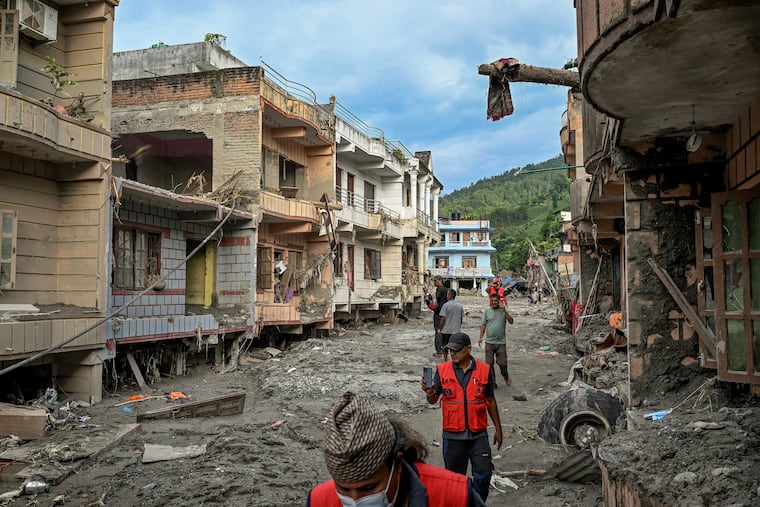
KATHMANDU, Nepal — Entire towns wiped out. Roads, bridges, and communication lines washed away. In just a matter of moments, tens of thousands of people were left devastated and disoriented as catastrophic floodwaters tore through the tranquil Himalayan valley.
Four days later, as the rescue efforts in Nepal and neighboring Tibet continued Saturday, the staggering scale of the flood’s devastation was coming into focus.
The official count of missing people jumped to more than 2,400, more than double the figure from a day before. The death toll rose to at least 675 and was expected to keep climbing. Morgues in several of the towns downstream from the deluge have been overwhelmed by the number of bodies, with officials forced to improvise makeshift arrangements.
“In living memory, we haven’t seen a mountain hazard event like this,” Kamal Kishore, the United Nations’ top official for disaster risk reduction, said Friday. “The impact on lives, livelihoods, buildings, infrastructure, bridges, hydroelectric projects, power generation is really immense.”
The recovery will be daunting.
Nepal is one of the poorest countries in the world. Its economy, long stagnated, is heavily reliant on the tourism industry and the remittances its workers send from abroad.
The catastrophe comes amid a shortfall in global humanitarian funding, as some of the largest traditional donors, particularly the United States under President Donald Trump, have pulled back from international aid in recent years.
The United States, for example, has announced that it will contribute $500,000 to the rescue effort — a fraction of what it had promised in the days immediately after a devastating earthquake hit Nepal in 2015. Sri Lanka, still emerging from its own economic crash, has pledged $1 million.
The limited pledges so far do not bode well for funding the reconstruction effort, said Pradeep Gyawali, a former foreign minister.
“The contrast with the 2015 earthquake is staggering, when Nepal struggled even to manage the huge volume of relief materials that arrived from around the world. Assistance came almost immediately, and on a much larger scale,” he said. “This time, however, the response has been much weaker.”
The small Himalayan nation also remains highly susceptible to climate change. Scientists have long warned about potential flooding from the lakes that melting glaciers have formed in the mountains. Even in normal years, smaller floods related to monsoon rains cause mudslides and block roads, straining the country’s vulnerable infrastructure.
The threat of fresh flooding hangs heavy over the rescue and relief efforts.
China reported Friday that a barrier lake, created when the landslide that started Wednesday’s deluge blocked the river system, had begun overflowing in Tibet, near where the floods originated. Nepali authorities issued repeated alerts downstream, and police officers hurried through nearby towns with megaphones, asking people to move to higher ground. China’s state broadcaster, CCTV, later reported that the risk of a breach at the barrier lake had “gradually decreased,” though the threat of another flood remained.
Much of the rescue effort on the Nepali side of the border appeared focused on several hydropower plants that were swept away by the torrent of water and debris. Army rescue teams rushed to recover workers from the muddy tunnels in dramatic scenes.
In a sign of how uncertain the situation remained, hundreds of workers from those plants had not been counted among the initial missing tally, Nepali officials said in explaining the sudden jump in the number of missing.
The threat of flooding temporarily paused the rescue efforts in Tibet on Friday. But on Saturday, Chinese rescue workers resumed their search efforts, looking for survivors near the Gyirong border crossing between Nepal and Tibet, CCTV reported. The footage showed firefighters combing the leveled site, tapping on the ground with shovels and shouting, “Is anyone there?”
The government in Nepal, which swept to power this year on the back of Gen Z protests, is trying to assert control and restore order in the face of the overwhelming tragedy.
Balendra Shah, the 36-year-old prime minister, has not addressed the nation but has been seen visiting the sites of destruction and leading meetings to coordinate the country’s response.
His government has deployed more than 30,000 security forces for rescue and recovery efforts. Possibly drawing on lessons from the response to a previous natural disaster in the country, which was criticized as chaotic and disorganized, authorities this past week initially declined foreign rescue teams.
But by the end of Friday, news media in Nepal reported that the government was easing that restriction.
On Saturday, Shisir Khanal, Nepal’s foreign minister, said the country was seeking support for tunnel rescues, with an Indian team already in the country and two teams from China also coming. He said the government also required outside help with forensic capabilities, and teams that can help identify bodies with DNA sampling.
More than 7,000 people had been rescued by late Saturday, many of them pulled out of flooded villages in helicopters before being sent to hospitals and relief camps, where they have been given meals and medical help.
Soon, the focus will have to shift to rebuilding. But for those who survived the surging waters — losing loved ones, livelihoods, and homes — a path to recovery may seem distant. It is unclear whether many survivors will be able to return home or if they will need to resettle elsewhere.
The damage has also been particularly heavy at the site of hydropower projects built along the Bhotekoshi and other rivers downstream. Tens of miles of roads and more than 40 bridges have been destroyed.
Initial government estimates in Nepal have put the cost of physical damage at more than $1.3 billion, and the country’s finance minister has predicted that recovery efforts could run into “a few billions.”
This article originally appeared in the New York Times.