
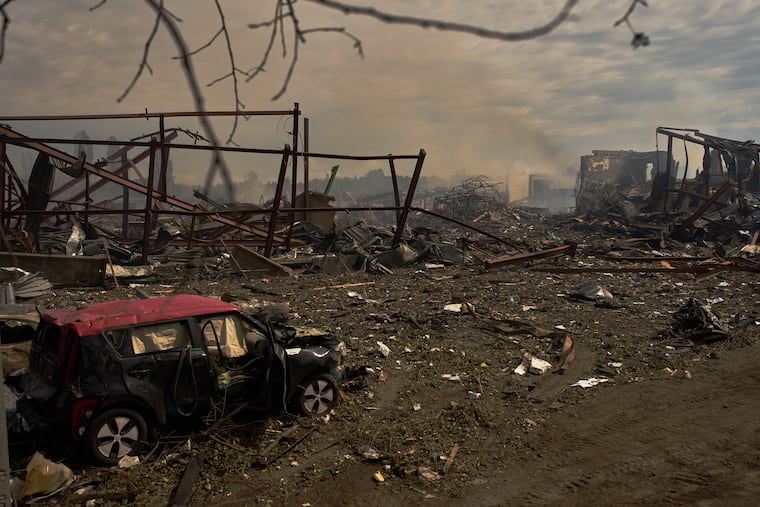
Russian airstrikes on civilian targets have destroyed shopping centers and food distribution warehouses across Ukraine, raising the specter of food shortages and price hikes as supermarkets in Kyiv and other cities struggle to keep their shelves stocked.
Moscow shifted tactics this month to focus on civilian targets, including shopping malls, after Ukrainian drones destroyed major e-commerce warehouses in Russia.
Russia initially bombed two distribution centers for Silpo, a major Ukrainian supermarket chain, and a main logistics center in Kyiv for Novus, another grocery and convenience store operator.
Shelves emptied of fresh produce, as well as dairy products including sour cream, yogurt, and cheese.
A wave of attacks in recent days has battered Kyiv and the surrounding region, hitting more warehouses and raising questions about how long retailers can keep stores stocked.
Some stores filled the empty space with kombucha and other surplus products, trying to minimize the sense of scarcity. The government, seeking to avoid public panic, has not issued any alerts.
The supermarkets, however, have warned customers of temporary disruptions. Silpo, for example, said: “Some goods will take longer to be delivered.”
“As of today, roughly speaking, 90% of food logistics operated by retail chains have been destroyed, but that doesn’t mean Ukrainians will be left without food,” the country’s agriculture minister, Taras Vysotskyi, told the Ukrinform news agency on Friday.
“There will be no threat of famine or a systemic physical shortage of food,” Vysotskyi said.
After 4½ years of full-scale war and a brutal winter that often left whole neighborhoods without heat or electricity, some Ukrainians were taking the food shortages in stride.
“I’m not worried because, first of all, it’s summer and we can buy whatever we need at farmers markets,” said Tata Verbetska, 39, a Kyiv resident. “Also, it’s not like everything is gone. In one supermarket, you’ll find one thing, at another supermarket, you’ll find something else you need. You just need to shop around more.”
Verbetska said items produced locally that typically aren’t warehoused, like bread and meat, were still available, while conserved foods and grains were in short supply. “There is almost no beer to be found,” she said.
On Friday evening, a Russian drone hit an ammunition depot in Myla, a village in the Bucha district west of the capital, triggering a massive explosion that killed 38 people in the surrounding residential area.
Explosions continued through the night and well into Saturday as more than 300 emergency workers tried to contain the disaster.
President Volodymyr Zelensky said Sunday that four people were still missing and at least 20 were injured.
About 130 houses were damaged, and a section of a nearby highway was closed as emergency crews searched for unexploded ordnance and struggled to extinguish fires that continued to burn nearby.
The Myla strike raised renewed concerns about ammunition depots and other military infrastructure being situated close to residential areas. Zelensky called that “unacceptable” and promised accountability for those responsible.
In early July, Russian forces similarly carried out a massive attack on the Kyiv region and hit an ammunition depot in Vyshneve, southwest of the capital, killing nine people.
More than 500 civilians were evacuated because of the risk of further detonations. And on Aug. 21, a Russian attack on military infrastructure in Kryvyi Rih killed 16 civilians and injured 130 others.
Following the Myla strike, the Defense Ministry ordered an audit of ammunition and weapons storage facilities, but the military’s general staff also sought to remind the public that Russia was primarily to blame.
In recent days, Russian strikes have repeatedly hit large shopping malls and other retail centers across Ukraine, including three Epicentr K big-box stores in the Zaporizhzhia region.
Similar stores in Sumy and Kryvyi Rih have been hit, as well, raising concerns that Russia is increasingly targeting large retail centers and their logistics networks to frighten and exhaust the civilian population.