
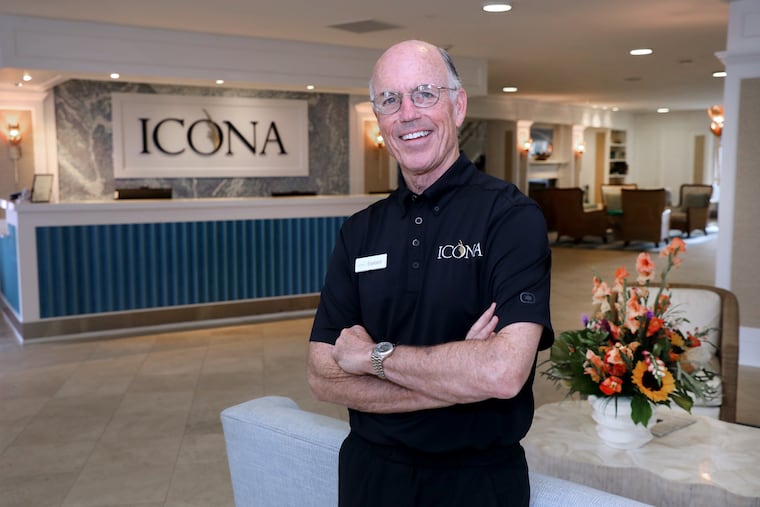
Icona Resorts founder Eustace Mita says he didn’t set out to change the Jersey Shore.
Sitting in a corner room at the Icona Avalon, the largest of Mita’s seven luxury hotels, the 72-year-old said it was the Shore, his lifelong “happy place,” that transformed him.
As Mita looked out onto the dunes, he recalled his baptism at St. Paul Catholic Church in Stone Harbor and his summer job as a teenage busboy and server at the Princeton Bar & Grill in Avalon.
Decades later, Mita leads both Icona Resorts and Achristavest homebuilders, which constructs multimillion-dollar waterfront homes — including a controversial 18,000-square-foot mansion that would be the largest in Avalon. Built on spec, it will likely sell for several tens of millions.
His for-profit companies are all about luxury. At the same time, they are imbued with Mita’s faith: The names, Icona and Achristavest, were inspired by spiritual experiences and words, and he displays 18-inch statues of the Blessed Mother in the hotel lobbies.
On a recent August day, he greeted employees by name and chatted with guests as he walked through Icona Avalon and neighboring Icona Windrift. Later, he visited under-construction homes, rattling off details about each project and staring in awe at the ocean views, as if seeing them for the first time.
“Do what you love and the money will come,” Mita said, referencing a lesson he learned from his grandfather, Eustace Wolfington, who owned Avalon’s first beachfront hotel, the Puritan, later renamed the Whitebrier. “That has been so true in my life.”
Mita declined to share how much his companies, which are privately held, are worth, or how much he’s invested in the Shore, saying only that it’s “hundreds and hundreds of millions of dollars” — and counting.
He’s ready to invest another $200 million in a seven-story resort on the Ocean City boardwalk, pending negotiations with city council.
For five years since he bought the now-shuttered Gillian’s Wonderland Pier, Mita says he has faced roadblocks and pushback, most recently from community groups who sued Ocean City and its council asking to void the site’s “in need of rehabilitation” designation. The designation allowed council to start talks with Mita about his plans to redevelop the former amusement park.
In a statement announcing the lawsuit, Jack Gutenkunst of Plaza Place Civic Association, one of the neighborhood-group plaintiffs, called the designation “deeply flawed” and said it “seeks to improperly strip away important planning protections that residents have long relied upon.”
» READ MORE: Ocean City community groups have filed a lawsuit challenging the Wonderland rehabilitation designation
Ocean City Council leaders, who were set to hold private negotiations this week about the redevelopment, did not return requests for comment.
Some residents near the old Wonderland Pier have said they are worried about traffic and loss of sunlight, as well as losing the area’s small-town, family-friendly charm.
“We have [millions] worth of real estate right here that would be degraded by this hotel, and our way of life would be degraded,” said Marie Crawford, who lives behind the pier.
Mita said the project, which has been downsized from the original proposal, would be an asset to Ocean City. The town calls itself “America’s Greatest Family Resort,” he added, but has not opened a new hotel in more than 50 years. He noted that several business owners on the boardwalk and elsewhere have spoken in favor of the project.
“We’re on the pathway now to being able to build Icona Ocean City, but we’ll see,” Mita said. “I don’t take anything for granted.”
He has his sights on two other potential hotel properties, one in Cape May County, though he wasn’t ready to share details.
Despite many offers, Mita has no interest in selling Icona Resorts. He has told his five grown children that they could do so someday — as long as they don’t sell the prime beachfront real estate where his hotels sit.
For now, his answer to the near-constant acquisition proposals is polite but firm: “Thank you, we’re not interested.”
But, he added with a laugh, “we’ll sell you a house.”
Mixing faith and luxury down the Shore
In a conference room off the Icona Avalon ballroom, dozens of hotel employees — many of them international workers on J-1 visas — sit facing a projection screen and white board where the company’s guiding principles are about to be reinforced.
Wearing a black Icona polo, black pants, and an unwavering smile, Mita slips into the morning meeting with little fanfare.
A manager kicks off a regular exercise: Stand, introduce yourself, and greet coworkers on either side of you by name. Seated in the back, Mita is among the last to participate, standing ramrod straight and speaking with a joyful lilt.
Whenever possible, managers remind the employees, they should call guests by their names, too.
“The sweetest sound to a person’s ears is the sound of their own name,” Mita said, referencing How to Win Friends and Influence People by Dale Carnegie, one of many books that influenced Mita’s leadership style. The most instrumental, he said, was Greatest Salesman in the World by Christian writer Og Mandino.
Mita also draws inspiration from Scripture and his involvement with the Camden Diocese and the Philadelphia Archdiocese. He founded an annual men’s spirituality conference, the nonprofit Man Up Philly. He has met Pope Leo twice and is building a nonprofit Catholic “soul-sanctuary” in Ireland, set to be finished in January.
He has built an orphanage in Kenya and a food center in Ethiopia and raised millions for international aid as the first lay president of the Papal Foundation.
When Mita first placed Blessed Mother statues in his hotels, he said, some suggested it could be “a little too religious.” But he stood by it, saying the Blessed Mother is the matriarch of all people, not just Catholics.
“If you don’t like Mom,” he said, “you don’t have to stay with us.”
More often, Mita said guests compliment the statues. He sees some passersby bless themselves and say a silent prayer.
“We don’t apologize for that,” he said of the iconography. “But we honor all faiths.”
How Icona Resorts were built
In his pursuit of hotels, Mita was particularly motivated by scroll three of Mandino’s work: “I will persist until I succeed.”
After graduating from Archbishop John Carroll High School in 1973 and studying for three years at Drexel University, Mita worked in the auto industry. In the 1980s, he founded Mita Leasing, then ran Half-a-Car, a lease-training company, with his uncle, Eustace Wolfington II.
Mita said he “backed into” the hotel industry around the time of the 2008 financial crisis, during which he lost about three-quarters of his net worth.
Back then, Mita’s Achristavest real estate company was knocking down small Shore hotels and building condo complexes, including the Grand at Diamond Beach, which sits between Wildwood Crest and Cape May.
Achristavest acquired the Grand’s neighbor, the Pier 6600 hotel, for $12 million in 2006, Mita said. Then, “Armageddon hit” with the recession.
“Our homebuilding business didn’t slow down; it literally stopped,” Mita said. When you’re building second homes, “everybody wants one, but they don’t need one.”
While demand for Shore homes remained low, Mita said he found that families were flocking to the hotel for short beach vacations at lower prices. So he went all in on resorts.
The Pier 6600 became Icona Diamond Beach in 2012. Mita has spent $30 million renovating it, he said, including the addition of a third-floor ballroom for its thriving wedding business.
Then, after 16 years of knocking on the door at the Golden Inn in Avalon, Mita acquired the iconic beachfront property for $25 million, which in 2015 was the largest hotel transaction in Cape May County history, he said.
Mita renamed it Icona Avalon. He said he has spent $35 million to remodel it.
A few years later, he purchased the Windrift hotel next door for more than $30 million and spent $27 million on renovations there, which include the new Avalon Prime steakhouse and a private third-floor “sky lounge.”
Icona Yacht & Beach Club members, who pay a $7,000 initiation fee plus $5,000 a year, can access the sky lounge, the Icona yacht, private beach service, and shuttle service.
They number about 25 now, Mita said, and he plans to cap membership at around 200 people.
It’s a similar setup as the Union League. The historic club, headquartered on South Broad Street, recently bought Avalon’s iconic Whitebrier for $23 million and last summer made it members-only. The move sparked debate over whether the Shore town was becoming too exclusive for even its wealthy homeowners.
The Jersey Shore experience, elevated
While middle-class families have increasingly been priced out of the Shore, Mita said he doesn’t believe his hotels are contributing to the trend.
“We don’t cater to the wealthy,” Mita said, adding that Icona has opened two “select-service” hotels — Mahalo Diamond Beach and Mahalo Cape May — which have fewer amenities and sometimes lower prices.
» READ MORE: Has Avalon become too exclusive for the people who live there?
Rooms there are about $200 a night on shoulder-season weekdays but can cost $500 to $700 on a summer weekend.
At Icona’s full-service resorts in Avalon and Diamond Beach, and its boutique hotel in Cape May, rooms start around $700 a night on peak summer weekends.
Outside South Jersey, Icona’s Grand Victorian boutique hotel in Spring Lake, Monmouth County, has slightly lower rates.
Icona is not the first brand to bring luxe hotel accommodations to Seven Mile Island, which contains Avalon and Stone Harbor.
The Reeds at Shelter Haven, a year-round resort in downtown Stone Harbor, opened a couple years before Icona Avalon. Rooms there start around $600 a night on midsummer weekends.
“It’s great to have healthy competition, right?” the Reeds’ general manager Carmen Russo said. “We always look at them and see what they’re doing, just as they look at us and see what we’re doing.”
As for Mita’s home-building business, Achristavest builds on the beach and bay from Cape May to Longport, with properties starting at $5 million. By comparison, the median listing price for all homes — not only waterfront ones — in Stone Harbor is just under $4.7 million.
Achristavest homes being built on spec in Avalon and Stone Harbor will likely sell for $15 million to $25 million.
“I tell my children rent in Delaware County and buy in Cape May County,” said Mita, who grew up in Bala Cynwyd and now has homes in Malvern and Ocean City.
What’s ahead for Icona and Achristavest
Mita speaks often of his legacy.
“I’ll be dead and gone, but imagine the next generation and then the next generation,” Mita said. “Everything we’ve built is built to last.”
And he said he hopes the lessons he instilled in employees are just as permanent.
One employee, Rob LaScala, worked at Mita Leasing and then went on to found LaScala Restaurant Group, which has dozens of locations across the region. In just a couple years working together, LaScala said, Mita left a mark.
Mita is “just a make-you-feel-good type of person,” LaScala said. “I over the years have tried to emulate him” and create a company culture that transcends business.
Mita refers to his 1,100 employees as family but said he works to prioritize time with his actual family. He spends summer weekends with his wife, Susie, and some combination of their five children and 18 grandchildren. His oldest son, Euse, was recently named Icona’s president and CEO.
But, of course, he said, work sometimes calls. On a recent weekend, with many summer staffers back at college, Mita helped clear tables at Icona Avalon while Euse was a fill-in valet.
Said Mita: “There’s no reason just because I’m a leader that I can’t bus tables, that I can’t sweep floors.”