
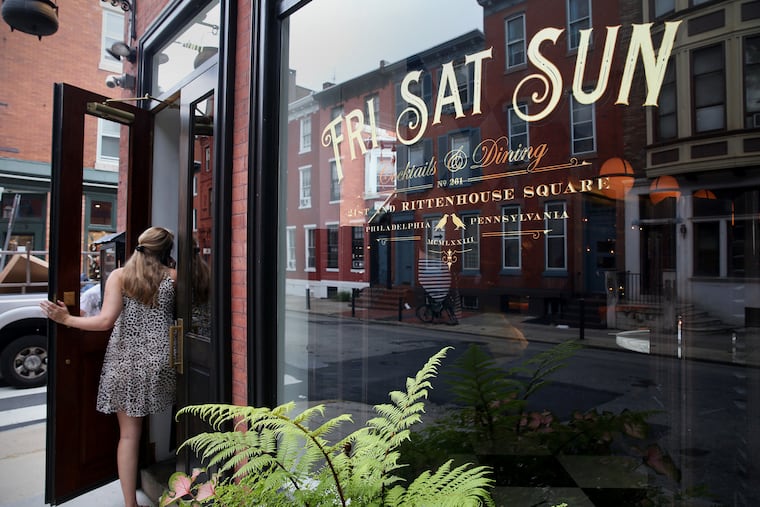
One of Philly’s most prominent fine-dining restaurants received a state grant to create an even higher-end establishment. The project promises to create 100 jobs and help cement Philly’s place as a culinary hotspot. It drew criticism over the use of tax dollars.
The Weekend Restaurant Group, which owns the acclaimed Rittenhouse Square restaurant Friday Saturday Sunday, was awarded $1.5 million from the state’s Redevelopment Assistance Capital Program in July to help finance the expansion of the Michelin-starred restaurant. The grant will cover only a fraction of the project’s multimillion-dollar budget.
The endeavor will be the “first minority-owned restaurant of its kind” in the United States, wrote Friday Saturday Sunday chef-owner Chad Williams, who is Black, in the restaurant group’s application.
The undertaking involves connecting Friday Saturday Sunday with a neighboring rowhouse that will eventually be transformed into a three-story dining destination with an 18-seat chef’s counter, private dining rooms, and a post-dinner sweets lounge.
Williams runs Friday Saturday Sunday with his wife, Hanna. Together, they announced plans to grow their award-winning restaurant at at 261 S. 21st St. last summer, after entering an agreement to buy the adjoining property at 2048 Rittenhouse Square. Neighbors enthusiastically endorsed their ambitious plan, which came five months before the restaurant earned a Michelin star.
In the state grant application, Williams wrote “the project will generate significant cultural impact [by] retaining and creating high-quality jobs, attracting visitors from the region and beyond, and raising Philadelphia’s profile.” Renovating the storied Philadelphia restaurant “demonstrates a long-term to commitment to the city, with the scale and ambition to be a generational anchor in its neighborhood.”
Yet when news of the grant spread on social media last month, it was met with critics who were angry that taxpayer dollars were funding a fine-dining restaurant.
“Luxe restaurant getting a grant to become more luxe? … WTF?” one person wrote under an Instagram post about the grant with over 100 comments, many of which were critical.
“Give it to the schools” instead, wrote another.
Williams says the grant money — which is from a fund for construction projects that would benefit the state culturally and economically — is a win for the city, not just Friday Saturday Sunday.
“I was born here. I left, learned all that I could, and came back. What we want to do is push the culture forward and, with that, hopefully [bring] economic benefits for everyone in the city,” Williams said.
“There’s going to be tax revenue and jobs that come back in a very real way.”
A much-debated grant program
Better known as RACP, the Redevelopment Assistance Capital Program defrays the cost of construction-ready projects across Pennsylvania that stand to generate substantial economic growth. The fund has stirred controversy in the past.
The program was launched in 1986 to support construction and real estate projects that intend to create jobs, boost tax revenue, or have significant cultural and civic impact. Eligible projects must cost at least $1 million and secure at least half of their funding from other sources.
Because grants are decided at the governor’s discretion, the program has previously been criticized for a lack of transparency and glad-handing.
RACP was overhauled in 2012 after an audit found that the Gov. Tom Corbett administration did not adequately disclose or document why projects were awarded grants. Similar accusations cropped up again in 2020, when critics alleged Gov. Tom Wolf and state legislators were misusing the program for political favors.
This July, Gov. Josh Shapiro’s administration allocated $445 million in RACP grants to 356 projects across the state. Recipients range from private real estate developments and public parks to affordable housing and renovations of schools, hospitals, and community centers. The program was particularly competitive in Philadelphia: 170 projects applied. More than half were rejected.
Friday Saturday Sunday’s expansion is projected to cost $7.5 million overall, according to the grant application. Once complete, Williams told The Inquirer, it will add 100 front- and back-of-house jobs to the Weekend Restaurant Group’s payroll. (The group currently has 40 employees, according to the application.)
Not all RACP hopefuls are awarded the full amount of funding they applied for. Friday Saturday Sunday’s expansion was one of 12 Philly projects awarded the full amount requested.
Other fully funded recipients include Rhoads Industries, a defense contractor awarded $4 million to build a new shipbuilding facility in the Navy Yard, and Comcast Spectacor, which received $1.4 million to build a traffic operations center at the sports complex, as well as Philadelphia Youth Basketball, the Community College of Philadelphia, and the Steamfitters Union. (The Philadelphia Eagles also received $4 million grant to renovate their training complex; the team applied for $7.725 million.)
A spokesperson for the Shapiro administration told The Inquirer over email that the Weekend Restaurant Group’s proposal “is fully consistent with the purpose and authorized uses of the RACP program and represents an appropriate use of RACP funds.”
Building on a legacy
Chad and Hanna Williams bought Friday Saturday Sunday — already a Philadelphia’s dining institution — in 2015, transforming the space into a cozy, first-floor bar and an elegant upstairs dining room. They reopened the restaurant in 2017, serving a tasting menu rich with Caribbean, Asian, and soul-food influences. Local and national praise has been steady ever since. Friday Saturday Sunday routinely earns a spot in Craig LaBan’s annual Top 10 and The Inquirer’s annual 76. It won the James Beard Award for Outstanding Restaurant in 2023 and was named on the World’s 50 Best in North America two years in a row. The first-floor Lovers Bar has also been twice-nominated by the James Beard Awards’ Outstanding Bar.
Receiving the RACP grant was a relief, said Williams, who said he is funding more than half of the $7.5 million project with loans.
Taking on the financial liability is “not a rosy story necessarily,” Williams said, “but it’s a risk we’re willing to take.”
Williams envisions the 3,500-square-foot rowhouse at 2048 Rittenhouse Square as a chance to create an old-school fine-dining experience inspired by the likes of Le Bec-Fin and Vetri Cucina. Guests will start with welcome drinks on the ground floor before moving upstairs for an intimate meal at a chef’s counter helmed by Williams. Diners will finish the meal on the third floor in a designated dessert space, Williams said.
The concept will extend the Friday Saturday Sunday brand and render the original tasting menu into a “less formal” affair that is more in line with “what neighbors and regulars want,” Williams said. The connected properties will also enable Friday Saturday Sunday to serve large parties and potentially open seven days a week. The expanded hours will allow for more staff, Williams said
Williams said the project could break ground in October. He’s optimistic about a September 2027 opening.
He framed Friday Saturday Sunday’s expansion as a moonshot. “To be frank, for a Black chef to have this opportunity and do it is a big deal,” Williams said.
“Having a chance to practice our craft at this level is extremely rare.”
‘We need all the help we can get’
Williams decided to apply for RACP funds after exhausting more traditional financing routes.
“Without state support, the project would face a significant financing gap,” he wrote in the application, “as private funds alone cannot absorb both the acquisition and essential structural work.”
Despite his restaurant’s extremely successful track record, the chef found the process similar to the original financing of Friday Saturday Sunday — which required the Williamses to sell their home and submit paperwork to “14 different banks” before finding one that would take a chance on them.
It’s a struggle many Black entrepreneurs know well: Several studies have found that Black-owned businesses are discouraged to apply, denied, and offered inferior loans at higher rates than white counterparts, even when appearing more creditworthy.
“We’ve put in our work here, had some success and won some things, but it did not make [financing] any easier,” said Williams. He was attracted to RACP because it was described to him as a “colorblind grant” by other BIPOC entrepreneurs who encouraged him to apply.
Friday Saturday Sunday is not the first Philly restaurant to receive state funding through RACP. North Philly’s Caribbean Feast was awarded $750,000 in 2022 for construction costs associated with renovating their kitchen facilities to support other Caribbean-owned food businesses through a commissary model. The program also awarded $500,000 to FringeArts in 2014 for creating a Delaware River waterfront restaurant and $1.5 million to Yards Brewing Co. in 2019 for its Spring Garden brewery and taproom buildout.
Williams is hopeful that other restaurants will consider applying for RACP after seeing his success.
“If I wouldn’t have done the research, I would’ve never known this was possible,” he said. “We need all the help we can get.”