
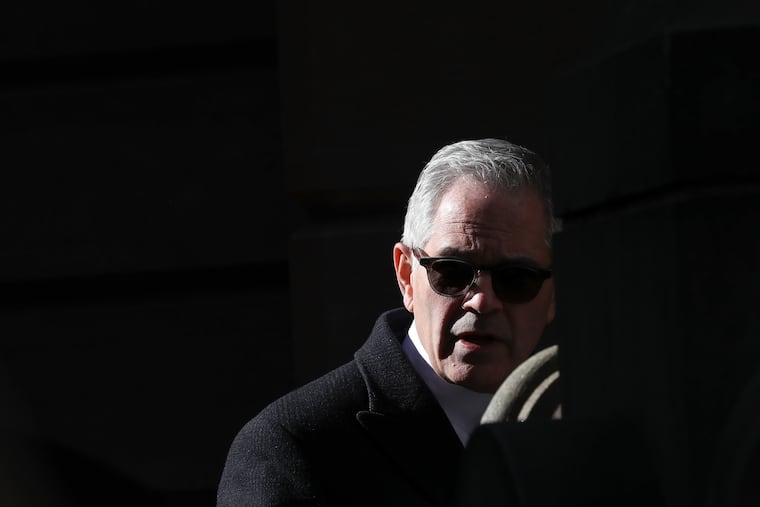
District Attorney Larry Krasner came into office promising to end mass incarceration, decriminalize minor offenses, eliminate cash bail, and free anyone who was wrongly convicted.
On its face, those reforms seemed laudable given Philadelphia’s — and the nation’s — decades-long, tough-on-crime politics, policies, and policing that resulted in high incarceration rates and a justice system rooted in racial and economic disparities.
But in Krasner’s zeal to right past wrongs, he has caused grave damage to himself and his office. A series of legal setbacks has cast doubt on Krasner’s ability to administer fair and impartial justice, let alone manage his office.
As a result, crime victims and the accused are left to wonder if the city’s top law enforcement official can properly do his job.
Krasner’s latest and most perilous legal trouble stems from a recent court case involving a man’s attempts to overturn his 2009 murder conviction.
Following an evidentiary hearing that stretched for three days over the summer, U.S. District Judge Paul S. Diamond referred the matter to federal prosecutors to investigate Krasner and Matthew Stiegler — the former head of the district attorney’s office’s Conviction Integrity Unit — for potential crimes, including conspiracy, obstruction of justice, and perjury.
Krasner and Stiegler have not been charged. It is unclear if the U.S. Attorney’s Office in Philadelphia will launch an investigation, though it appears very likely considering that amid the hearing that spurred the criminal referral, Diamond said that “potential wrongdoing abounds.”
Even before Krasner’s latest legal morass, a disturbing pattern of lies and chicanery emerged involving the office’s handling of other post-conviction cases, mainly for murder.
One supervisor was disbarred last year and another suspended in June for repeatedly lying in federal court while seeking to overturn the death sentence of a man convicted of killing a couple in their East Mount Airy home. The federal judge in that case found the DA’s office provided a “false account” of the events, and ordered Krasner to write a letter of apology to the victims’ family.
In the very first exoneration of Krasner’s first term, a Common Pleas Court judge ruled his team unfairly accused two former prosecutors of misconduct and had “misplaced and/or destroyed” records and relevant evidence. The judge fined the district attorney’s office $120,000.
In June, the state Supreme Court found the office had violated its duty of candor to the court and ordered the state attorney general’s office to review future attempts by the DA’s office to reduce a sentence or overturn a past conviction.
The latest case before Judge Diamond featured stunning sworn testimony by four supervisors hired during Krasner’s tenure who remain on the job.
Their accounts from the witness stand painted a disturbing picture of Krasner and Stiegler scrambling to contain any legal fallout involving the lazy and disingenuous handling of their decision to initially go along with defense attorneys seeking to overturn the 2009 second-degree murder conviction of Dennis Johnson.
» READ MORE: Krasner’s candor problem started with his first exoneration win | Paul Davies
For years, Johnson’s post-conviction appeal efforts were repeatedly rejected. In 2022, then-Assistant District Attorney Jaclyn Mason filed a brief that agreed with Johnson’s lawyers that his trial counsel had been ineffective, and his conviction should be overturned.
In May, Diamond ordered an evidentiary hearing to examine what new evidence emerged to prompt the DA’s change in position.
That spurred a group of supervisors in the district attorney’s office to scrutinize Mason’s initial brief in which they found numerous “material misstatements.” The four supervisors — Katherine Ernst, Steven Wildberger, David Napiorski, and Peter Andrews — determined the office needed to withdraw the motion and apologize to the court.
They asked Mason to sign the filing with them, but she said Stiegler should take responsibility since he drove the effort to concede after several meetings with Johnson’s defense attorneys at the Pennsylvania Innocence Project.
Fearing she would get all the blame, Mason quit in June and testified the following month that Stiegler had “colluded” with Johnson’s defense team and told her, “If it is good enough for the Innocence Project, it was good enough for him.”
After Mason quit, the supervisors said Stiegler lobbied his fellow supervisors to go through Mason’s other cases, find errors, and tell Diamond she was a rogue actor. Krasner endorsed the plan, calling it a “good idea,” according to the supervisors.
» READ MORE: The day Larry Krasner’s office was put on trial — by his own prosecutors | Paul Davies
The supervisors rejected that scheme and instead argued for the case to be turned over to the state attorney general. Krasner repeatedly opposed that plan, citing the need to “protect the office.” The four supervisors concluded the efforts by Stiegler and Krasner created a conflict of interest for them and the office.
The supervisors testified that Krasner threatened “consequences” if they told Diamond about the internal discussions. But rather than go along with the ruse, the four supervisors withdrew from the case.
Diamond found Krasner’s threat “could amount to obstruction of justice,” and the scheme with Stiegler to present a false narrative “might amount to criminal conspiracy.”
Diamond credited Ernst, Wildberger, Napiorski, and Andrews for coming forward “at the risk of their jobs.” He wrote their testimony was “compelling and corroborated by contemporaneous documents.”
The judge rejected Stiegler’s version of events, writing that he found his testimony “contradictory, evasive, or outright dishonest.” He said Stiegler was “responsible” for the errors in the concession brief and that Mason followed his orders. Diamond added that Stiegler’s testimony “may well amount to perjury.”
Confirming Mason’s fears, Diamond found Krasner directed the four supervisors to implement Stiegler’s plan to blame her for errors in the brief.
Sources told The Inquirer that Stiegler abruptly resigned from his position as head of the exonerations unit Thursday, but he will remain in the district attorney’s office.
Krasner issued a statement that said he “respectfully and vigorously” disagreed with Diamond’s findings and planned to appeal. He said he couldn’t comment further because the case is pending.
But even that is not entirely truthful. Diamond said Krasner could have defended himself at the hearing. The judge wrote that Krasner “chose not to testify” or even to submit an affidavit after the hearing.
» READ MORE: Larry Krasner’s exoneration push faces a reckoning | Paul Davies
“[Krasner] apparently does not dispute — or does not address — much of the testimony presented,” Diamond wrote.
Krasner’s handling of the Johnson matter is beyond troubling. Perhaps just as telling, before the judge’s ruling was released, Krasner’s take on events, detailed in a filing made by his office, underscored that he remains unbowed. Indeed, as the legal setbacks have mounted, Krasner has demonstrated a glaring blind spot regarding his failings as a leader.
As a result, Krasner faces a legal peril of his own making.
Krasner came into office with a long list of real and perceived detractors. But he has frittered away his credibility, and his actions have undermined the hard work and dedication of many of his rank-and-file attorneys.
This Editorial Board has endorsed Krasner in previous elections, but now believes he has created an untenable situation that could impact the treatment of crime victims and wrongdoers.
One significant challenge: Will judges and juries trust prosecutors from the DA’s office?
There is no denying that innocent people who were wrongly convicted sit in prisons. Krasner was right to review past convictions. But the questionable handling of these cases that was described in court has sabotaged his own authority to right those wrongs.
» READ MORE: Krasner hasn’t said a word about a growing exoneration controversy — but his own court filing does | Paul Davies
The DA’s office is now rife with turmoil, fear, and distrust. Krasner sent a chill through the office after he allegedly threatened jobs and called prosecutors in the state attorney general’s office “Nazis.” One assistant supervisor recently stepped down from his leadership post after losing faith in the office.
Krasner, who spent decades as a defense attorney, entered public office with a list of grievances and a deep mistrust of law enforcement, which he called “systematically racist.”
Before first getting elected district attorney in 2017, Krasner sued the Philadelphia Police Department 75 times. Days after taking office, he ousted more than two dozen staffers, including many experienced prosecutors.
Krasner has expressed disdain for the state attorney general’s office. He often views judges who oppose him as hostile, according to people familiar with his thinking.
His jaded and often huffish views inform how he administers justice, whom he indicts or doesn’t indict. Not to mention his fraught relationship with police. Lives hang in the balance, including the accused, victims, and the wrongly convicted.
Krasner now faces a major challenge: Can he regain the trust of the public and the prosecutors in his office? He should start by installing experienced and respected leaders.
Then Krasner needs to look in the mirror and determine if he can continue to run the district attorney’s office under the giant cloud he has created.