
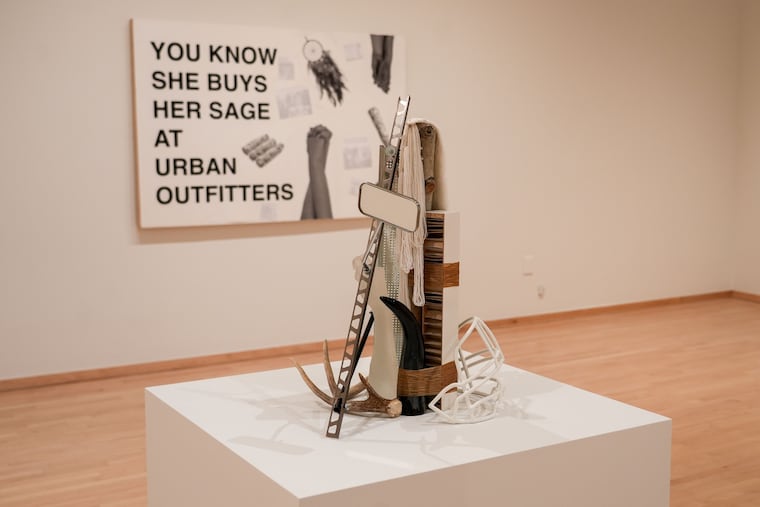
Calling Anna Tsouhlarakis’ sculpture She Dares You to Steal Her Hair mixed media doesn’t begin to describe the multitude of parts in Tsouhlarakis’ whole.
Part of the new exhibition “Indigenous Irregularities: Anna Tsouhlarakis” at Temple Contemporary, here is the full list of materials for the piece:
A glass cast of Tsouhlarakis’ hand and forearm, found metal, horsehair, hardware, shed antler, bicycle mirror, beads, artificial sinew, ermine, Ikea remnant, curtain rod, steer horn, rope, thread, football face mask, adhesives, paint, marker nail, toy velociraptor.
The ingredients come together like accidental theater, from the flimsiest of human creations — an exposed remnant of Ikea particleboard, a material she has been working with for the better part of a decade — to the sturdiness of the steer horn.
In Coyotes Run From Her, there’s a similar clash of natural and manufactured ingredients: a security camera, press-on nails that form a cascading echo of nearby horsetails, a softly furred deer leg stands next to a tower of tin tobacco lids.
Other materials used in Coyotes Run From Her: glass cast, found metal, deer hair, porcupine hair, yarn, leather, Aspen wood, saw blades, hardware, deer leg, spur artificial claws, beads, toy grenade, paint adhesives, tobacco lids, Ikea remnant, security camera, faux silver object, press-on nails, driftwood.
Her art contains multitudes.
The materials come together to, as the exhibition says, “embrace irregularity as both a formal strategy and a conceptual framework.”
“I’m a complex individual that comes from diverse heritages,” Tsouhlarakis, 49, a citizen of the Navajo Nation and Creek Tribe who also is of Greek descent, said in a recent interview. “I’ve lived all across the United States. When I’m bringing in those pieces, all of those disparate objects, that’s a representation of my narrative, and my experiences.”
Her work is art that can be contemplated and processed for long stretches, ingredient by ingredient, or as a cascading whole. It can be picked apart, whimsically, then put back together, more profoundly as a whole.
She said she starts with the titles first, but does not view the works as literal expressions of those. As an Indigenous woman, she said people often expect her to be a storyteller, but she purposely sees and conceives of her work in less linear terms.
“It is complicated,” she said. “It seems disconnected. It forces people to reckon with it. I hate the idea of linear narrative. I fight back. What else can I do to throw in here to mess up?”
Around the walls are five black-and-white collages with cheeky sentences that play off Native identity asserting itself in a modern white world: You know she buys her sage at urban outfitters,” “Her look might say rez but her accent says city,” and “Her eyes cut quicker than a switchblade.“ The text collages also contain faded out images of Native internet memes and other cutout images.
Tsouhlarakis says she’s been thinking about Navajo cultural taboos, “how one moves through the world, especially within this moment, within our country.”
“How I have to hold myself when I walk through an airport, how I notice I’m not necessarily at ease,” she said. “The way my presence in a place is questioned or uncomfortable for people. It makes me more aggressive immediately.
“How would this imaginative female figure that I have in my mind confront these things with all the power in the world,” she asks herself. “By having cultural taboos and flipping them.”
This dynamic shows itself in the sculpture’s title, She Dares You to Steal Her Hair. “In Navajo culture, if somebody takes a lock of hair, it takes away your power,” she said.
Tsouhlarakis was the Edgar Heap of Birds Family Artist in Residence at the Tyler School of Art and Architecture last year, where she worked with glass for the first time. The residency was established through a gift from Edgar Heap of Birds (MFA ’79), a leading Native American artist.
Tsouhlarakis said she typically models casts of body parts on other Native women. But while in Philadelphia, she used her own body for the first time. One sculpture uses a cast of her arm and forearm, the other, her bent elbow.
Matthew Jordan-Miller Kenyatta, the curator of the exhibition, as well as another exhibition now at the gallery, “Dream Different: A Wonder Rebellion,” says Tsouhlarakis’ work recalls the line from Stephen King: Humor is almost always “anger with its makeup on.”
In Tsouhlarakis’ work, “absurdity coexists alongside this stance of awe,” he said. “You are defamiliarizing yourself of things that seem mundane and everyday.”
“It’s an accumulation of history, of uses,” he said. “Beautiful accumulations of different moments she’s experienced.”
Of the wall pieces, Kenyatta called them “collections of absurd moments were she’s had to contort herself or people she knows contorting themselves.
“I’m sitting with the absurdity,” he said.
“Indigenous Irregularities: Anna Tsouhlarakis” is on display through Dec. 5 at Temple Contemporary, 2001 N. 13th St, Philadelphia. now.temple.edu
An Artist Talk will take place Sept. 17, 2026, at 4:30 p.m.