
Leonard Bernstein’s big, audacious, belief-shaking Mass has never slotted easily into the choral/symphonic repertoire, requiring Broadway and rock music resources as well as orchestral ones, with a confrontational message that echoes beyond its 1971 premiere.
Bernstein himself once wondered if the populist, many-faceted Mass should be performed in a gymnasium.
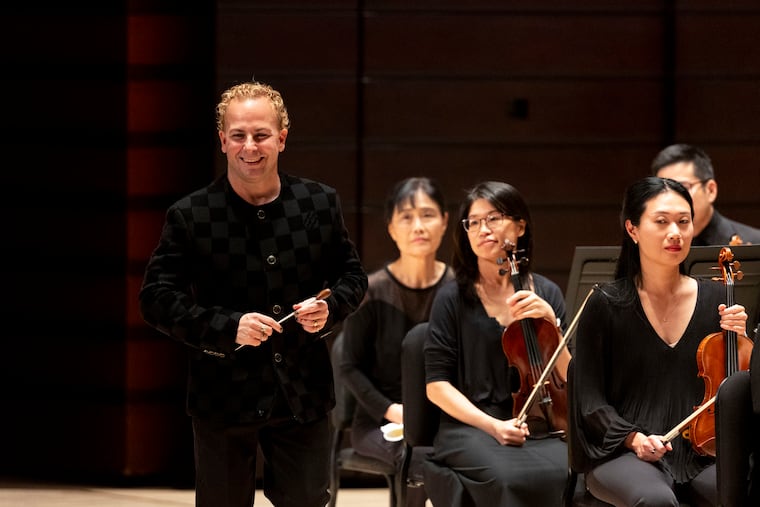
But the newly created suite heard Friday, played (and commissioned by) the Philadelphia Orchestra at the Kimmel Center, is a much more viable version. And it’s not a secondhand encapsulation but an entity unto itself.
And not a day too soon.
No single work has been more closely identified with the now-closed Kennedy Center: Its 1971 opening was the Bernstein Mass premiere. In preperformance comments, music and artistic director Yannick Nézet-Séguin made that connection, calling Mass a statement about “why arts and culture are worth fighting for.”
I agree in spirit. But among listeners, you either got the Bernstein Mass gene or not. I did not (and was most excited to hear Alexandre Kantorow play the Brahms Piano Concerto No. 1 that began the program).
Though Mass’ individual songs are indeed lovable, the scrupulously unconventional whole (where the original Mass text is a distant point of reference) is puzzling to me. Why the counterfeit rock music? (Bernstein followed The Rolling Stones and knew better.) Why such glib philosophical conclusions? (Such as “I believe in God but does God believe in me?”)
Nézet-Séguin has not been one to tone down any such element, fearlessly embracing the abrasive modernism lurking around the sides. Garth Edwin Sunderland, vice president for artistic projects at the Leonard Bernstein Office, refashions the piece into Four Symphonic Rituals from MASS, richly scored for orchestra (no singers) that’s a close cousin to Symphonic Dances from West Side Story, but with a harder-edge sound palette.
“My solution was to focus each movement on one of the musical concepts, punctuated by interjections from the others,” wrote Sunderland in the program notes.
With a bit of editing, these Rituals may well have longevity. The opening moments establish the lyrical but nervous character of the piece, bringing out the jazz that wasn’t so obvious in the original — and is very welcome since Bernstein spoke jazz as a first language.
One could write a dissertation on Sunderland’s choices, but the total effect is that of a concerto for orchestra that touches as many bases as possible. Too many, in fact. The last 10 minutes are so splintered that the through line is intermittently lost.
But one unexpected conclusion is that the sung words aren’t missed (except “I Go On” and “Simple Song”). In fact, much of the music seems liberated without words. Electric guitars are still there but blended in as part of the larger sound texture.
What would Bernstein think? It’s worth asking.
(Later tonight, I’ll be near his grave site in Brooklyn where Green-Wood Cemetery is hosting an event for the Missy Mazzoli opera Lincoln in the Bardo.)
Brahms piano concerto soloist Kantorow has been called a fire-breathing virtuoso, and he has that quality, but the Gilmore Artist Award he received goes to pianists who have much more than that.
Whether playing solo, chamber music or with orchestra, the 29-year-old French pianist (making his Philadelphia Orchestra debut in these concerts) is thoughtful, highly personal, but never eccentric. He brings an extra depth to Brahms’ early-period concerto from having spent much time with the composer’s three early piano sonatas, finding in them surprising maturity but also youthful rage that carried over into the more stentorian parts of the concerto.
Throughout the first movement, one felt part of a searingly direct conversation with Brahms. The second movement lost me for a bit; Kantorow was too inward to be outwardly communicative. The final movement had reckless chemistry.
When a Philadelphia Orchestra performance lacks complete coordination, you know musicians are deep in the moment and not falling back on remembered emotion.
The program will be repeated at 8 p.m. Saturday and 2 p.m. Sunday at the Kimmel Center. Tickets: $29-$232, philorch.ensembleartsphilly.org or 215-893-1999.