
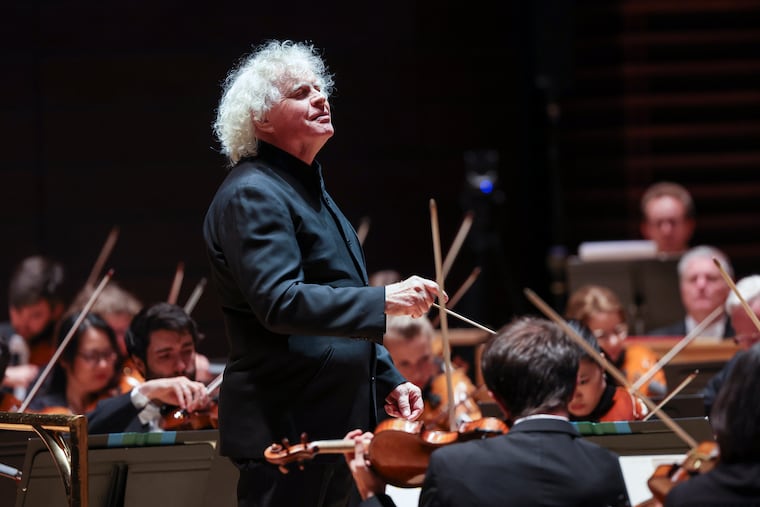
Classical music has long sought a friendlier mien, and this fall the genre seems to have redoubled its efforts. New books and author chats are in abundance, aiming to demystify the art form and make personal connections. Films with live orchestra have become not a special event, but a regular feature. Concert formats continue to get rejiggered in an effort to make the tent bigger.
There’s a danger, of course, that in its quest for relevance, classical will no longer be the main event. Some of the Philadelphia Orchestra’s appearances with pop artists, for instance, are hard to justify artistically. The balance bears watching.
But in a season that offers rare Bach and Mozart, the continuation of a chamber music series second to none, and a generous pipeline of new works, it’s hard to feel anything but fortunate as the curtain raises on a new season in one of the nation’s classical music hot spots.
Orchestra After 5
Oct. 8, Marian Anderson Hall
The Philadelphia Orchestra sometimes launches an initiative only to let it quietly fade, but the Orchestra After 5 series has had remarkable staying power. Now in its fourth season, it’s designed to be a friendly on-ramp for newbies, though one suspects that it’s also luring experienced listeners with its earlier start time, conviviality, and brevity.
The first of three such concerts this season features the orchestra and popular guest conductor Dalia Stasevska in Respighi’s Pines of Rome and, with Gil Shaham, Saint-Saëns’ Violin Concerto No. 3. It starts with a 5 p.m. happy hour in the Kimmel plaza, and the hourlong concert is followed by an artist chat. philorch.ensembleartsphilly.org, 215-893-1999.
Philadelphia Orchestra Children’s Halloween Spectacular
Oct. 10, Marian Anderson Hall
With excerpts from Elmer Bernstein’s Ghostbusters Suite, Bach’s Toccata and Fugue in D Minor, and Grieg’s “In the Hall of the Mountain King” from Peer Gynt, the Saturday morning family concert promises to be a fright. But within bounds. This first of five full-orchestra offerings in the coming season aimed at young listeners is sensory-friendly, with house lights kept at mid-level, a cool-down space for stimulated guests, and other accommodations. The aim for all is an introduction with impact to the world of the symphony orchestra, which this ensemble never fails to deliver. Austin Chanu conducts. philorch.ensembleartsphilly.org, 215-893-1999.
Anthony Roth Costanzo’s ‘Countertenor’
Oct. 27, Free Library of Philadelphia Parkway Central Library
“When you are nervous about going onstage, they say you’re supposed to picture the audience naked. But what happens when you’re nervous about actually being naked onstage in front of three thousand fully — and mostly very nicely — dressed people?”
Costanzo, who has maintained a busy performing schedule as a countertenor while running Opera Philadelphia, recounts the unusual experience of performing naked at the Metropolitan Opera in his forthcoming book. What is a countertenor? Costanzo explains his unusual voice type in this mix of autobiography and opera history, which he’ll discuss at the Free Library’s author series.
There is, of course, a companion recording, which comes out a few days before his talk. Tracks include not just works of Osvaldo Golijov, Philip Glass, and Mozart, but also, intriguingly, the Frankie Valli and the Four Seasons tune “Walk Like a Man.” freelibraryfoundation.org/events.
Lara Downes with Rhiannon Giddens
Oct. 30, Rowan University Pfleeger Concert Hall
In a “musical conversation” called Sounds Like America, pianist Downes and singer-cultural historian Giddens explore the “roots and routes” of American music, with stops at “Amazing Grace” and Paul Simon’s “American Tune” along the way. go.rowan.edu/america.
Anthony Tommasini, author of ‘Voice of a Century: The Life and Artistry of Marian Anderson,’ in conversation with Anthony McGill
Nov. 12, Free Library of Philadelphia Parkway Central Library
The former chief classical music critic of the New York Times chats with Anthony McGill, principal clarinetist of the New York Philharmonic, about Tommasini’s new biography of the Philadelphia contralto and civil rights leader. freelibraryfoundation.org/events.
Philly Pops ‘La La Land’ in Concert
Nov. 28, The Met Philadelphia
Can it really be a decade since La La Land was released? I never quite got the film, at least not in the way many others did. But this presentation puts a live orchestra and jazz band behind it, which promises to up the daffy appeal and vibe in the room a few notches. Conducted by Esin Aydingoz. phillypops.org.
Philadelphia Bach Collective in ‘Nun komm, der heiden Heiland, BWV 62′
Dec. 1, St. Mark’s Church
So seemingly endless is Bach’s genius that even the experienced listener will keep finding gems previously unknown. This is the promise of the Philadelphia Bach Collective, a series of short, pay-as-you-wish afternoon concerts featuring Bach cantatas and other works. To mark the start of Advent, the skilled instrumental and vocal forces take up Nun komm, der heiden Heiland, BWV 62. It’s a concise cantata whose opening chorus based on a Lutheran hymn announcing the coming of the Savior is a beautiful paradox: in a minor key, yet so joyous it can barely contain itself.
“The idea is that Advent is a time of joyful but active anticipation. It’s essentially a call to arms,” says Heather Miller Lardin, one of the collective’s co-artistic directors.
Organist John Walthausen will also perform two other settings of Nun komm, der heiden Heiland (BWV 659 and 661) on the main organ at St. Mark’s. philadelphiabachcollective.org.
Yo-Yo Ma and Emanuel Ax
Dec. 6, Marian Anderson Hall
Beethoven? Brahms? Rachmaninoff? The program remained unannounced at press time, but it’s a pretty sure bet that the only thing most ticket buyers really need to know are the names of the cellist and pianist who have both entered the increasingly rarified realm of the legendary. ensembleartsphilly.org, 215-893-1999.
Bach’s ‘Christmas Oratorio’ with the Philadelphia Orchestra
Dec. 12 and 13, Marian Anderson Hall
Bach’s packaging of six cantatas into one vast canvas encompassing the Christmas story offers an astonishing variety of orchestral combinations and colors, not to mention emotional realms. The Philadelphia Orchestra, which has never before performed the work in its entirety, is led here by its music and artistic director, Yannick Nézet-Séguin.
The program, by the way, is in addition to (and not instead of) the orchestra’s traditional Messiah, which will be performed Dec. 4 and 5 with conductor Bernard Labadie. philorch.ensembleartsphilly.org, 215-893-1999.
Brentano Quartet
Dec. 13, Perelman Theater
The fugue in classical music is like the golden mean in nature or classical columns in architecture. Once you know it’s there, you start seeing it everywhere. Put simply, it is where a melodic theme is introduced and then repeated in another key while the first one continues. It’s more complicated than this, but basically it’s an almost mathematical tool for creating a dense overlap of competing (though complementary) voices.
Is there a greater meaning to the fugue — say, a philosophical one? The Brentano Quartet, in residence at Yale University, explores that question in works of Beethoven, Shostakovich, and, of course, the fugue’s unsurpassed innovator, Bach. pcmsconcerts.org, 215-569-8080.
Chamber Orchestra of Philadelphia, Bach Brandenburg Concerti
Dec. 19 and 20, Bryn Mawr College’s Goodhart Hall and Philadelphia Film Society Center
Philadelphia’s long-running chamber orchestra has adopted a format of concerts running more or less an hourlong in venues around town. That includes this holiday-time one with Bach’s Brandenburg Concerto Nos. 1, 3, and 4. They are joined by Christopher Theofanidis’s Muse, which was inspired by the third Brandenburg concerto. David Hayes conducts. chamberorchestra.org, 215-545-1739.
Simon Rattle and the Philadelphia Orchestra
Jan. 28, 29, and 30, Marian Anderson Hall; Feb. 2 at Carnegie Hall
Even if he didn’t end up being music director, Rattle still visits the Philadelphia Orchestra’s podium from time to time. His current absence from the orchestra has been a painfully long one — a decade — and he returns with a program of works that seems bound by nothing other than their potential for virtuosity from the ensemble and interpretive depth from the podium: John Adams’ Harmonielehre, Debussy’s La Mer, and the second suite from Ravel’s Daphnis et Chloé. That works just fine for us. philorch.ensembleartsphilly.org, 215-893-1999.
The Gershwins’ ‘Let ‘Em Eat Cake’
Jan. 29, 30, and 31, the Academy of Music
Who knew this is where we’d end up as a country? George and Ira Gershwin did, in an opera with a book by George S. Kaufman and Morrie Ryskind. The piece depicts an election denier who renovates the White House and establishes a dictatorship. “You couldn’t write a better farce about what’s going on in the world than this,” said Costanzo, who is bringing the work from 1933 to Opera Philadelphia for the first time. Conducted by Corrado Rovaris and directed by Zack Winokur. operaphila.org, 215-732-8400.