
Joan Dillon opened a childcare center in June of last year for 46 infants and toddlers in Gloucester County, where options for working class and middle-class families are scarce. But within a month, the center was in trouble.
New Jersey froze additional funding for its Child Care Assistance Program in July 2025, stranding most families who expected to receive financial help pay most of the cost. Former Democratic Gov. Phil Murphy reversed the decision eight months later, but it was too late for many of these parents, Dillon said.
“One third of the mothers of those families left the workforce. Some families moved out of the area to live with relatives who could help them. Others pieced together inadequate care,” Dillon told 20 members of the Assembly for what was an often emotional hearing at the Statehouse in Trenton on what many called the “child care crisis” in New Jersey.
Dillon was among the dozens of speakers Thursday who explained how “the math does not work” when it comes to the cost of childcare. The monthly rates range from $1,600 to $2,200 a month for infant care and $1,400 to $1,900 monthly for toddler care, according to state market data.
Childcare centers also struggle because even for those families who qualify for help through the state’s assistance program, the subsidy only covers one-third to one-half of the cost of rent, utilities and trained educators, providers said.
“We invest in public dollars in pre-K through 12th grade because education benefits our entire society. But somehow, when children are at their most critical stage of brain development, we treat their early education as a private family obligation,” Dillon said. “We are asking New Jersey to recognize that education does not begin at age 3.”
A campaign led by childcare providers and nonprofits called Strong Start New Jersey offered one solution to begin to address the problem: commit $35 million a year in the next three state budgets to expand the subsidy program to families with slightly higher-incomes. This would allow 3,000 more families a year to qualify for help, said Sharon Levine, the Start Strong New Jersey director.
The $870 million program served about 70,000 working-poor families across the state last year.
Families don’t qualify for subsidies if they make more than 200% of the federal poverty rate, which is $66,000 for a family of four, Levine said. But a family with two parents and two children needs to earn $116,000 a year in order to afford basic necessities like child care, based on a statistically-tested standard developed by the United Way of Northern Jersey.
“Unfortunately, this means many working families with young children are stuck in an affordability gap – their income is too high to qualify and too low to afford child care without assistance,” Levine said.
Shelby Willmot of Hamilton said she fell into that gap. A promotion edged her just out of range for subsidized childcare.
She has since put pursuing a bachelor’s degree on hold and every month decides which bill she can pay late because she needs childcare for her son.
“I want to keep working. I want to finish my degree and provide a stable home life for my son,” Willmot said. “I’m asking for a system that gives us a chance to do that.”
Assembly member Brian Bergen (R., Morris), a member of the Assembly Commerce and Economic Development Committee, said he would support adding $35 million to expand the subsidy program.
“That doesn’t sound like a lot of money,” Bergen said. “What we heard today is an easy solvable solution if we just cut the junk out of the budget.”
Assembly member William Spearman (D., Camden), who chairs the Commerce committee, said one solution may be to adjust the program’s income limits to reflect what families take home after taxes.
Other solutions must help small and family-run businesses, which have been hit hard by the state’s push to expand free pre-kindergarten programs — a great initiative that has hurt childcare centers.
Kayanna Jackson, owner of Angel Touch Nature Preschool in Southampton in Burlington County, said she has allowed parents to skip or delay payments because she understands they are struggling to hold on to their jobs.
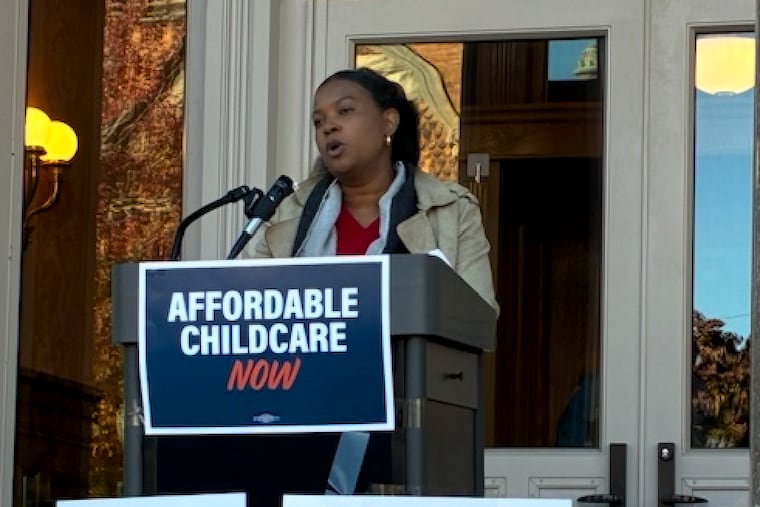
“As an educator and taxpayer, I contribute to our tax system, and I believe our tax dollars should be invested in meaningful change that strengthens our communities and builds an economy for our future generation,“ Jackson said in a rally before the hearing on the Statehouse steps.
”Our children deserve a system that will protect them and invest in them so that they can give back to the system and their communities.”
A Rutgers-Eagleton poll, released this month, found nearly 3% of state residents said it’s “very” or “somewhat” difficult to afford child care expenses – more than for housing, utilities, and other spending categories.