
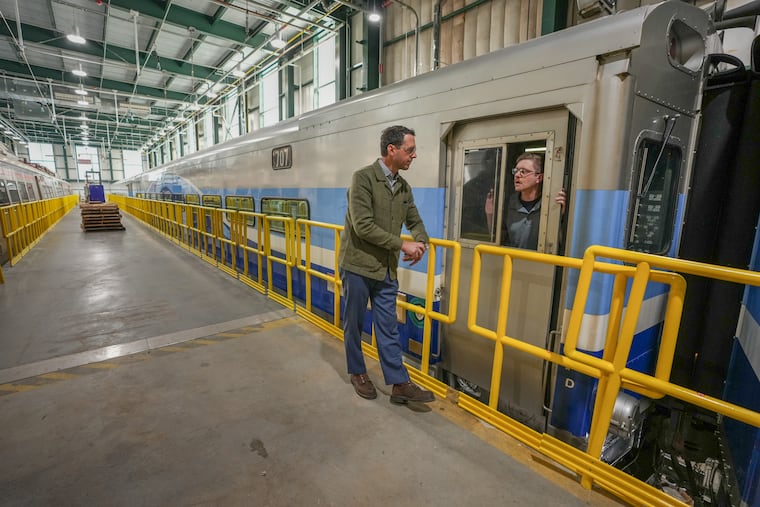
SEPTA’s 24 used rail cars gleamed Tuesday, thanks to paint applied by the previous owner, Montreal transit system Exo, and a good scrubbing after the long trip south.
They’re sitting in shop service bays and parked on sidings at the transit agency’s Frazer maintenance facility in Malvern, as crews work to modify them to bolster the Regional Rail fleet after last year’s mechanical and safety problems.
When all of them are online, the transit agency will have increased the number of its locomotive-powered “push-pull” passenger cars by 53%, from 45 to 69.
And that will mean longer and less crowded trains, with fewer bypassed commuter stations as Regional Rail continues to rebound, said SEPTA General Manager Scott A. Sauer.
“To start, customers will see some extra capacity, more room,” Sauer said. The coaches carry about 140 passengers, with a line of seats along one wall and wide aisles with poles for standees to hold.
The surplus Bombardier Comet II passenger coaches cost SEPTA $8.58 million, with 75 pallets of extra parts thrown in. They were built in 1988 and 1989 and refurbished more than a decade ago. For the last several years, they’ve been mothballed as Montreal upgraded its commuter fleet.
But Sauer said, they are “young compared to our senior citizens, the Silverliner IVs,” which are the workhorses of the Regional Rail fleet and at least 50 years old.
In October 2025, the Federal Railroad Administration (FRA) ordered SEPTA to inspect and repair all 223 of the Silverliner IV railcars, after five of the aging vehicles caught fire earlier that year.
For months, passengers dealt with canceled trips and delays as the Silverliner IVs were fixed. Trains were shorter than usual and packed.
The Canadian cars will begin running on Regional Rail early next year, SEPTA officials say, after modifications to comply with Federal Railroad Administration safety standards for interior signage, lighting and windows and other things, as well as the installation of Positive Train Control, a now-mandatory system that regulates speed.
Workers also need to replace way-finding maps of Montreal’s commuter train lines and dozens of French-language signs like Sortie de secours (emergency exit) and old ads such as the one inviting people to “Ecoutez la difference” on 107.3 Rouge FM, which broadcasts throughout Quebec.
They are expected to last long enough to help ease the transition to a newly made set of cars, to be called the Silverliner VI. Like the IVs and the next generation Silverliner V SEPTA also uses, the new units will be capable of carrying passengers and generating propulsion powered by overhead electric wires.
SEPTA has solicited bids and plans to award a $2 billion contract in the first quarter of next year, Sauer said. It would take about a decade for the first new models to begin arriving.
Detailed inspections before and after the purchase have found no significant corrosion in the structural steel of the used Bombardier Comet II cars.
“They’re in great shape,” said Greg Buzby, SEPTA’s chief officer, rail equipment engineering and maintenance. “Kudos to Exo for how well they’ve maintained the vehicles.”
One of the biggest tasks will be to cut down the full-length doors on the cars from Montreal — where all the station platforms are low — and add “traps” that conductors use to align with the high and low platforms of SEPTA’s variety of Regional Rail stations Buzby said.
Of the 24 Comet II cars, eight are so-called cab cars, which lead the train and allow the engineer to control a locomotive pushing the train from behind.
“You get to the end of the line, switch to the locomotive, and you pull [the train] the other way,” Buzby said. The rest of the cars are passenger coaches with no power source of their own.
SEPTA currently has only 10 cab cars in its Regional Rail fleet, so the additional cabs will provide flexibility — “kind of game changer for us,” Buzby said. Comet II coaches are considered ideal for express runs and routes where stations are spread farther apart.
Last year, the transit agency leased 10 coaches from MARC, Maryland’s commuter rail system. But none is a cab car.
The Montreal coaches and cab cars share the same manufacturer as those SEPTA already owns so the equipment is familiar to mechanics and engineers, Buzby said. In fact, Bombardier built the Frazer shop to assemble them.
“They’ll integrate with our cars seamlessly,” he said.