
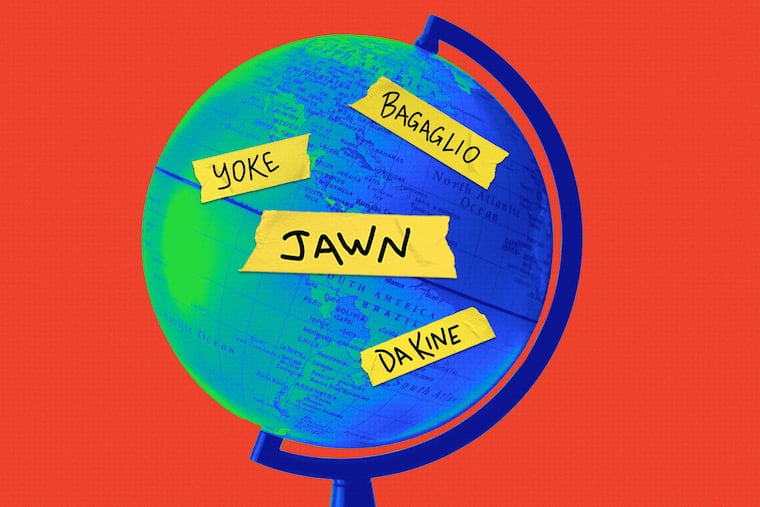
Before it became Philadelphia’s favorite all-purpose noun, jawn was joint. And, tragically for Philadelphians, it came from New York.
Originally used to refer to a place, like a bar or nightclub, joint took on a broader meaning once it spread to Philadelphia. In 1981, University of Pennsylvania linguist William Labov famously recorded a young Black man from West Philly using the word to refer to a number of things including a place, a bag, several women, and, last but not least, his penis.
Over time, the pronunciation changed, too, with oi stretching into an aw sound so long it knocked the t clean off the end. Joint was now jawn, a word unique to Philadelphia.
But the concept behind jawn — a word that could mean anything? That actually isn’t unique at all.
Yoke tales
Just as every culture has its own version of a hoagie, people all over the world have their own way of saying things. Including their own ways of saying, well, thing. Or thingy. Or thingamajig.
“There are tons of these all-purpose words across languages around the world,” said Andrea Beltrama, a sociolinguist at the University of Delaware.
In fact, they’re so common that linguists have a term for them: placeholders. They are the words you reach for when you can’t remember or don’t know what something’s called, can’t be bothered to name it, or figure the person you’re talking to already knows what you’re talking about.
Their meaning comes not from the words themselves, Beltrama explained, but from the situations in which they’re used. The listener has to fill in the blanks, allowing a single word to stand in for a remarkable number of things. That’s the trick all these jawns have in common. But the actual word you use — and just how far you can stretch it — depends on where you are in the world.
In Ireland, there’s yoke. Like jawn, it’s an informal word you can use when you don’t know an object’s actual name. Originally, a yoke was the wooden contraption that kept two oxen together as they pulled a plow. These days, the Irish use it when they don’t know what something’s called, especially when they have no idea what it does.
“When you don’t recognize the purpose of an object, then you ask, ‘What’s this yoke for?’” explained Raymond Hickey, a linguist who studies Irish English. So if you don’t know much about tools, you might call a monkey wrench a yoke. If baking isn’t your thing, a flour sifter could be a yoke. And unless you regularly hitch oxen to a plow, a yoke is probably a yoke.
‘Oh, this bagaglio’
Ireland isn’t the only place with a jawn of its own. Italy has one too. Actually, it has several. “There are all sorts of region-specific [Italian] words that do exactly what jawn does,” said Beltrama, the University of Delaware sociolinguist. Take the word bagaglio, for example. To most Italians, it means a piece of luggage. But in the northern city of Bologna, people use it much like Philadelphians use jawn. “Whenever you want to talk about something without naming it,” Beltrama said, “you say, ‘Oh, this bagaglio,’ meaning this object or this thing.”
So a salt shaker can be a bagaglio in Bologna but not in Venice. Just like it can be a jawn in Philadelphia, but not in Baltimore. And because their use is so specific to those cities, these words are more than just placeholders. They are identity markers too, a way of saying I’m from here.
As Beltrama explained, “It’s part of the Bologna identity to be able to use [bagaglio] in this particular way because no one else in the country would do that.”
‘No, because da kine’
The thing about bagaglio and yoke, though, is that both words have real meanings. Luggage and a wooden headlock for oxen, respectively. Jawn has no meaning other than the special meaning the speaker confers on it: restaurant, box, girlfriend, pants, etc.
But jawn isn’t alone in that respect, either. Consider da kine, an expression in Hawaii Creole (commonly called Pidgin). It loosely comes from the English phrase “the kind,” though you’d never know it from the way people use it today. Like jawn, it has no fixed meaning and can stand in for all sorts of things. Actually, more things.
“Da kine is unusually flexible,” said Tohru Seraku, a linguist at Hankuk University of Foreign Studies. While jawn generally sticks to nouns, da kine can replace verbs, adjectives, even whole sentences.
In one example Seraku studied, a man recalling why he left school as a child used da kine in place of the verb quit: da kine because we didn’t have enough money. In another, a man explaining why his bosses didn’t object to his leaving a job simply said, “No, because da kine,” using da kine to stand in for an entire explanation he went on to provide.
Of course, getting away with that much vagueness depends on who’s listening. You can only swap in da kine if the other person can figure out what it means. And that shared understanding, Seraku said, can strengthen the bond between speakers and reinforce their sense of belonging to Hawaii’s local community. Using Da Kine doesn’t just say “I’m from here.” It says, “I’m of this place and proud of it.”
Does jawn do all that too? According to Beltrama, absolutely. “By saying jawn, I’m not just referring to a backpack,” he explained. “I’m also signaling my and your position as Philadelphia people, Eagles fans, cheesesteak fans, and all the other things that can be associated with the city.”
Which makes da kine a pretty convincing contender for Hawaii’s own jawn. But what about yoke? According to Hickey, it doesn’t carry the same weight as a symbol of Irish identity. And while da kine can stand in for an entire sentence, yoke generally sticks to objects. Compared with jawn, Hickey said, “its core usage is much more restricted.”
A jawn all its own
So we’ve got a word in Hawaii that can do more than jawn, a word in Ireland that does less, and one in Italy that still means luggage. They all resemble jawn, but not quite in the same ways. Which raises the question: what do we actually mean when we say a word is just like jawn?
To Taylor Jones, a social scientist who has studied jawn extensively, being a placeholder is just the beginning. For a word to truly be like jawn, you also have to consider how it behaves, what it can mean, and where it fits into a sentence.
Despite its apparent versatility, jawn has a lot of rules. As Jones points out, it can stand in for practically any noun, but it can’t become a verb. “You wouldn’t say ‘I jawned him,’” he said. There goes da kine.
Even as a noun, jawn has its peculiarities. It doesn’t like to be in a phrase, Jones said, and it has collocation restrictions, meaning it doesn’t naturally combine with certain words. That’s why a “pair of jawns” sounds normal, but “a jawn of shoes?” Not so much.
And those little quirks add up. The more specific you get about how a word is used, the harder it is to find another one that behaves exactly the same way. Sure, other places have placeholders. But finding one that walks and talks exactly like jawn?
“That’s a little rarer,” Jones said.
It’s entirely possible no other word behaves quite like jawn. Then again, the same could be said of yoke, da kine, or bagaglio. Each has its own meanings, grammatical habits, and history. That’s what Jones means when he says “every word in every language variety is basically definitionally unique.”
So yes, jawn is unique. Just not in a way that sets it apart from every other word in the world.
“It’s a special snowflake like all the other snowflakes,” Jones said.