
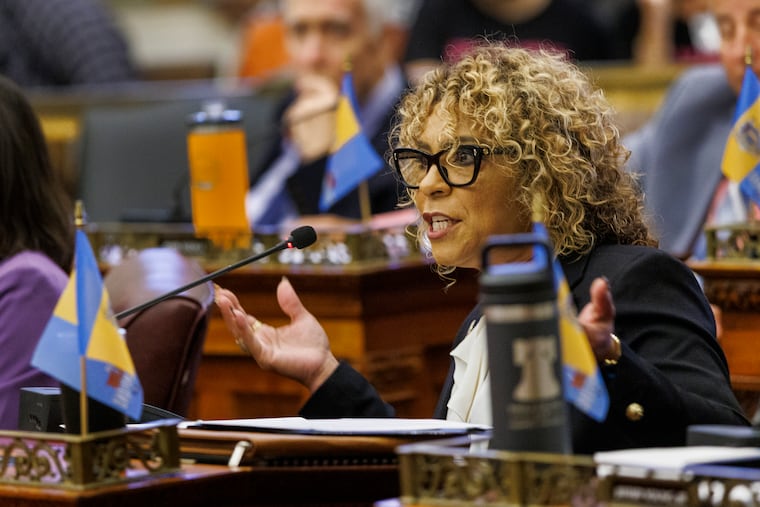
Tensions are running high between City Council and the Office of Property Assessment (OPA) following a hearing Monday on the agency’s performance.
Philadelphia’s real estate assessments have been criticized for years for placing disproportionately high tax burdens on lower-income neighborhoods.
Mayor Cherelle L. Parker has called for scrutiny of the process, dating back to her time on City Council. At the end of last week, her Philadelphia Home Assessment Bias Task Force released a report on next steps.
One of the task force’s chief recommendations is to stick with a two- to three-year citywide reassessment cycle. That suggestion did not sit well with some City Council members, who instead are asking for a freeze on assessments.
“I understand that a lot of the recommendations will take time, so I just want to go back to this point of prioritizing equity as much as we prioritize reassessments,” said Councilmember Jamie Gauthier, chair of the Committee on Housing, Neighborhood Development, and the Homeless.
“Are you willing to halt reassessments until we have more progress on these recommendations?” Gauthier asked OPA chief James Aros.
He responded: “For us to pause, I would not commit to that. For us to pause for a certain period of time to when there is a complete fix would prevent improvement.”
Experts and some advocates say that OPA’s performance is getting better, but the latest reassessments saw valuations rise higher in long impoverished Kensington than in any other neighborhood.
Councilmember Quetcy Lozada, who represents much of that area and called for Monday’s hearing, expressed frustration with Aros’s responses and clashed with him repeatedly.
“This City Council called for reforms back in 2019, and we’re still having the same conversation about a process that has been unfair, has been nontransparent, and has been a problem for everyone,” Lozada said.
Parker’s task force found that OPA’s performance improved over time, although iniquities persist. Although the average increase in this year’s assessments was 3%, some predominantly Black and Latino neighborhoods saw spikes of as much as 50%.
One member of the task force, Monty Wilson of Community Legal Services (CLS), who has the support of City Council and the administration, tried to strike a balance between recognizing the legislators’ concerns while acknowledging OPA’s efforts.
“Things have improved, and it would be absolutely wrong of me to say otherwise,” said Wilson, a senior attorney with CLS’s Consumer Housing Unit.
“The truth is that the Philadelphia Assessment Office is probably the best, most accurate assessment office” in Pennsylvania, Wilson said. “I’m not saying that’s good enough, but that’s the truth.”
Still, Wilson noted, OPA makes thousands of errors across the close to 600,000 parcels in its purview. The window to challenge inaccurate assessments should be extended, he said, so those who will be subject to dramatically higher property tax bills have more time to contest them.
Currently, new assessments are released in the summer, and challenges must be submitted by early October. Why not extend that to December, Wilson said, or allow for appeals at any time, if property owners can show cause?
At the hearing, Aros said his agency is seeking better data for future evaluations, including from the real estate listing service Bright MLS, which has been resistant to their overtures.
OPA also would like to work with Council members to get property owners on board to do in-person inspections of homes in particular neighborhoods, Aros said.
Another task force recommendation is for an independent review of the OPA’s practices to help identify any lingering disparities and “identify fairer approaches.”
Lozada was not excited by that last option.
“It seems to me that all we’re continuing to do in this report is articulate the problems that we know have existed and creating more… six-figure jobs that are going to continue to articulate a problem that we already know we have,” she said.
Council has not decided on next steps, especially as members said they hadn’t had time to absorb the task force’s report, which was issued Friday.
Still, CLS’s Wilson said he found the exercise fruitful.
“No one was going to develop an action plan today,” he said after the hearing. “But this is the official starting gun.”