
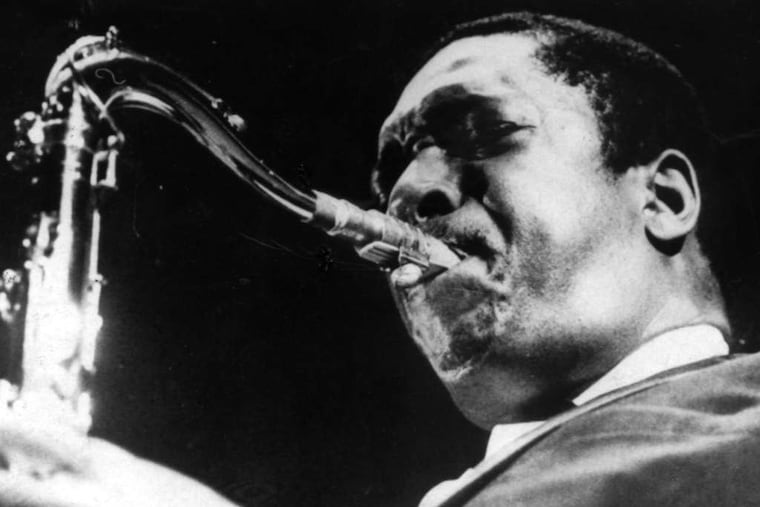
Sixty years ago, this week, John Coltrane returned to the city he had called home for more than a decade. He was playing at Temple University’s Mitten Hall, barely two miles from the Strawberry Mansion rowhouse where he’d spent several formative years.
He died nine months later in July 1967 and the Nov. 11, 1966 performance turned out to be the saxophonist’s final concert in his former hometown.
But the concert remains legendary for other reasons as well. Most notably, it featured the only known instance of Coltrane vocalizing, singing his venturesome melodic ideas while accompanying himself by beating rhythms on his chest.
The Mitten Hall show was broadcast live on WRTI, then circulated for years as a bootleg before finally receiving an official release in 2014 as Offering: Live at Temple University. The album reveals the extremes to which Coltrane was stretching his music near the end of his life.
The concert featured several unexpected guests joining Trane and his regular band mates — his wife and pianist, Alice Coltrane; fellow tenor saxophonist Pharoah Sanders; and drummer Rashied Ali, along with local bassist Sonny Johnson. Several percussionists had been invited to share the stage that evening, while a pair of saxophonists, Arnold Joyner and Steven Knoblauch, were allowed to sit in.
“True confession: I probably spent more time in the jazz clubs in North Philadelphia than I did on the Penn campus,” Knoblauch, now an accomplished psychologist, who was at that time an 18-year-old freshman at Penn, admitted over the phone from his home in upstate New York. “One of the reasons I chose to go to Penn was because I knew Philadelphia was full of great jazz musicians.”
Growing up in Jersey City, Knoblauch had frequented the Greenwich Village clubs where the jazz avant-garde was then taking shape. He has vivid memories of seeing pioneers like Coltrane, Miles Davis, Thelonious Monk, Sun Ra and Albert Ayler, and kept up the habit after moving to Philly.
During his four years at Penn, he led his own quartet, playing local clubs and coffeehouses. Hearing rumors that Coltrane had permitted young musicians to sit in with the band during recent performances, he showed up early to the Temple auditorium, sax in hand. Seeing that he and a bassist friend were musicians, the box office manager let them inside.
“When Coltrane and the band came in,” Knoblauch recalled, “his manager said, ‘Who told you to come up here?’ But Coltrane said, ‘No, no, let them stay.’ He told us to sit stage left on a piano bench.”
Later in the evening, in the midst of the band’s 20-minute rendition of “My Favorite Things,” Coltrane strolled to the side of the stage and invited Knoblauch to take a solo.
“When you were around Coltrane, the man could read anybody,” Knoblauch marveled. “It was like being around a guru or a professor or a saint. He was a highly accomplished, highly intuitive, highly knowledgeable human being … He just looked at me and somehow he knew that I would play what he wanted me to play in that moment.”
Jazz Philadelphia and Ars Nova Workshop will commemorate that concert’s 60th anniversary this week on the campus where the original event took place. On Wednesday, the annual Jazz Summit will include a conversation on the stage of Mitten Hall with Robert Kenyatta and Knowblauch, moderated by WRTI’s Nate Chinen. On Thursday, a concert celebrating the event will feature an all-star band including pianist Kris Davis, bassist Robert Hurst, drummer Terri Lyne Carrington, and two saxophonists whose fathers led that night’s sonic torrent: Ravi Coltrane and Tomoki Sanders.
Throughout the month prior to the concert, Coltrane had become a regular presence at North Philly’s Church of the Advocate, where a group of local drummers met to practice twice a week.
Among them was Kenyatta, then a 24-year-old percussionist and member of the Visitors, a band led by brothers Carl and Earl Grubbs, cousins of Coltrane’s first wife, Naima.
“I knew who he was right off,” Kenyatta said last week, remembering the saxophonist’s impromptu first visit to the church. “He walked over to me on the stage and asked, ‘Would you mind if I sit in with you?’ I waved my hand at him like, ‘Get out of here. You’re John Coltrane!’ And he smiled, went to the other end of the stage, took out his horn, and started playing.”
Kenyatta and his fellow drummers were at first somewhat dismissive of the fiery, experimental sound of Coltrane’s playing. But when he returned in early November, they were stunned.
“To our surprise, he started playing each of our rhythms on his horn. That spaced us out. He must have gone home and studied them in his head. When we finished, he asked if many of us could do a gig.”
Kenyatta took him up on the offer, joining a cohort of percussionists that included Charles Brown, Angie DeWitt, and Umar Ali, brother of the band’s drummer, Rashied Ali. It was an early career highlight for Kenyatta, who would go on to tour with Sonny Rollins and the Beach Boys, and work extensively with the Philly jazz bagpiper Rufus Harley.
This week’s events are part of the ongoing celebration of Coltrane’s centenary in September in the city and beyond. Last week saw the release of The Tiberi Tapes, a collection of live recordings captured on a portable reel-to-reel tape by the saxophonist Frank Tiberi beginning in 1960 at clubs including Philly’s Showboat and Pep’s.
“Jazz Philadelphia Summit: Offering Edition,” Nov. 11, 1:30 p.m., Mitten Hall, Temple University, 1913 N Broad St, jazzphiladelphia.org
“John Coltrane’s Offering Revisited,” Nov. 12, 8 p.m., Temple Performing Arts Center, 1837 N Broad St, arsnovaworkshop.org