
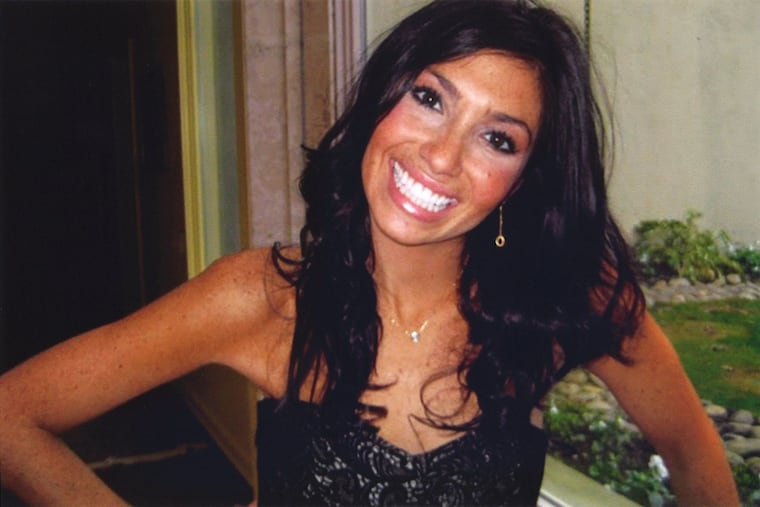
The U.S. Attorney’s Office is seeking documents and information from those connected to the case of Ellen Greenberg, whose 2011 death remains shrouded by questions about whether it was properly investigated by authorities, according to sources.
The sources, who asked not to be identified, said federal prosecutors recently sent out subpoenas in the matter, and that the investigation does not appear to be focused on the manner of Greenberg’s 2011 death by 20 stab wounds — which was initially ruled homicide then switched to suicide. Instead, the sources said, the probe appears to be centered on questions about how a variety of agencies handled the case in the years after she died, and whether any of those missteps might amount to criminal corruption.
Still, the scope of the potential inquiry was not clear Wednesday.
Multiple city and state agencies have been involved in Greenberg’s case in the last 15 years, including the Philadelphia Police Department, the Philadelphia Medical Examiner’s Office, the Philadelphia District Attorney’s Office, the Philadelphia Law Department, and the Pennsylvania Attorney General’s Office.
Spokespeople for all of those city offices would neither confirm nor deny they have received subpoenas.
A spokesperson for the U.S. Attorney’s Office said they could “neither confirm nor deny the existence of an investigation.”
Joseph Podraza Jr., the attorney for Greenberg’s parents, said he and his clients are “ecstatic.”
“If that is in fact correct and accurate, that the federal government is going to investigate … this is exactly what we’ve wanted all along,” he said. “It’s unfortunate it’s taken more than seven years to get to this point but we are really grateful and thankful to the U.S. attorneys and, of course, are available to assist in any way we can in helping their investigation.”
From homicide to suicide
Greenberg, 27, was found by her fiancé, Samuel Goldberg, in the kitchen of their Manayunk apartment with a 10-inch knife lodged four inches into her chest on Jan. 26, 2011.
Investigators on the scene treated her death as a suicide because Goldberg told them the apartment door was locked from the inside and he had to break it down to get in. There were no signs of an intruder and Greenberg had no defensive wounds, police have said.
During an autopsy the next morning, then-assistant medical examiner Marlon Osbourne noted a total of 20 stab wounds to Greenberg’s body, including 10 to the back of her neck, along with 11 bruises in various stages of healing, and ruled her death a homicide.
By the time homicide investigators returned to the scene to conduct their investigation, the apartment was already professionally cleaned and electronic devices belonging to Greenberg had been removed by a member of Goldberg’s family.
Shortly after the homicide ruling, police publicly disputed the findings, citing “mental issues” Greenberg may have had. Osbourne later changed his ruling to suicide, with no explanation to Greenberg’s parents, Joshua and Sandra.
Greenberg was dealing with anxiety, had met with a psychiatrist, and was prescribed anti-anxiety and sleep aid medications. Her psychiatrist told police Greenberg felt overwhelmed at work, but “there was never any feeling of suicidal thoughts,” and according to the medical examiner’s investigation report at the time, there was nothing indicative of suicide found on Greenberg’s computers.
She did not leave behind a note.
The Greenbergs subsequently retained numerous independent forensic experts who have questioned authorities’ findings, as first detailed in a March 2019 Inquirer report.
In their search for answers, the Greenbergs hired then-civil rights attorney Larry Krasner in 2012. He convened a meeting for the Greenbergs with police officials and the district attorney’s office in an effort to get the investigation reopened, but nothing happened, the Greenbergs said.
When Krasner became district attorney in 2018, the Greenbergs reached out to see if he’d reopen the investigation. Krasner referred the matter to the state Attorney General’s Office, then helmed by now Gov. Josh Shapiro, to avoid the appearance of a conflict of interest.
Shapiro’s office had the case for more than a year. It was only when The Inquirer pressed the office for answers that Shapiro’s spokesperson at the time, Joe Grace (now spokesperson for Mayor Cherelle L. Parker), said in a 2019 statement that they had conducted a “thorough investigation,” the “evidence supports ‘Suicide’ as the manner of death,” and that the office had closed the investigation.
Grace pointed to search history on Greenberg’s computer that included the search terms “suicide methods,” “quick suicide,” and “painless suicide.”
When asked why the medical examiner’s 2011 report said nothing indicative of suicide was found on Greenberg’s computer, Grace said his office didn’t find the analysis in the file, so “we cannot say if anyone, police or prosecutor, ever looked at it.”
The lawsuits
Following the Attorney General Office’s review, the Greenbergs filed a lawsuit against the Medical Examiner’s Office and Osbourne in 2019 seeking to have the manner of their daughter’s death changed back to homicide or undetermined.
The city law department fought to have the case dismissed and a lengthy appeals process followed. In the Commonwealth Court’s 2-1 decision in 2024, judges wrote they had “no choice under the law” but to grant the city’s appeal but added that “… this court is acutely aware of the deeply flawed investigation of the victim’s death by the City of Philadelphia Police Department (PPD) detectives, the City of Philadelphia District Attorney’s Office (DAO), and the MEO [Medical Examiner’s Office].”
While that case was ongoing, the Greenbergs filed a second suit in 2022, based on additional details about the case that came to light through the first suit, including new information about the process around how Greenberg’s death was classified.
In the new suit, Podraza alleged the investigation into Greenberg’s death was “embarrassingly botched” and resulted in a “cover-up” by Philadelphia authorities. It sought monetary damages for intentional infliction of emotional distress.
The city law department fought both suits until February, when Osbourne — the pathologist who initially ruled Greenberg’s death a homicide then switched it to suicide — signed a sworn statement saying he now believes her death should be categorized as something other than suicide.
Within days, and shortly before the second case was to go to trial, the city offered to settle with the Greenbergs. The settlement included $650,000, which was paid, and an agreement that the Medical Examiner’s Office conduct an “expeditious” review of the manner of Greenberg’s 2011 death.
As part of the settlement, the Greenbergs agreed to withdraw both of their lawsuits against the city. The first suit had been was slated for a hearing before the Supreme Court of Pennsylvania last year.
In October, Philadelphia Chief Medical Examiner Lindsay Simon delivered her review of the case, in which she said she discovered 20 additional bruises and three additional “perforations in the skin” never before documented on Greenberg’s body, raising the total number of bruises to 31 and stab wounds to 23, up from 20.
Simon concluded that Greenberg “would be capable of inflicting these injuries herself,” and that her death “is best classified as ‘Suicide.’”