
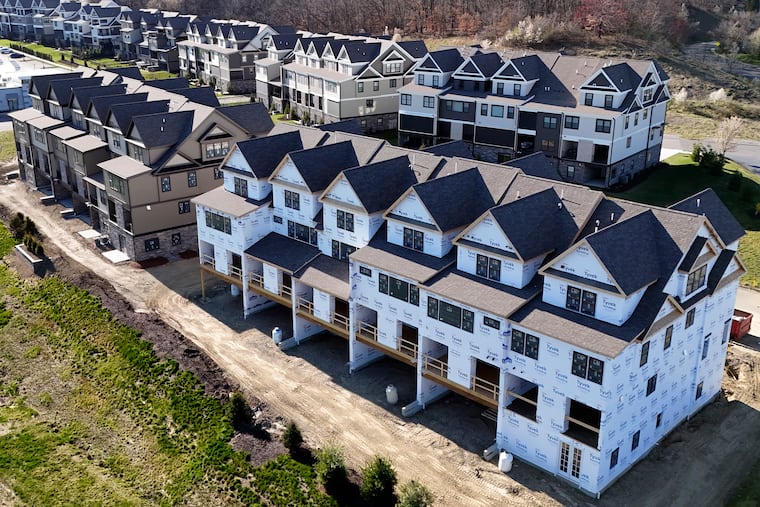
Housing policy debates are everywhere these days — from President Donald Trump reportedly (and profanely) telling House Speaker Mike Johnson that no one cares about them, to Mayor Cherelle L. Parker making affordability a centerpiece for her administration. But are our leaders making the right choices?
ROAD to nowhere
Housing policy nerds were once genuinely excited about the federal, bipartisan ROAD to Housing bill. However, last-minute modifications, meant to appease social media populists, have undermined its effectiveness.
The initial aim of the bill was to increase housing production, a goal now emphasized across the political spectrum. A national shortage of homes and apartments has left renters paying more each month and driven up costs for first-time homebuyers.
Some experts are concerned that the shortage may even affect family formation and increase a sense of hopelessness among young people who feel that the American dream is out of reach. Congress aimed to ease the burden by cutting red tape, like restrictions on manufactured homes or the wait time for inspections for buildings utilizing housing choice vouchers.
These are positive moves for affordability. Unfortunately, the bill also restricts the construction of “build to rent” single-family homes. This is meant to address claims, seemingly more popular among conspiracy theorists on TikTok than in any housing policy journal, that the increase in housing costs is because “BlackRock is buying all the homes.”
Of course, it is true that some institutional investors, like Blackstone (which is a different company from BlackRock), are buying up single-family homes. But the influencers have the cause and effect backward. Big finance is investing in housing because housing is in such short supply.
Just look at what Blackstone’s own articles say about the topic: “We are seeing a dramatic decline in new supply across virtually every sector globally, down 60%+ across our major U.S. sectors. This is the No. 1 reason we are bullish on real estate today: Lower supply generally leads to stronger rent growth and higher values.”
That doesn’t make big investors heroes or villains, just opportunists. While finding an appropriate scapegoat is easier to explain in a 60-second video clip, going after build-to-rent housing is more likely to hurt the young families who rent these homes and struggle with housing costs the most than it is to stop private equity firms from making money.
The best way to strike back at these large-scale investors is to make hoarding homes unprofitable again. That means taking on the quite ordinary people who crowd local planning meetings to express very common, popular, and often unfounded “not-in-my-backyard” concerns about crowded schools, overtaxed sewer systems, parking, or the idea that moderate density projects will “turn Upper Gwynedd into Philadelphia.”
Toothless TOD
Meanwhile, Mayor Parker’s H.O.M.E initiative faces another pitfall: councilmanic prerogative. The Parker administration unveiled legislation last week that would expand the city’s transit-oriented development, or TOD, zones. The program allows developers to add height and density near transit stops. Research shows that people who move to housing that’s near transit are more likely to use transit than others. Strengthening the zones is a prudent move that would help SEPTA grow its ridership and reduce overall housing costs.
A quick look at the designated zones showcases one of the immediate problems — the bill doesn’t include the Broad Street Line, the city’s highest capacity transit route and the nation’s only four-track subway system outside of New York City. Any urban planner would tell you that housing growth along Broad Street should be the top priority for any additional density in the city. So far, it is entirely absent from the plan.
While several Market-Frankford Line stations are included in the TOD zones, they are constrained by another acronym: MIN. While the Mixed-Income Neighborhoods zoning restriction does not exist in most of Philadelphia, it does exist in the two council districts that host the most El stops, the 3rd and the 7th. The existence of MIN will make it difficult for new developments to make financial sense, even with the bonus.
Opponents of statewide zoning reforms often say that land use should be a local issue. City Council’s insistence on implementing policy on a district-by-district basis is a great demonstration of how that idea works better in theory than in practice.
Harrisburg hopes
Given the struggles of their federal and local counterparts, can we really expect Harrisburg to do any better?
Lt. Gov. Austin Davis is certainly saying the right things. In an op-ed published by his hometown paper, the Pittsburgh Tribune-Review, Davis eloquently lays out the personal stakes of this fight. Despite his comfortable salary, the Davises lost out on eight homes before finally getting a bid accepted. It is a familiar story for young families across the country.
Gov. Josh Shapiro has made it a goal to grow Pennsylvania’s economy, but housing is a key prerequisite. Without affordable options at every income level, companies will struggle to move to or expand their existing presence in the commonwealth. States like Texas and Florida have become political powerhouses in part because they build so much housing. If Shapiro wants the Keystone State to again see glory days, he’s going to need a bigger, bolder, better housing plan.