
What does it mean to paint a bowl of fruit in 2026?
For Kerry Bickford, associate curator at the Brandywine Museum of Art, the question is less quaint than it sounds. It’s one she has given a lot of thought to.
The museum’s new exhibition, “Abundance/Excess: A Contemporary Eye on Still Life,” gathers work by 10 contemporary artists who draw on the long history of still-life painting to wrestle with ideas of wealth, waste, and the uneasy politics of plenty.
“Still life, as I’ve very succinctly defined here, is the painting of things,” Bickford, 35, said. But, she explains, those “things” have sometimes carried moral weight.
For instance, in the Dutch Golden Age, artists often thought about abundance through a Christian lens, creating still-life images that paired lavish spreads of pastries, meats, and fresh produce with skulls, wilting flowers, or a single fly.
“These were gestures at the fact that luxury is fleeting,” Bickford said.
By contrast, 19th-century American still-life painters, many working in and around Philadelphia, were more likely to record luxury “as is,” said Bickford, and sell it to Gilded Age bankers and businessmen.
The moral anxiety softened. Abundance looked aspirational.
Bickford was curious about that shift and in what might happen if contemporary artists “reinserted the fly into the American still-life tradition.”
Her curiosity resulted in “Abundance/Excess,” which is built on the Brandywine’s existing collection of Philadelphia still lifes, and unfolds in two sections.
The first section, “Abundance,” features artworks that interrogate wealth distribution and question buying and selling patterns in America.
It includes works by local artists Kate Abercrombie and King Cobra that are representative of plenty, whether historically or in the present, such as Cobra’s sculpture of a moldy piece of cake.
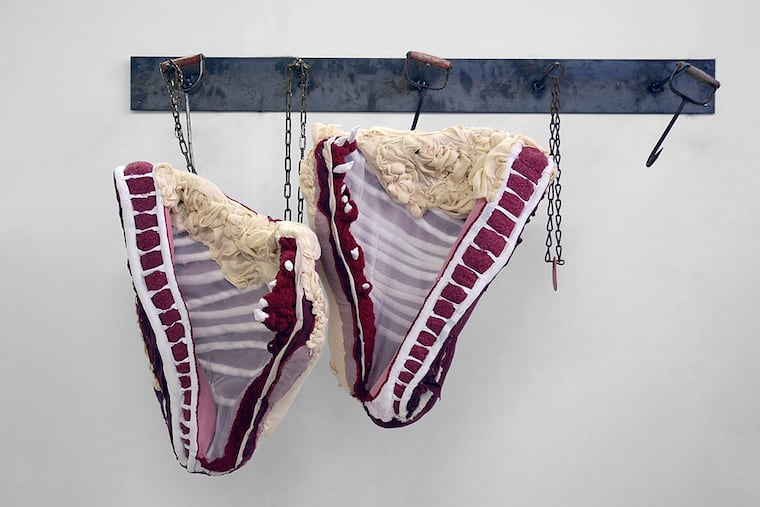
The second section, “Excess,” considers the environmental and social consequences of overconsumption. Several of the artists used discarded and repurposed materials in their works, fitting for a museum that is also a conservancy, Bickford said.
Others, like Nadia Hironaka and Matthew Suib, considered excess more broadly, as a negative force on America’s political and cultural climate.
In Bickford’s view, abundance and excess are not quite opposite sides of the same coin. They sit on the same spectrum.
“It’s a continuum more than it is a dualism,” she said. “The question is always how much is too much?”
Still life, she argues, is uniquely suited to that inquiry. The genre demands close looking. It rewards “really fine-tuned attention to everyday things,” she said.
By isolating fruit, flowers, fish, or household objects, artists force viewers to confront what they consume, display, discard, and desire. In “Abundance/Excess,” visitors will be invited to consider not only how they view everyday objects but how they value them.
“Abundance/Excess: A Contemporary Eye on Still Life”
📅 March 15-Jun. 7, 📍 Brandywine Museum of Art, 1 Hoffmans Mill Rd., Chadds Ford 🌐 brandywine.org/