
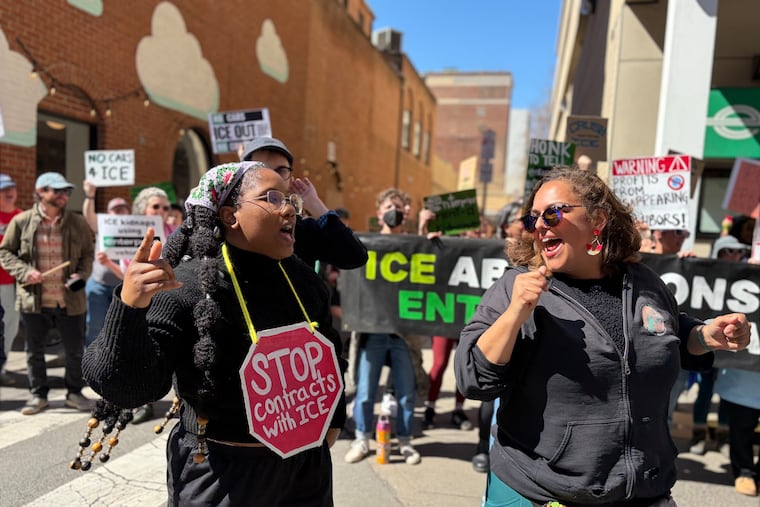
Blowing whistles and shouting slogans isn’t how this group shows its opposition to President Donald Trump and to ICE.
Instead, it speaks against what it sees as grave injustice with something softer and in some ways more powerful: song.
“We can feel the grief,” said Jessica Zimmerman, 37, a leader with Singing Resistance Philly, but “we can feel the joy of being together in community. I sing because it is a way to connect and to have all of our voices supporting one another during this moment that’s really scary.”
Singing Resistance, together with a group called the Rise Choir, have turned song into a way to support immigrant neighbors at a time when Trump has turned the federal immigration-enforcement apparatus hard against them.
They sang out last month during a Center City protest to demand that Enterprise Rent-A-Car stop leasing vehicles to Immigration and Customs Enforcement, and members of the groups took part in a “Week of Action” that ran through Saturday, organized by No ICE Philly to call attention to agency arrests in the city.
“There is something about injustice that causes a lot of rage,” said Sandra Telep, who joined Rise Choir about two years ago. “My form of activism is really rooted in hopefulness and love, and I think Rise Choir and singing about injustice is one way to root yourself in that.”
In March, outside of the Enterprise Rent-A-Car office on South 19th Street, protesters sang and danced as bystanders applauded and drivers honked their horns. The demonstrators held a banner that said, “ICE abductions use Enterprise cars.”
Telep said all are welcome to join the choirs, with enthusiasm valued over skill.
Her favorite song is the choral version of Chappell Roan’s “Hot to Go!” because that adaptation, she said, has a Philadelphia vibe.
“Philly is known for having an attitude,” Telep said. “We are rooted in brotherly love but we are also going to fight back.”
Aly Halpert, a song leader with Singing Resistance, enjoys not just the excitement of creating music but also the coming together in solidarity.
“When I’m singing songs, I feel more connected to the people around me,” she said. “We’re opening our hearts more. We’re really saying like, from a heart-centered place, we are here to protect life and we’re here to be in solidarity with people.”
The idea for Singing Resistance emerged in Minnesota, as President Donald Trump surged ICE agents into the Twin Cities. It quickly grew from a few hundred people singing on streets and in churches to a nationwide movement joined by thousands.
The idea, organizers said, is to peacefully — even joyfully — resist authoritarianism and ICE by singing songs of hope. Some events are organized and announced in advance, others occur spontaneously or through discreet planning.
Use of songs and music as a tool of protest is a long tradition, reaching all the way back to the creation of the United States.
The song “Free America,” sometimes pronounced as “Free Americay,” was penned in 1774 in opposition to British rule, the First Amendment Museum in Maine noted. The author, Joseph Warren Warren, set his song to the tune of the “British Grenadiers,” a traditional British military march. It remained popular throughout the American Revolution, though Warren died in the fighting a year after he wrote it.
Woody Guthrie’s enduring, patriotic-sounding “This Land Is Your Land,” since recorded by everyone from Joan Baez to Bruce Springsteen, was written as protest, a response to Irving Berlin’s “God Bless America.” An often omitted stanza has the author seeing neighbors at a relief office and, “as they stood there hungry, I stood there wondering if God blessed America for me?”
Protest music went mainstream in the 1960s, as from opposition to the Vietnam War emerged classics including Bob Dylan’s “The Times They Are A-Changin’,” and “Eve of Destruction” by Barry McGuire.
“One thing that we want to do with Rise Choir and Singing Resistance is to make the protest irresistible,” said Pax Ressler, 36, of Rise Choir. “We want to make it sexy, so folks can be interested in what we’re doing. … It kind of takes down the barrier to involvement. We believe anyone can sing.”
Zimmerman, who until recently lived in Minnesota, saw a chance to be a local part of what the Rise Choir had started.
“Singing is an antidote to fear,” she said. “Authoritarianism wants us to feel scared and isolated. Singing is a way to tell the truth of the violence, and the resistance, and to join in community.