
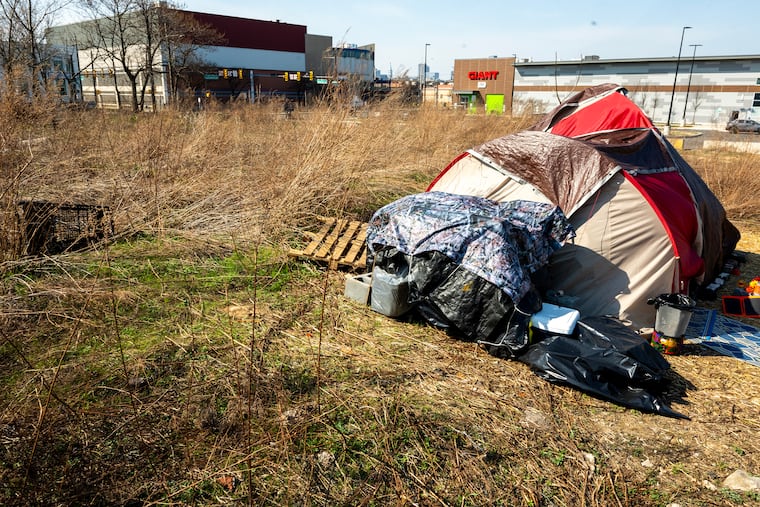
Maybe it’s the methamphetamine or her broken heart or the cold winds that blow off the Delaware River and rattle her wounded tent, but Cathy doesn’t sleep much anymore.
The hole in her tent doesn’t help. The ragged, half-moon-shaped tear just above where she sleeps — bundled in blankets with her husband, Mark — came courtesy of the men with machetes, she said. Contractors, including a few carrying long blades, and a property owner jangling a cowbell attempted to raze the camp.
Now, Cathy lies awake, staring at the rip in the fabric, knowing it’s just a matter of time before the owners send more men.
“They’re rich people and we’re poor people,” she said, above the din of the waterfront wind. “That’s just how the world works.”
‘Treating people like cattle’
Cathy is among roughly 20 remaining residents of Camp Chloe, a makeshift community of tents, huts and human souls in a swath of fenced–off brush between Christopher Columbus Blvd., and the Delaware River Trail, near the South Philly Giant.
Formed last fall after a nearby waterfront homeless encampment was razed, the settlement takes its name from a coffee-colored pit bull that roams the grounds, seeking treats and affection and protecting against outsiders.
Sitting on hilly ground, almost like a stage, and standing in stark contrast to the neon newness of the supermarket, the camp has become a battleground, as my colleague Ximena Conde reported. The shelter-resistant residents living illegally in the dunes represent the last outpost of a community of unhoused people that have been pushed around the waterfront for several years.
Last month, contractors cleared four tents from Camp Chloe before police and advocates negotiated a temporary extension for residents, who want “safe sleep sites,” where people could camp while waiting for permanent housing, and a receipt system for confiscated property. Some residents fled.
“They started to treat people like cattle,” said Hanif, 45, a big man who speaks softly, and sleeps in a tent by the camp entrance. “So people started moving like cattle. They just grazed off.”
Icy nights, grief, and shame
Camp Chloe is Cathy’s first time in the wild.
“Cathy with a C,” she said. “Like a Cat.”
Originally from Bridesburg, Cathy has lived in the encampment for nearly five months. She and Mark have been homeless longer. Mark’s done time. Cathy said her son died from drugs — a loss that triggered a nervous breakdown, which she said led to the instability that sent her into homelessness.
For a time, the couple slept in a van under the highway, relying on the kindness of a Walmart potato chip deliveryman who would let a few extra bags slip.
Cathy, who wears white bubble slippers and combs her graying blond hair out of her eyes, smiles easily, playing a maternal role in the camp. She believes she is living in the last days of Camp Chloe.
“It’s been a lot harder than I thought it was gonna be out here for me,” she said.
There’s the icy nights when she was sure her feet were frozen. The stinging grief over her son, Matthew, whom she remembers as a carefree child giving her wet willies from the backseat on Roosevelt Boulevard lvd — but who was 25 when he died from an overdose in 2021. The guilt. The Spider-Man birthday card for her grandson, never mailed, but still carried with her.
“I feel so shameful,” she said. “I have forgotten my two live children.”
She has found family in Camp Chloe, she said — with the dedicated volunteer outreach workers who come often with supplies; with a fellow resident, Kate, who is young and pretty, but talks little about her past. At camp Chloe, they call Kate the “Rock Garden Queen” for the stone arrangements she quietly toils over. And Hanif, who refused to leave when the contractors came.
“It’s like a first class citizen being treated like a second class citizen in a third world country,” Hanif said, collecting brush for a burn barrel, with Chloe trotting beside.
Stark reminder
City officials are sympathetic — to a point.
Councilmember Mark Squilla, who represents portions of South Philadelphia, said his office has been working with the city’s Office of Homeless Services to find services and housing, including slots at new city facilities where couples like Cathy and Mark can stay together.
“The goal is to get them into transitional housing and then permanent housing,” said Squilla, adding that his office has been flooded with complaints from residents angry about the trash-strewn, but dignified encampment, where residents hoard and share donated, scavenged, and stolen items for survival. “But it’s hard to support people trespassing on somebody else’s land.”
Tower Investments, which owns the land on where Camp Chloe sits and plans a mixed-use development on it, called Sugar Mill, has agreed to delay evictions until Squilla can meet with residents, he said. The company did not return a call for comment.
On its own, the camp is a visceral reminder that while crime is dropping in Philadelphia, homelessness remains stubbornly intractable, with more souls believed to be sleeping on Philly streets in 2025 than the year before.
“As a city of the first class, we should be better than that,” Squilla said.
‘Trespasser’s Harbor’
Some mornings, Chet, who lives in a tent in the camp, and said he studied architecture in college, shares what breakfast he has with Cathy. Chet, like most residents, said he has lost everything so many times that he preferred to maintain some of his privacy, and not use his last name. He called his homelessness, “a spiritual journey.”
“Humans are very hard for me to trust right now,” he said.
In the previous camp, Chet, who is middle-aged, with a salt-and-pepper beard and shares a more than-passing resemblance to the actor, Mark Ruffalo, built an 8-by-12 cottage out of salvaged materials overlooking “Trespasser’s Harbor,” as some residents call the waterfront piers.
Relying on scavenged pallets, flattened beer cans, vinyl flooring, police barricades, driftwood, and a beveled window with a bullet hole in it, he modeled his home on the pioneer structures from “Little House on the Prairie,” which he used to watch on television. Using corrugated metal for rain collection, he said he even rigged up a shower.
“It was a tiny home,” said Chet, who wore a plaid scarf fashioned like an ascot, and noodled a sketch of his old home in my notebook. “A scaled-down salt box with two double bunks and a big picture window.”
In October, contractors bulldozed Chet’s cottage as he and outreach workers looked on.
“Every time I start to get a leg up, there’s a camp clearance,” he said. “We’re stakeholders, we’re citizens, we’re residents, and we’re people, and we’re just treated as a problem.”
‘I just pray for us.’
Cathy has made her hillside hut a home.
Inside, toiletries neatly fill a shopping bag. A bucket and bottle of Clorox serve as a toilet. Pink plastic rosary beads dangle from a canopy chair. Outside, Mark landscaped a rock garden and winding pathway. Cathy made planters from cinder blocks and donated plastic flowers.
She kept a television plugged into the camp generator — for Mark and others to watch scary movies — until the contractors trashed it. She also lost bags of clothing, which she set out to launder, and a bistro set where residents liked to sit in the morning to watch the sun rise over the trees and the river.
“The sunrise from here is unbelievable,” she said. “You see purple and blue, you see yellow. We even see pink. I never realized there were so many colors in the sunrise.”
In the quiet of the morning, she used to sit at the table alone and pray — for Matthew, that he made it to Heaven, and for her fellow residents of Camp Chloe.
The money will win. The camp will eventually disappear. And for Cathy and Mark and the residents of Camp Chloe, what little they have left will be taken from them — not a fresh start, just another place gone.
“I just pray for us,” she said, before heading back inside her torn tent.
Shae Mercer contributed reporting to this article.