
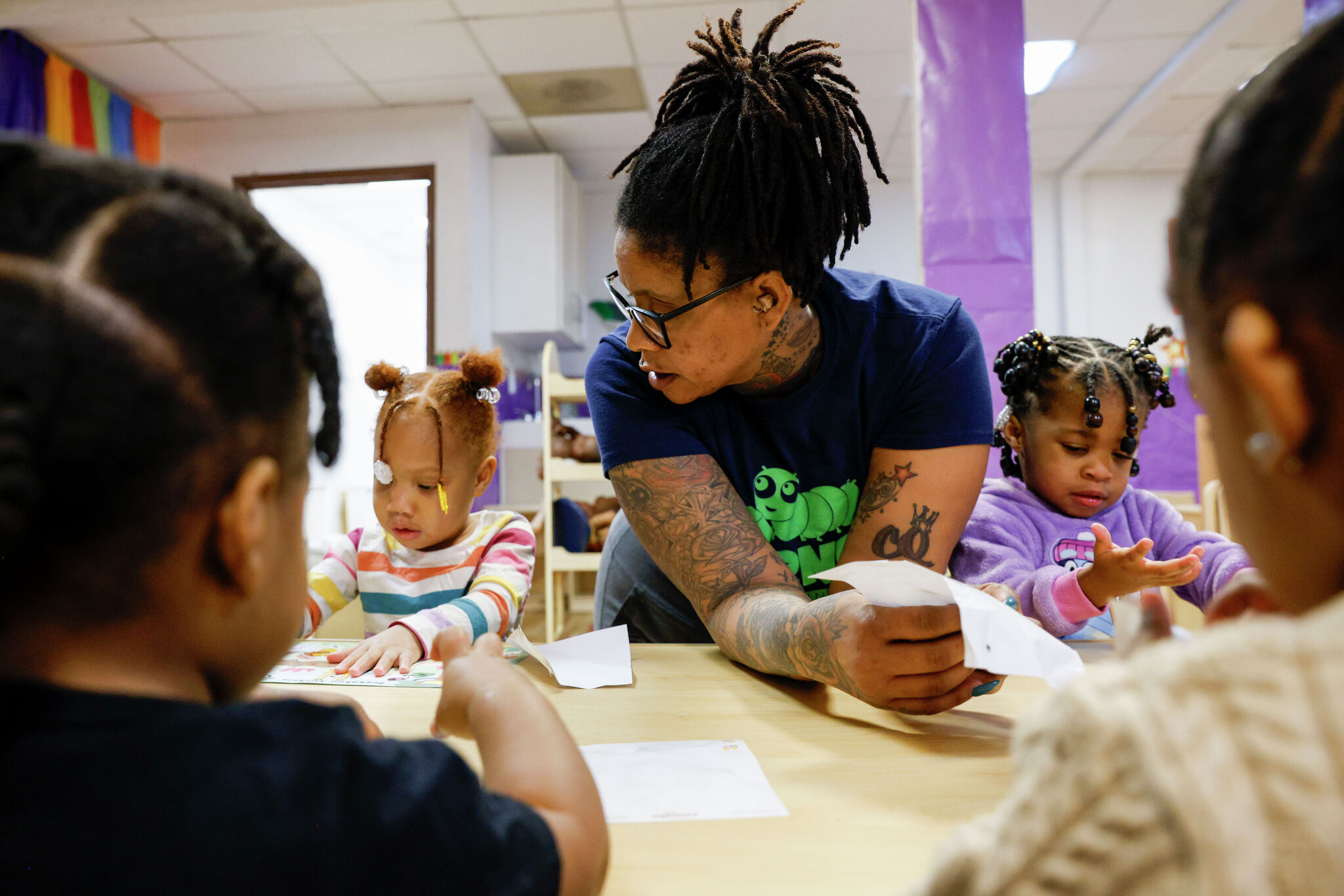
The Dallas County Commissioners Court hosted a full house of parents, pastors, nonprofit leaders and business representatives on Monday, many wearing red stickers that read “childcare supports working families.”
It’s not yet clear whether a childcare tax will reach the Nov. 3 county ballot, but the meeting’s turnout reflects the growing recognition of Texas’ childcare crisis. About 9,500 families are on a waitlist to receive childcare assistance through Workforce Solutions Greater Dallas, while childcare in Dallas County can cost about $11,000 a year for one child, according to the Living Wage Institute.
Hillary Evans, vice president of policy and advocacy at United Way of Metropolitan Dallas, told commissioners 83% of eligible Dallas County children cannot access affordable, high-quality care. Roughly 19,000 parents want to work but cannot because they lack reliable childcare, she said, while advocates estimate childcare shortages drain nearly $4 billion from the regional economy annually.
Related: From promise to paycheck: How Dallas is building a path to a living-wage future
“Too often, childcare is discussed only as a household expense, when in reality, it is a core economic infrastructure that supports parental employment, business stability and long-term educational success for children,” Evans said.
Melanie Rubin, director of the North Texas Early Education Alliance, explained that the proposed Dallas County Children’s Fund would levy a 3-cent tax per $100 of assessed valuation, which advocates said amounts to roughly $10 a month for the average homeowner. The tax could generate an estimated $132 million annually, most of it directed toward childcare scholarships and stabilizing infant and toddler classrooms.
Advocates asked the county to begin drafting ballot language and implementation plans this month, so commissioners could decide by early August whether to place the measure before voters in November.
But it remains unclear whether enough commissioners support putting the proposal on the ballot. As Rubin referenced Denver and other local models, Commissioner John Wiley Price cut in with a reminder of the limits Dallas County faces under state law. He suggested advocates may ultimately need statewide action from lawmakers in Austin.
Commissioner Elba Garcia praised the vision behind the plan but questioned whether the proposal could reach enough families. She pointed to New Mexico’s universal childcare model and argued “we need to look at the models that don’t disqualify anyone, that are fair for everyone.”
Business leaders argued employers are already paying for the childcare gap through higher turnover and unfilled jobs. Jeff Kitner, president of the North Dallas Chamber of Commerce, said companies across industries report that workers want to work but often cannot because they lack reliable childcare, particularly outside standard daytime hours.
Other speakers grounded the policy debate in personal experience. Tobitha Holmes, director and owner of W.I.S.E. Academy in Cedar Hill and president of the Early Education Leaders Coalition, warned providers are operating on margins so thin that “an unexpected expense could threaten” their survival.
Benjamin Bernardino, who said he benefited from affordable childcare as a child, told commissioners the support allowed his mother to continue her education and career while her children were safe.
“I’m not here because of luck,” he said. “I’m here because someone invested early. I am living proof that this system works.”
The advocates left without a firm commitment that a childcare tax will appear on the November ballot, but with evidence the proposal has drawn support from parents, nonprofits and business leaders.
Commissioner Andrew Sommerman, who chairs the Continuous Improvement Steering Committee and called Monday’s discussion, told The Dallas Morning News he was struck by the turnout and said the proposal still needs more work before reaching the full court. He also pushed back on calls for a statewide solution.
“Bluntly, I don’t think that that’s realistic,” Sommerman said.
“I don’t think the state is going to do anything, so I think it’s either on us or no one.”
This reporting is part of the Future of North Texas, a community-funded journalism initiative supported by the Commit Partnership, Communities Foundation of Texas, The Dallas Foundation, the Dallas Mavericks, the Dallas Regional Chamber, Deedie Rose, Lisa and Charles Siegel, the McCune-Losinger Family Fund, The Meadows Foundation, the Perot Foundation, the United Way of Metropolitan Dallas and the University of Texas at Dallas. The News retains full editorial control of this coverage.