
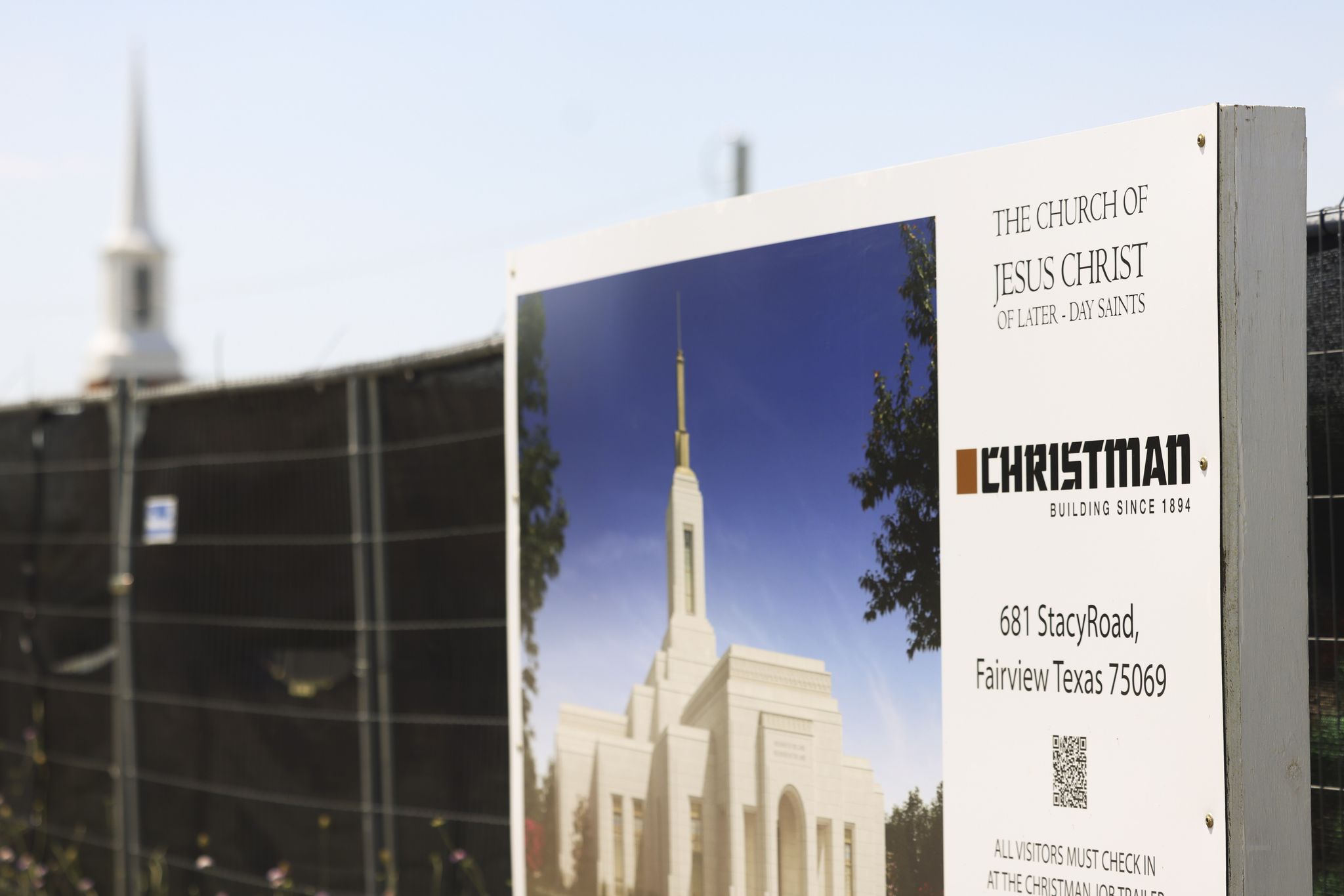
Many readers are familiar with the fact that our town of Fairview, where I serve as mayor, will be the site of a new temple for the Church of Latter Day Saints. I want to be clear that the people of Fairview have welcomed this temple in our community. But we continue to have deep concerns about the LDS plan to build a steeple at a height that is simply incompatible with the surrounding residential neighborhoods.
We asked the church to amend its plans to build a 120-foot steeple and fit with our town’s zoning requirements. That request was rejected by the LDS Church in a letter from Salt Lake City that said “… whether a steeple should exist at all is not for municipal authorities to decide…” or to put another way “mind your own business.”
In our view, a church with billions of dollars used a well-intentioned but deeply flawed federal law to bully an 11,000-person town. The Religious Land Use and Institutionalized Persons Act (RLUIPA) was passed in 2000 to protect minority congregations from discriminatory zoning. Its core protection: “No government shall impose or implement a land use regulation in a manner that imposes a substantial burden on the religious exercise of a person, including a religious assembly or institution, unless the government demonstrates that imposition of the burden on that person, assembly, or institution — (A) is in furtherance of a compelling governmental interest; and (B) is the least restrictive means of furthering that compelling governmental interest.”
But more than a quarter century after the law was passed, and through numerous lawsuits, the courts cannot agree on the definition of “a substantial burden.” Some federal circuits require near-total exclusion of religious activity before finding a violation; others treat nearly any permit denial as a potential violation. The Supreme Court has declined to resolve this split at least five times. So we have a statute with no settled meaning, enforced by a church whose legal team dwarfs our entire municipal budget. That is not law. That is leverage.
It gets worse. Under the law, a prevailing church can recover attorney’s fees from the losing municipality. Win or lose, the litigation costs could drain our reserves for years. That is not a fair legal system.
The church’s recent letter claims it already made “very significant concessions” reducing the steeple and cutting square footage by nearly a third, and that the Town Council approved the result by “supermajority.” Let me be precise: The council passed the settlement on a narrow vote under the threat of litigation pressure, not as an endorsement of the design. The town agreed not because the outcome was fair, but because the threat of ruinous legal fees left us no real choice. Our community knows it, and they are still angry.
Here is a question no one has adequately answered: How does the difference between a 100-foot steeple and a 120-foot steeple constitute a “substantial burden” on religious exercise?
The church operates approximately 350 temples worldwide. Most do not have 120-foot steeples. Some have none at all.
The steeple is a symbol, even a beautiful one, perhaps. But baptisms, sealings, endowments: None require a spire dominating the highest elevation in town. Asking for a compatible design is not a substantial burden on faith.
Until Congress or the courts defines that term, towns like Fairview are stuck. The settlement is signed, but this conversation is not over. We continue to ask the church to do the right thing to be a good neighbor in our town.
As people of all faiths pass through Fairview in the years ahead, what will this steeple say to them? Will it speak of a church that chose goodwill over legal advantage? Or will it stand as a monument to an institution that imposed its will on a small town that lacked the means to resist?
The church teaches that symbols matter. This steeple will be one. The question is what it will symbolize.
John Hubbard is the mayor of Fairview.