
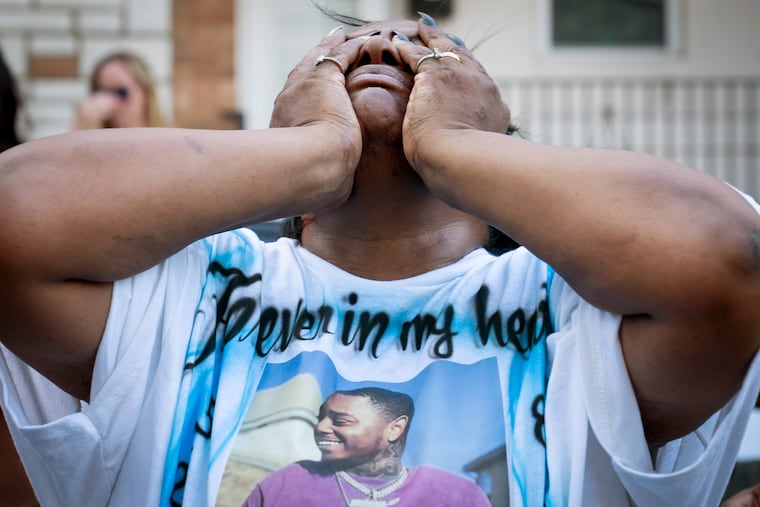
Every now and then, Kathi Camp would pull up a website with the list of Philadelphia’s most-wanted criminals and click on the photo of the man accused of killing her son.
“Just to see his face,” she said.
It had been more than three years since police said Marcus Whitehead, in a jealous rage, shot and killed 26-year-old Diniar Camp as he walked a woman home from a bar one night in August 2022.
Whitehead, 25, fled the state and evaded law enforcement for years, police said. In his absence, the most-wanted website became a sort of ritual for Camp, a way of holding onto something when the case felt like it was slipping away.
But finally, in the fall, Whitehead was arrested in Maryland and charged with Camp’s murder.
On Tuesday, Camp sat in a Philadelphia courtroom and, for the first time, came to face the man accused of killing her only son and upending her life.
Whitehead looked different from the man she had studied in that photo so many times, she said. His hair is closely cropped now, his beard trimmed short.
But his eyes, she said, are the same.
Diniar Camp was born and raised in South Philly but had moved to Nevada in 2022 to escape Philadelphia’s gun violence and pursue a career in music. He returned to the city a few months later for the funeral of a close friend who had been shot and killed in late July.
While visiting, he reconnected with a young woman he had been dating, and she joined him and his friends and family after the service. They went to a bar in North Philadelphia, and shortly after midnight, Camp offered to walk her home.
Meanwhile, the woman testified Tuesday, her ex-boyfriend, Whitehead, was calling and texting her, asking where she was, but her phone was off.
As they approached her mother’s rowhouse, near 19th and Berks Streets, she said, she saw Whitehead walk out from a dark alley with a gun in his hand.
She tried to stand between the men and calm Whitehead down, she said, but Camp pushed her out of the way.
Then, she said, Whitehead shot him.
Camp tried to pull his own legally owned firearm from the holster beneath his left armpit, she said, but Whitehead shot him repeatedly, killing him. Homicide Detective Kevin Bradley said he found Camp in the street, lying on top of his gun.
After the woman told police Whitehead was responsible, a warrant was issued for his arrest days later. But Whitehead was already gone. Bradley said he fled south and started selling drugs — and reconnected with the woman he is accused of killing Camp over.
In court Tuesday, the woman testified that she had moved out of Philadelphia after the shooting, and received texts from an unknown number with threats against her family and believed they were from Whitehead or one of his friends. Resuming her relationship with him, she said, was her way of trying to protect them. She never told police where he was staying — often, officials said, it was with her.
In June 2024, Whitehead was arrested in Maryland and charged with drug and gun trafficking, records show, and he was later extradited to Philadelphia to face charges of murder, illegal gun possession, and related crimes.
On the witness stand Tuesday, the woman was unflinching when recounting the night of the shooting.
“Are you confident in who shot Mr. Camp?” Assistant District Attorney Sean Perez asked.
“Marcus Whitehead,” she said calmly.
Municipal Court Judge Christine M. Hope found sufficient evidence for the case to proceed to trial.
Whitehead’s attorney, Samuel Stretton, cast doubt on the woman’s account throughout the hearing, saying she was trying to protect herself by implicating Whitehead. He declined to comment after the hearing.
Throughout the morning in court, Kathi Camp anxiously rocked back and forth in her seat.
So much of her life has changed since Aug. 6, 2022. She had gotten her real estate license that year and sold three homes, she said, but has not sold one since. She is too depressed to work.
She and her husband have divorced. At 59, she walks with a cane, cannot get her blood pressure down, and suffers from insomnia.
When she learned Whitehead was finally in custody, she said, she was relieved only briefly. It was the moment for which she had been waiting for so long, she said, and yet all she could do was cry.
“I just couldn’t stop thinking about how I don’t have him no more,” she said.
And ahead lies a new journey of waiting — in courtrooms, for trial dates, for justice.