
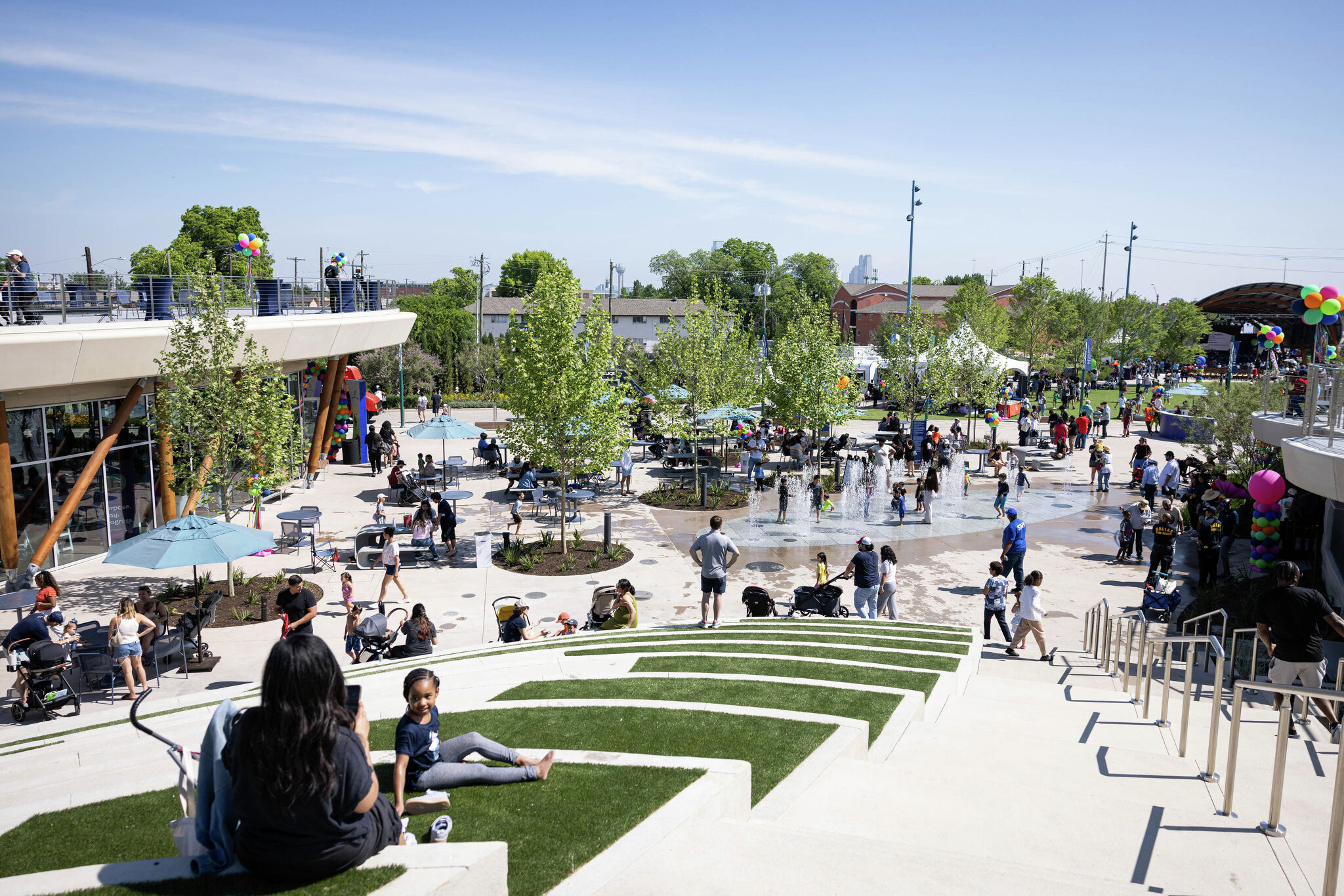
Hundreds of people flocked to Halperin Park, Dallas’ newest deck park, for its grand opening on Saturday. Kids climbed playgrounds and got soaked in water fountains while families enjoyed the sweeping views of downtown and Fair Park. Dallas was finally savoring the effort that it took to make Halperin Park a reality.
The cultural significance of the park — stretching over Interstate 35E, reconnecting neighborhoods in Oak Cliff that had been physically and economically separated for decades — cannot be overstated. This park has the potential to change Dallas for the better.
It’s already having an impact. As the park was being constructed, new developments were underway in east Oak Cliff, including the East Dock, a mixed-use project to repurpose a 1900s-era icehouse. We expect more positive changes in the surrounding neighborhoods in the years to come.
A few steps from the deck park is the Dallas Zoo, which is likely to benefit from the park’s presence, much like the Dallas Museum of Art benefited from its proximity to Klyde Warren Park, the city’s first deck park.
The $122 million first phase of Halperin Park, spanning 2.8 acres, is what’s now open to the public. Once its second phase is complete, the $300 million park will cap the highway between South Ewing and South Marsalis avenues. The second phase has already secured $87 million in funding commitments, and it is expected to be completed around 2029.
Halperin Park represents Dallas at its best, with the city’s philanthropic arm at the forefront. This was a true public-private partnership, with about 60% of the funding for the first phase coming from donors, including a generous $23 million gift from Gayle and Jim Halperin. Much deserved credit goes to April Allen, president and CEO of the Southern Gateway Public Green Foundation, who has shepherded this project.
Halperin Park stands now as the newest jewel in Dallas’ park system, ready to attract visitors from all over just in time for the World Cup. According to a University of North Texas at Dallas analysis, the park is expected to generate $1 billion in economic impact within its first five years.
This park is not only about its beauty and the new space it provides. More than anything, it’s about promise and opportunity.