
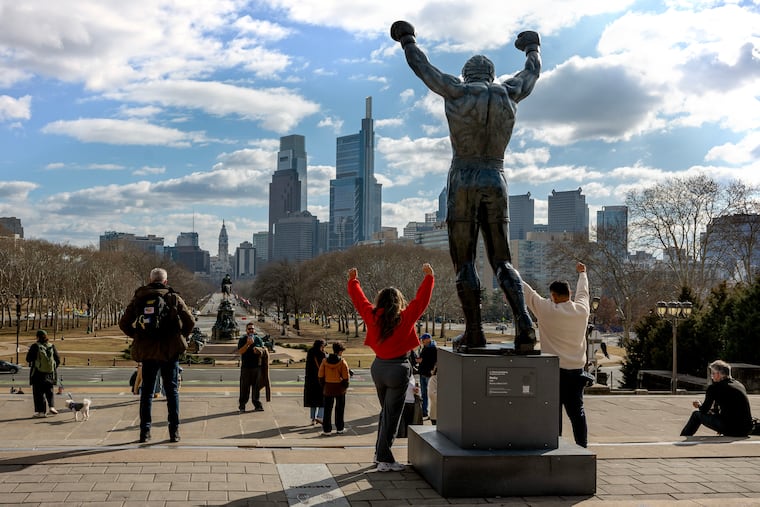
It seems strange to admit now, but there was a time in his life when Paul Farber turned his nose up at the city’s famed Rocky statue.
Never mind that he was a Philadelphian, born and raised (“I learned my first curse words in the 700 level at Veterans Stadium,” he said). Or that he entered the world the same year the statue first appeared on-screen, in 1982’s Rocky III. Or that he grew up listening to the Rocky theme playing during gym class.
“Why would I pay attention to this statue of a fictional character?” Farber remembered thinking.
It’s safe to say his thoughts on the matter have evolved.
On April 25, Farber, 43, will debut his curated exhibit, “Rising Up: Rocky and the Making of Monuments,” at the Philadelphia Museum of Art, a wide-ranging exploration of how monuments “are made and remade by artists, by communities, and by time.”
» READ MORE: Why is Stallone’s ‘Rocky’ statue still on top of the Philadelphia Museum of Art steps?
The exhibit, which runs through Aug. 2 in the museum’s Dorrance Galleries, comes on the 50th anniversary of the original Rocky film, and will delve deep into the city’s rich history with boxing, underdogs, and how monuments have changed — and not — with time.
At its core, the exhibit seeks to answer the same question Farber himself once had: Why, each year, do millions of people make the pilgrimage to honor, in Farber’s words, “the most famous Philadelphian who never lived”?
Each of the exhibit’s sections is intended to answer that question.
More than 150 pieces by some 50 artists — including Hank Willis Thomas, Carrie Mae Weems, and Andy Warhol — will be on display, along with artifacts dating 2,000 years. The exhibit will include an ode to the Blue Horizon, the legendary former Philly boxing venue, as well as local boxing icon Joe Frazier.
The collected works span disciplines, from sculpture and painting to drawings and photography.
» READ MORE: Stallone’s Rocky statue will be on top of the Philadelphia Museum of Art steps all month
It will also mark the first time the Rocky statue has been inside the museum.
“The Rocky statue is the most visited and photographed public artwork in Philadelphia,” Louis Marchesano, the Marion Boulton “Kippy” Stroud deputy director of curatorial affairs and conservation, said in a statement. “‘Rising Up’ is an opportunity for the art museum to reframe the narrative around Rocky and the steps, placing it in the context of Philadelphia’s civic and cultural identity.”
Farber’s fascination with — and expertise on — monuments is long-standing.
As cofounder of Philadelphia’s Monument Lab, a nonprofit studio devoted to public art, history, and design, he has regularly delved deeply into the subject. Three years ago, he co-curated an exhibit of monuments on the National Mall in Washington. That same year, his podcast for NPR/WHYY, The Statue, traced the compelling history of the Rocky monument and its place in Philadelphia lore.
Farber, who today serves as director of Monument Lab, credits his mother with ultimately changing his attitude toward the Rocky statue.
“She’s the one who took me off my high horse,” he said. “She basically said, ‘Pay attention to the line. Where else do you see people lining up every day of the year — no matter the weather, no matter the time of day — to be with a monument?’”
“I spent years just paying attention to the line,” he adds, “and the pilgrimage from people posing with the statue [or] running up the steps.”
He learned, too, just how deeply ingrained it is in the national consciousness: that some four million people visit the Rocky statue each year — around the same number that visit the Statue of Liberty, and more than twice the number of visitors to the Liberty Bell.
He recalls a story from his childhood, when his family hosted a foreign exchange student. After picking their guest up from the airport, they asked where in the city he wanted to visit.
“I want to go to the Rocky steps,” their visitor replied.
“When you think of a monument, you may think of a president or a leader or a general on horseback,” Farber said. “But when you look across history, you actually find boxers as monumental figures in ways that both exemplify triumph but also resilience and struggle.”
And that might be especially true here, in a city where a fictional underdog has, for decades, held an unshakable place in the civic imagination.
“I think there is something here that will actually give insight into the sports psychology of this city and the idea of underdogs,” Farber said. “Why do we root for underdogs? What does it mean to think of ourselves as underdogs?”
“Rising Up: Rocky and the Making of Monuments,” April 25-Aug. 2, Dorrance Galleries, Philadelphia Museum of Art, 2600 Benjamin Franklin Pkwy, philamuseum.org