
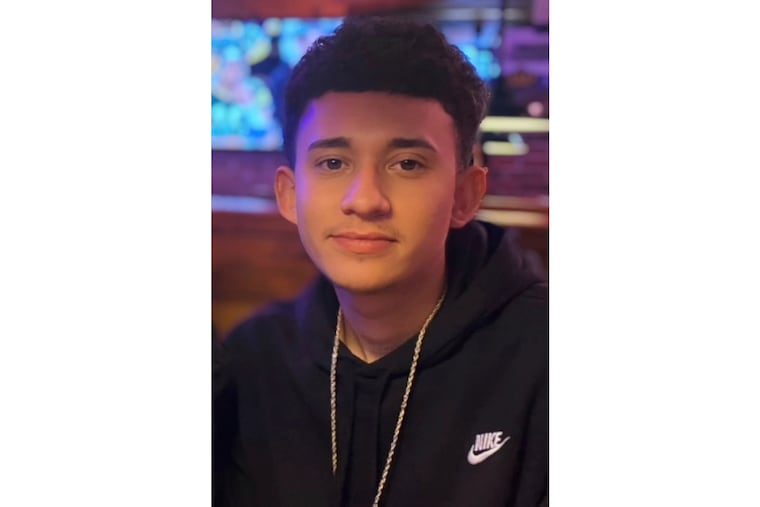
After the Texas Ranger knocked on her door and delivered the numbing news, Rachel Reyes realized she hadn’t thought to ask who shot her son. She figured it had been another Ranger that killed Ruben Ray Martinez, 23, after he allegedly failed to comply with a law enforcement officer’s orders.
But a week later, Reyes read an article from a local news outlet in South Padre Island that confused her. The police in that small, South Texas beach community were saying there had been an officer-involved shooting and a man was dead, but a separate, unnamed agency was responsible. Reyes called the Ranger who notified her and was now investigating the shooting: Who shot Ruben?
A Department of Homeland Security agent assigned to immigration enforcement was responsible, the Ranger said.
Reyes didn’t go public, instead deciding to await the results of the investigation by the Rangers, who are part of the Texas Department of Public Safety.
The March 15, 2025, killing of Martinez, a U.S. citizen, drew almost no public attention, even as protests erupted over the January shooting deaths of two U.S. citizens in Minneapolis — Renée Good, a mother of three, and Alex Pretti, an ICU nurse. South Padre Island Police put out a news release on Martinez but did not identify the agency responsible for his death. A two-sentence police report described Martinez striking a federal agent with his vehicle but did not mention the shooting that allegedly happened a moment later.
Texas officials, citing their ongoing investigation, declined to release footage of the incident. DHS did not publicly acknowledge that one of its agents had fatally shot Martinez until last month, when a lawsuit over a year-old public records request unearthed an internal narrative of the shooting by a Homeland Security Investigations agent. The request by American Oversight, a nonprofit government watchdog group, sought internal emails from the agency containing a variety of phrases and words, including “use of force.”
Martinez is now the first known American citizen shot to death by federal immigration agents during President Donald Trump’s second term.
Some Texas lawmakers are expressing alarm at the lack of transparency, demanding a public hearing and immediate release of all body-camera footage and other records. They have also raised concerns about conflicting information between DHS’s account of the shooting and a witness statement describing what happened.
“When government uses its most serious power, the power to take a life, the facts cannot remain hidden,” said State Rep. Ray Lopez, a Democrat whose district includes the city of San Antonio, where Reyes lives. “A young Texan lost his life, and the public was left without full clarity for nearly a year. That is not about politics. It is about trust.”
Michael Sierra-Arévalo, an associate professor at the University of Texas who studies policing and use of force, said DHS’s failure to promptly disclose the shooting to the public fits a pattern during the Trump administration, in which officials have at times taken extraordinary measures to defend and shield immigration officers who use deadly force from scrutiny.
“This was very much known to local authorities. What they were burying was that it happened with this particular agency,” Sierra-Arévalo said. “The ability for federal law enforcement to not be subject to the same sort of oversight that local law enforcement experiences when they’re involved in these incidents in collaboration with local police underscores the danger of federal police operating with practically unchecked power.”
Many states, including Texas, have passed laws requiring police departments to report shootings to oversight agencies, but there is no federal statute mandating a similar protocol.
A spokesperson for U.S. Immigration and Customs Enforcement, which includes Homeland Security Investigations, said the department’s policy requires that agents report every use-of-force incident. They are then reviewed “in accordance with agency policy, procedure, and guidelines.” Shootings, the spokesperson said, are first examined by “an appropriate law enforcement agency” and then ICE conducts an internal review.
A DHS spokesperson declined to explain why the shooting of Martinez was not publicly acknowledged by the department for 11 months. The agency documents released through the records request state that Martinez’s car struck an agent and lifted him onto the hood of Martinez’s vehicle. In a statement that followed that disclosure, a DHS spokesperson said Martinez “intentionally ran over” the agent and that another agent shot and killed him.
Those words shocked Reyes — they seemed disconnected from the young man she raised, from the story Martinez’s friend and a witness to the shooting told her, and from the narrative the Ranger shared in her living room in San Antonio, several hours after the killing. He said Martinez had tapped an officer with his car and was shot multiple times in response. No one was injured, Reyes said the Ranger told her.
The Texas Department of Public Safety did not respond to requests for comment on Reyes’s recollection of the Ranger’s account.
Reyes, a 48-year-old mother of three and a nurse for a medical insurance company, said she voted for Trump in 2024 and “doesn’t have a strong position” on immigration enforcement. But she does not like how officials have handled her son’s death.
“I don’t really have anything negative to say about Trump. He wasn’t the one who pulled the trigger — it was the department. How they’re handling it is irresponsible.”
Conflicting narratives
When she first learned of Martinez’s death, Reyes assumed her son had been in a car accident.
“Ruben was really nice,” Reyes said, “and he didn’t have enemies or make enemies or get in fights, so I would never in my wildest dreams imagine that someone would want to hurt him.”
He’d left the house at 2 p.m. without telling his mother where he was going. He’d just turned 23, and later, she realized, had likely kept his plans from her because she wouldn’t have approved of him celebrating his birthday in South Padre Island, which has a reputation for rowdy nighttime partying during spring break.
Joshua Orta, a friend who was in the passenger seat when Martinez was killed, later told Reyes they’d gone to a bar. Driving to their next destination, they approached the scene of a traffic accident where first responders including the South Padre Police and Homeland Security agents were directing traffic. A Ranger saw an open container of alcohol in the vehicle, Orta said. The Ranger questioned the men about it, but ultimately told them to move along.
But other officers began shouting, Orta said. Reyes said the Ranger told her that Martinez failed to follow instructions from the officers to stop his car, the car “tapped” an officer and another officer opened fire, killing Martinez.
Reyes asked if the officer was OK. The officer was “shaken up” but not injured, the Ranger said, according to Reyes.
Orta, in a written statement provided to lawyers for Reyes, disagreed with that account: “I was present, and I state clearly and without hesitation that Ruben did not hit anyone,” Orta wrote. “The trooper seemed to be trying to get in front of the car, like he wasn’t moving out of the way when we tried to turn around and leave like the police officer told us to do.”
The DHS narrative paints a different picture.
Officers and agents commanded Martinez to exit the vehicle, according to the documents released via FOIA, and Martinez “accelerated forward, striking a HSI special agent who wound up on the hood of the vehicle.” Then an agent shot Martinez through his driver’s side window.
Martinez was transported to Valley Regional Medical Center in Brownsville, Texas, and pronounced dead, according to the documents.
“The special agent who was struck was taken to a hospital for treatment of a knee injury and was later released,” the internal DHS report states.
Orta had been planning to participate in the family’s legal fight for transparency and civil compensation, lawyers for Martinez’s mother said, but was killed in February in an unrelated, fiery vehicle crash in San Antonio.
Reyes said the description of her son, paired with DHS statements following the shooting, have been difficult to stomach without seeing the evidence for herself.
“I was told there’s no injuries and that someone was tapped. That’s completely different from being told a human was ran over,” Reyes said. “That’s upsetting. It’s hurtful and inappropriate.”
‘A pattern’
For answers, and evidence, Reyes first reached out to the South Padre Island Police Department. They pointed her to the Texas Department of Public Safety, who turned her back to the Ranger handling the investigation, who said he couldn’t share any more information.
“I was just going in circles,” Reyes said. “I just didn’t know anything because I didn’t know what I could do. I felt like I was kind of helpless. I decided to just trust the process and wait to hear from him.”
Then a life insurance claim through Martinez’s employer was denied, citing the government’s claim that Martinez injured an officer. Reyes eventually retained a team of attorneys to investigate the case. They have been filling records requests and exploring potential civil actions against DHS.
Meanwhile, Reyes has been watching DHS’s actions in other cities around the country and wondering if her son’s death is not part of a pattern. Trump administration officials quickly labeled Good and Pretti “domestic terrorists” before investigations were conducted. Witness videos analyzed by the Washington Post conflict with official statements regarding both incidents.
“I thought that was callous and awful to call that woman a domestic terrorist because obviously that’s not what she was doing,” Reyes said, referring to Good. “You start to see things in a different light. There’s a pattern here of them using these statements to characterize these people, and to justify their agents’ actions, and I think that’s awful.”
Reyes said she’s prepared to fight for accountability if the same is true for her son.
On Feb. 25, days after news organizations broke news that a HSI agent was responsible for the killing, the Cameron County district attorney convened a grand jury to consider whether to press charges against the agent who fired at Martinez.
The grand jury, shown video of the incident that has not yet been made public, declined to indict the agent. The Texas Department of Public Safety, which has declined to release video of the incident while the investigation is ongoing, said that its investigation is now complete and the department is completing “proper redactions” before releasing the video.
Reyes said she won’t watch it. She plans to have people she trusts explain what happened. If video shows the government’s claims to be true, she said, “then I’ll have to live with that. I just want to know.”
Martinez’s wake was standing room only, Reyes said. An uncle gave his eulogy, drawing from Corinthians a passage that resonated with his mother: “To be absent from the body is to be present with the Lord.”
She considered burying his body, but opted instead to bring Martinez home, “where it’s safe,” she said. She had Martinez cremated and first set the urn on the dresser in his bedroom, then she brought him to a living room shelf to sit beside a framed picture of him smiling at her birthday dinner two years ago. Martinez never liked to hang out in his room, she said. He preferred to be with his family.