
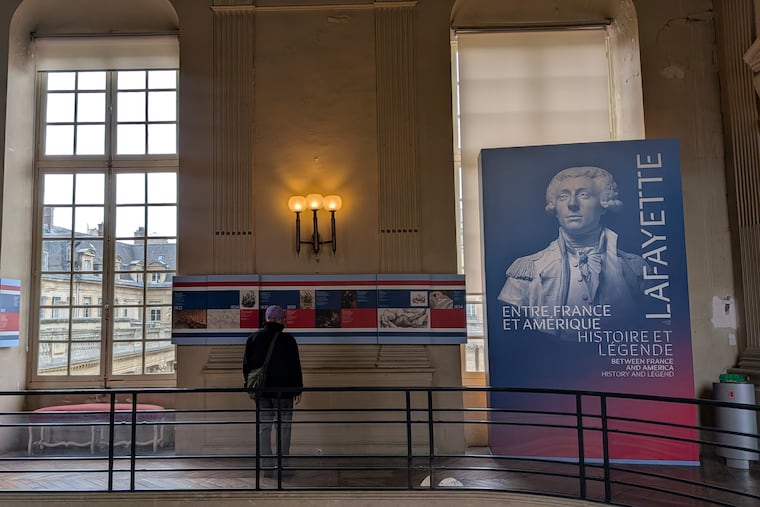
PARIS, FRANCE — On a recent sunny May morning, Parisian middle schoolers had found a curious selfie point. Not a tourist landmark, not a kitschy backdrop, and not a mirror booth.
But the long Rococo staircase of the 14th century Hôtel de Soubise, which houses the Museum of the National Archives of France, plastered with the face of Marquis de Lafayette, the French military officer who died in 1834.
“This has become a selfie hot spot somehow,” said Alexandra Hauchecorne, the technical director of the ongoing “Lafayette, between France and America: History and Legend” show at the museum.
Lafayette — both before and after Lin-Manuel Miranda’s Hamilton — is a celebrated hero in America. Textbooks record that he was only 19 when he came to America in 1777 to join the Continental Army under George Washington. He fought for American independence, participated in the Battle of Brandywine and the Siege of Yorktown, faced the harsh winter of Valley Forge, convinced the French King Louis XVI to send more troops to the country, and developed a deep relationship with Washington — so much so that Lafayette named his only son, George Washington.
And of course, Lafayette has also become the de-facto author of the catchphrase “Immigrants… We get the job done” by way of Daveed Diggs playing him in Miranda’s immensely popular musical; a phrase splashed on countless tote bags and hashtags.
In France, however, “Lafayette was not regarded the same way as he is here,” said Olga Anna Duhl, professor of French and Comparative Literature at Easton’s Lafayette College, and one of the exhibition’s curators.
His involvement in the French Revolution and desire to have France be a constitutional monarchy, as opposed to a republic like America, made him a target of criticism from both the left and right of the French political system. He was perceived as a traitor and eventually forced to flee the country. Lafayette was imprisoned first by the Austrians and then by the Prussians, who (ironically) considered him a rebel.
With it being the American Semiquincentennial, Duhl “thought that it would be wonderful” to have an exhibition in Paris and “educate the French people, and any person who comes to visit” about Lafayette.
In France, she said, “you study history, then you go into his life, and especially his American side. But you know very little about his French contribution, which is very paradoxical.”
The exhibition encompasses five rooms color coded to fit the years of Lafayette’s life — yellow, the color of the Continental Army uniform, to tell the story of Lafayette’s years in America; red denoting the American Revolution; green to denote Lafayette’s years in semi-retirement in France that he spent gardening and practicing agriculture, often experimenting with seeds from America; a light blue to mark Lafayette’s triumphant return to America in 1824; and a darker blue to denote monarchy and Lafayette’s last years that he spent backing King Louis Philippe I and supporting other revolutions.
The red room—the most interesting one—builds Lafayette up as the American hero he became. Among other artifacts, it includes a letter Ben Franklin wrote to him on behalf of the Philadelphia Philanthropic Society in 1788.
“Most of our Legislators have already abolished the Slave Trade,” it reads, “…But from the influence of narrow prejudices and jealousies there is too much reason to apprehend that nothing effectual will be done in this business untill France concurs in it, of which we cannot but entertain the most pleasing expectation.”
Franklin enclosed copies of the Constitution for Lafayette’s perusal, only six months after Franklin had James Wilson read aloud his closing speech at the Constitutional Convention, because of Franklin’s failing health.
A letter written to George Washington by Lafayette on March 17, 1790 is on display too. Along with the letter, Lafayette sent his mentor the key to “that fortress of despotism” that was the Bastille. Thomas Paine, who carried this extraordinary gift, said, “That the principles of America opened the Bastille is not to be doubted, and therefore the Key comes to the right place.”
Also on display in the room are lampoons and letters that speak to the immense distrust both the aristocrats and democrats had of Lafayette.
“If this is the eldest child of Liberty, he is murdering his mother,” a letter reads. “Lafayette treated as he deserves by democrats and aristocrats,” reads a lampoon showing the French Lieutenant Général being hung by a noose by two men on his either side.
Lafayette, on his part, was a canny self promoter. He hired several publicists who defended his public image and recruited people to clap at his speeches. In what would be classified as merch today, his face would often adorn fans, buttons, and commemorative plates.
In the light blue room marking his triumphant return to America in 1824, several objects — pitchers, tea sets, baby shoes, shoeshine brushes — emblazoned with his face and name are on display.
As Lafayette’s reputation in France remained checkered at best, many of these branded memorabilia were found in the homes of Philadelphia, which was a prominent stop in Lafayettes’ “Farewell Tour” of all of the Union’s 24 states. An invitation to the Lafayette Ball held in Philadelphia in 1824 hangs on the wall.
Much of the artifacts come from the collection of Lafayette College, which is the only college in the U.S. named after him. More streets and public places in the U.S. are named after Lafayette, than any other foreigner. In Paris, about six hours away from Chateau Lafayette where he lived, only Rue La Fayette, one of the city’s longest streets, bears his name.
That and a glitzy shopping mall with 10 floors, best known for its rooftop views of the city.
“Lafayette is very well known [in France] but not as a historical figure,” said Duhl. “And one of the educational aims of this exhibition is to educate people about this compelling figure … so that the new generation can really develop an idea about who Lafayette really was, because he has disappeared basically from manuals.”
On a weekday morning, there was a mixed bag of visitors to the exhibition that, Hauchecorne said, was a rare bilingual event at the Archives. Parisians and school children have been visiting, as have Americans on vacation; to know more about the man who has been shown rapping lines that are becoming of his high self-esteem: “No one has more resilience or matches my practical, tactical brilliance!”
Even though previous exhibitions have not had much materials translated into English, the Archives, which houses records dating back to the 1st millennium, has had Americans dropping in before.
Most notably: Tom Cruise performing a motorcycle stunt as Ethan Hunt in Mission: Impossible — Fallout (2018).
“Lafayette between France and America: History and Legend” runs through July 14 at Musée des Archives Nationales, 60, rue des Francs-Bourgeois, 75003 Paris. archives-nationales.culture.gouv.fr