
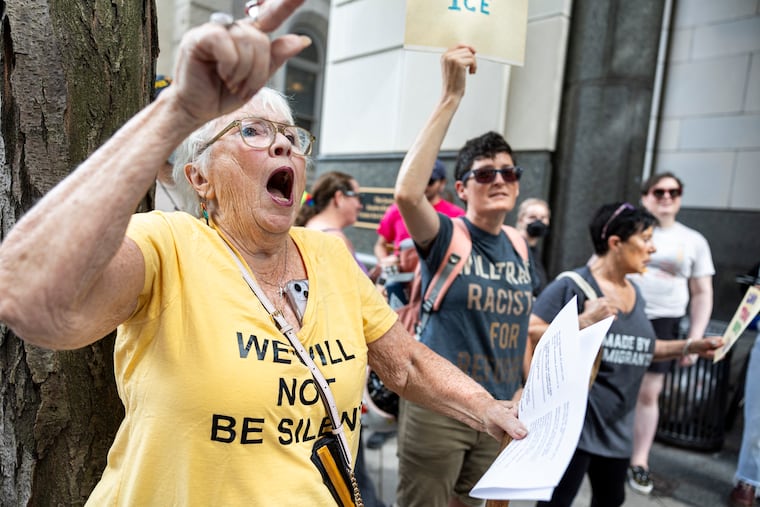
Activists will rally outside the Philadelphia Criminal Justice Center on Thursday to press their assertion that ICE has been allowed to turn the courthouse into “a hunting ground” for immigrants.
The noon demonstration crystalizes months of contention between activists and lawyers who say the courthouse must be a place to seek and render justice ― not to target immigrants ― and federal authorities who insist that making arrests there is legal, safe and sane.
No ICE Philly, the rally organizer, says ICE agents have been enabled to essentially hang out at the Center City courthouse, waiting in the lobby or scouring the hallways, then making arrests on the sidewalks outside, a pattern they say has been repeated dozens of times since President Donald Trump took office in January.
Many people who go to the courthouse, the group noted, are not criminal defendants ― they’re witnesses, crime victims, family members, people dealing with alleged offenses like shoplifting or trespassing and others who are already in diversionary programs.
No ICE Philly, a newer group whose last demonstration saw four people arrested, says immigration agents must be barred from the property. They want Sheriff Rochelle Bilal to meet to discuss changes.
“We want to put the sheriff on notice that we’re watching,” said Aniqa Raihan, a No ICE Philly organizer. “We want to raise awareness of the fact … that ICE is using the courthouse as a hunting ground.”
As word of plans for the demonstration spread, Bilal issued a statement aimed at “addressing public concerns” around ICE activity.
“Let me be very clear: the Philadelphia Sheriff’s Office does not partner with ICE,” the sheriff said. “Our deputies do not assist ICE, share information, or participate in immigration enforcement.”
Deputies verify the credentials of ICE agents entering the courthouse ― and those agents are not permitted to make arrests inside courtrooms or anywhere inside the courthouse, she said.
Raihan and other advocates say that’s no protection. ICE agents linger in the lobby, they said, then follow their target outside and quickly make the arrest.
In April, The Inquirer reported that a Philadelphia police officer escorted a Dominican national out of the courthouse and into the custody of federal authorities shortly after a judge dismissed all criminal charges against the man.
A Police Department spokesperson said at the time that the Spanish-speaking officer offered to walk with the man to help translate, but did not detain him. The Defender Association of Philadelphia and others questioned how the incident squared with the city’s sanctuary policies.
Immigration and Customs Enforcement officials in Philadelphia did not immediately reply to a request for comment.
Whitney Viets, an immigration counsel at the Defender Association, said ICE agents are at the courthouse almost every day, and arrests occur there almost every day.
The government does not publicly release data detailing where most immigration arrests occur, but Viets estimated that dozens of arrests have taken place since the start of the year. Masked plainclothes agents are seen outside the building, in the lobby, in courtrooms, and in hallways, she said.
“Agents are effectively doing enforcement in the courthouse, though identification,” she said.
She explained that an agent may identify a person they’re seeking in or near a courtroom, then either follow them outside or else alert other agents who are already waiting on the sidewalk.
It’s unclear where ICE is obtaining information on who will be at the courthouse on any particular day, although some details about ongoing criminal cases are available in public records. One result of ICE enforcement, she said, is people are afraid to come to court.
“This is about whether our justice system operates effectively,” Viets said. “The actions of ice have gotten brazen … What we need at this time is public engagement against this activity.”
This week No ICE Philly decried ICE “kidnappings” and demanded the sheriff “protect everyone inside and outside the courthouse,” including “immigrants targeted by ICE as well as citizens observing and documenting ICE arrests.”
The Philadelphia Sheriff’s Office is in charge of courthouse security. However, Bilal said, her office has no authority to intervene in lawful activities that are conducted off of the property.
“Inside the courthouse, everyone’s rights and safety are protected equally under the law,” she said. “We are law enforcement professionals who follow the law.”
A spokesperson said the sheriff had no additional comment on the matter.
In Philadelphia and places around the country, courthouses have become disputed locales as the Trump administration pursues ever-more-aggressive arrest and deportation policies.
Under President Joe Biden, limits were set on what ICE could and could not do at courthouses. Agents were permitted to take action at or near a courthouse only if it involved a threat to national security, an imminent risk of death or violence, the pursuit of someone who threatened the public safety, or a risk of destruction of evidence.
Even then, advocacy groups accused ICE of violating the policy by arresting people who were only short distances away from courthouses.
The Biden restrictions on ICE vanished the day after Trump took office.
The new guidance said agents could conduct enforcement actions in or near courthouses ― period. The only conditions were that agents must have credible information that their target would be present at a specific location, and that the local jurisdiction had not passed laws barring such enforcement.
The guidance said that, to the extent practicable, ICE action should take place in non-public areas of the courthouse and be done in collaboration with court security staff. Officers should generally avoid making arrests in or near family or small-claims courts.
The Department of Homeland Security said the Biden administration had “thwarted law enforcement” from doing its job, that arresting immigrants in courthouses is safer for agents and the public because those being sought have passed through metal detectors and security checkpoints.
“The ability of law enforcement to make arrests of criminal illegal aliens in courthouses is common sense,” Assistant Secretary Tricia McLaughlin said earlier this year. “It conserves valuable law enforcement resources because they already know where a target will be.”
The issue cuts deep in Philadelphia, which has stood as a strong sanctuary city and welcomed immigrants who were sent here by the busload by Texas Gov. Gregg Abbott in 2022 and early 2023.
Philadelphia city officials have said repeatedly that they do not cooperate with ICE, and that the sanctuary-city policies created under former Mayor Jim Kenney remain in place under Mayor Cherelle L. Parker.
Nationally, nearly 10 months into the Trump administration, some Democratic jurisdictions are acting to tighten ICE access at courthouses.
In Connecticut this month, state lawmakers passed a bill to bar most civil immigration arrests at courthouses, unless federal authorities have obtained a signed judicial warrant in advance.
The Senate bill, already approved by the House, also bans law-enforcement officers from wearing face coverings in court, Connecticut Public Radio reported. Democratic Gov. Ned Lamont is expected to sign the measure.
Last month in Chicago, which has faced weeks of controversial immigration enforcement, the top Cook County judge barred ICE from arresting people at courthouses. That came as federal agents stationed themselves outside of courthouses ― drawing crowds of protesters, CBS News reported.
On Monday a federal judge dismissed a Trump administration challenge to a New York law that barred the immigration arrests of people going in and out of courthouses. New York passed the Protect Our Courts Act in 2020, during Trump’s first term, which the administration said had imposed unconstitutional restrictions to enforcement, The Hill reported.
In July the Latino advocacy group Juntos shared a video of a man being violently arrested by agents outside the Philadelphia courthouse, prompting fresh attention to ICE activity there.
Efforts to reach Juntos leaders were unsuccessful this week.
The Thursday rally marks the third recent protest by No ICE Philly, which seeks to stop agency activity in the city. The organization’s Halloween Eve demonstration outside the ICE office in Center City erupted into physical confrontations with police, with several people pushed to the ground and four arrested.
That came after some demonstrators attempted to stop ICE vehicles from leaving the facility at Eighth and Cherry Streets.
No ICE Philly organizers said that on Thursday they plan to bring signs depicting magnifying glasses to the Criminal Justice Center, to symbolize scrutiny and oversight.
“There are people watching, we have eyes on this,” Raihan said, adding that ICE is “allowed to hang in the lobby, sometimes in the courtrooms.
“Somehow they seem to know when somebody vulnerable is in the courthouse. … We’re concerned with how they’re finding out that information.”
This is a developing story and will be updated.