

Media members gather in front of Collin County Courthouse, Friday, June 5, 2026, in McKinney during Karmelo Anthony’s trial. Anthony is charged in the stabbing death of student-athlete Austin Metcalf at a Frisco ISD track meet last year.
Chitose Suzuki/The Dallas Morning NewsMcKINNEY — Jurors on Friday got their first glimpse of the pocketknife prosecutors say Karmelo Anthony used to fatally stab Austin Metcalf.

Collin County Assistant District Attorney Bill Wirskye pulled on black gloves to display the knife: A 3.5-inch black blade with a textured silver handle, small enough to fit in a palm and to legally carry on school grounds in Texas.
The outcome of the case could hinge on how the jury views the weapon, and whether they believe Anthony’s decision to use it on the unarmed Metcalf was justified.
Article continues below this ad
Student-athletes who saw the incident unfold testified that Anthony, now 19, had his hand in a backpack before the altercation. They said they thought he was bluffing and were shocked when he pulled out the knife.
“No one brings a knife to a track meet,” a 16-year-old student-athlete testified under questioning from Wirskye. District Judge John Roach Jr. forbade media outlets from naming him or other minors called as witnesses.
The case, which has drawn national attention, racially charged demonstrations and online animus, centers on a dispute last year that began when Metcalf and others told Anthony to leave their team’s tent during a rain-delayed high school track meet in Frisco.
Anthony’s attorneys have argued he acted in self-defense, making a split-second decision in the face of a threat from teenagers who were taller and larger than he was. Prosecutors say Anthony baited Metcalf into the altercation as a pretext to use the knife.
Article continues below this ad
Earlier in the day, jurors watched an officer’s body-worn camera footage from the moments after the stabbing, showing paramedics tending to Metcalf as he lay motionless at the base of the metal stands.
The judge allowed a prolonged break after the video was played, he said, because it made one juror feel sick.
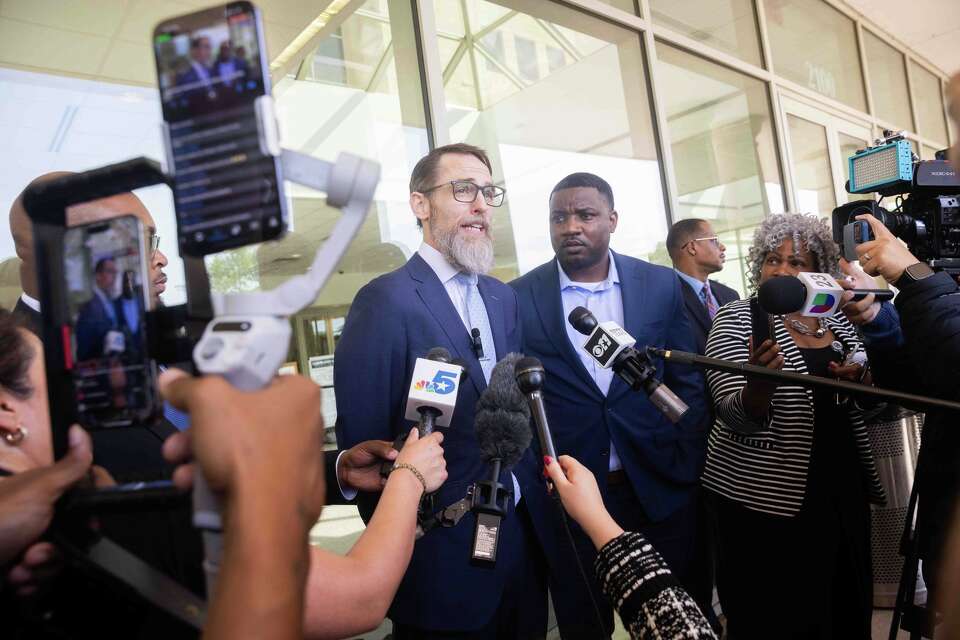
(From left) Mike Howard, attorney for Karmelo Anthony, speaks to reporters as Dominique Alexander, president and CEO of Next Generation Action Network (NGAN), stands next to him following a bond hearing in Anthony’s case at the Collin County Courthouse in McKinney, TX on Monday, April 14, 2025. Karmelo Anthony, 17, a Frisco Centennial High School student and football player, is accused of stabbing Austin Metcalf, also 17, to death at a track meet earlier this month.
Juan Figueroa/Staff PhotographerStudent witnesses with differing accounts have same conclusion
Friday’s testimony moved closer to the confrontation under the Frisco Memorial High School tent.
Article continues below this ad
In a demonstration for the jury, one of Anthony’s defense attorneys, Toby Shook, sat in a chair in the middle of the courtroom to allow the 16-year-old to reenact the moment Metcalf was stabbed.
The student, standing over Shook, placed a hand on Shook’s right shoulder. At the same time, Shook, portraying Anthony, stood up, simultaneously acting out a stabbing motion on the student’s upper chest.
Because he had moved toward Anthony to shove him, the student said, Metcalf was leaning into Anthony when the stabbing occurred, and fell backward directly after.
Metcalf, another student testified, fell down the bleachers, landing on his back. He stood up briefly, lifting his shirt to find his chest covered in blood.
Each subsequent student who testified shared slightly differing memories of the moments leading up to the stabbing.
Article continues below this ad
Jalen Matthews, who graduated from Frisco Memorial earlier this year, described Anthony as being “half in, half out” of the tent, recalling the awning didn’t quite cover Anthony enough to shield him from the rain.
Matthews, 18, described Anthony and Metcalf’s interaction as tense, finding them both more frustrated than angry. Matthews said he noticed Anthony’s hands were in his backpack, but said no one expected the exchange to turn violent.
A 17-year-old student who took the stand said Anthony was not sitting under Memorial’s tent, but rather directly behind it. The student said several people told Anthony to leave more than a dozen times.
If he wasn’t under the tent, what was the problem with that?” Shook asked the 17-year-old during cross-examination.
“Relative area,” the student said.
Article continues below this ad
The 16-year-old student said Metcalf used one hand — not two — to shove Anthony in the seconds before he was stabbed.
Each student was asked whether Anthony provoked Metcalf.
They all identified Anthony as the aggressor and said they did not believe the stabbing was an act of self-defense.

A photo of Austin Metcalf, sits over the mantel at his residence on, Thursday, April 3, 2025 in Frisco. Austin was killed after he was fatally stabbed during a high school track meet in Frisco on Wednesday, April 2, 2025.
Officer who detained Anthony testifies
Eduardo Cortez, a school resource officer assigned to Frisco ISD’s Staley Middle School, testified that he ran to the nearby stadium after hearing a radio call about a stabbing. Cortez said he located Anthony and placed him in handcuffs.
Article continues below this ad
Under questioning from Wirskye, he said Anthony did not try to run.
During cross-examination, Anthony’s lead defense attorney, Mike Howard, honed in on his client’s demeanor, noting he could have refused to give his name or given a false one when detained. Cortez agreed the teenager was cooperative.
Wirskye presented a replica of the knife to the jury while questioning Frisco police officer Jacob Shalz, who secured the scene and collected evidence on the day of the stabbing.
When Shalz passed to Howard for cross-examination, Howard asked the officer if he was aware that while a knife under 5 and a half inches may violate school policy, it’s not a crime.
“Yes, sir,” Shalz affirmed.
Texas law does not ban every knife from school campuses or school-sponsored events. Criminal charges apply to what the law refers to as “location-restricted knives,” defined as one with a blade longer than 5 and a half inches.
Eric Ruben, a Southern Methodist University law professor who studies weapons regulations and how they intersect with self-defense laws, said the lawfulness of a weapon is often a separate question from whether someone was justified in using it.
Ruben said that in cases with self-defense claims, the use of a weapon can raise questions about why the defendant had it and whether they were looking for a fight.
“It speaks to the reasonableness, it speaks to state of mind,” he said, “and that’s incredibly important in a self-defense case when the jury has to decide whether the threat perception was reasonable and whether the response was reasonably believed to be necessary and proportionate.”
The trial is set to resume at 9 a.m. Saturday.