
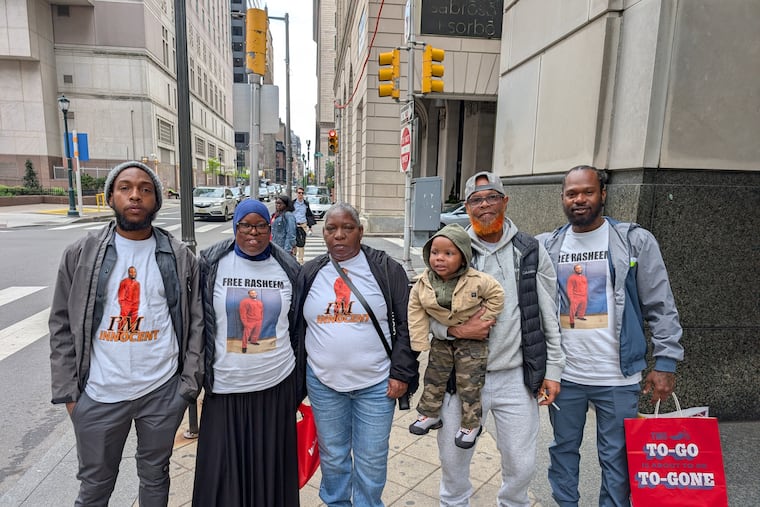
Since his 2010 murder conviction in a fatal North Philadelphia shooting, Rasheem Hall has insisted that he didn’t commit the crime.
His defense attorneys say Hall, now 42, was not at the scene when 34-year-old Ronald Kennel was shot in the head on the 1600 block of West York Street in 2007.
The witness who identified Hall as a shooter was an unreliable jailhouse informant, his lawyers said — one who later recanted the statements he made to prosecutors and detectives and apologized to Hall, a childhood friend, for implicating him in the crime.
In a Philadelphia courtroom on Wednesday, Common Pleas Court Judge Rosemarie Defino agreed with Hall’s lawyers that based on newfound evidence, the murder case should be retried.
“The jury didn’t know the whole background on this witness,” Defino said before ordering that Hall be granted a new trial.
The district attorney’s office has 30 days to decide how to proceed. A spokesperson for the office declined to comment Wednesday.
Hall will remain incarcerated pending those developments. But family members, sharing hugs after the ruling, said the decision offered hope that Hall will one day return home.
Some wore “Free Rasheem” T-shirts emblazoned with a photo of Hall in an orange prison jumpsuit.
“I’m happy and hoping everything goes well from here on because I know my son is innocent,” said Rasheem’s father, Ronald. The past 18 years had been “a hurting thing,” he said.
Hall’s attorney, Robert Gamburg, presented what he called “explosive, exculpatory” evidence that he said would have altered the outcome of the case had it been presented at trial.
That included a prison phone call between the informant, Derrick Williams, and his mother in 2009 in which he told her Hall “wasn’t there” when Kennel was killed.
“I [expletive] up,” Williams said during the call, according to transcripts of the conversation introduced in court. “Like, [Hall] wasn’t there. Like, I kept telling the [expletive] detectives he wasn’t there, and they kept saying he was, and I told them he wasn’t, but they said he was.
“I need to fix this [expletive] before he goes to [expletive] court,” Williams later said during the call.
Gamburg said prosecutors had acted improperly when — after discovering the recordings in 2013 during another case in which Williams was an informant — they did not hand them over to Hall, who by then had appealed his conviction.
And Gamburg said there was more evidence that would have been valuable to Hall’s case.
He pointed to a chain of emails exchanged among prosecutors showing that Williams had been an informant in a handful of their cases and that Gamburg said suggested Williams may have received a letter of recommendation to the parole board in exchange for his cooperation.
Over the years, court records show, Williams has implicated at least six defendants in eight different killings, as detailed in a 2022 Inquirer report on serial jailhouse informants.
In court Wednesday, Assistant District Attorney Jonathan Frisby disputed Gamburg’s contentions, saying the prison phone calls did not offer any evidence that a jury had not already heard when Williams made similar statements during Hall’s 2010 trial.
And he suggested that Williams had been pressured into recanting his statements about Hall with threats of violence, not because they were untrue. Williams had been stabbed in prison a year before Hall’s trial, Frisby said, and his girlfriend had been shot at and his mother threatened.
Defino, for her part, said the prosecutors’ email exchanges about Williams were important evidence and should not have been withheld.
“These emails should have been turned over to the defense,” she said.
In a hearing that spanned several hours, Gamburg called Richard Sax, the prosecutor in Hall’s 2010 trial, to the stand — a move that drew audible gasps from Hall’s family.
“That’s the one that got him in there,” one relative said upon seeing Sax — retired, bearded, and bespectacled — enter the courtroom.
Asked about the recordings of Williams’ prison calls, Sax agreed with Gamburg that they should have been turned over to Hall’s defense team. But he said he and other prosecutors had been unaware of the content of the recordings contained when they subpoenaed them years ago in connection with another case.
The district attorney’s office did “not have the resources” at the time to comb hundreds of hours of witness phone calls, he said.
When the judge ruled that Hall deserved a new trial, his father said he looked forward to a different result, and the possibility that his son could be released and reunited with his daughter, who was only 1 year old when he was convicted.
“I told him when he got locked up to just never stop fighting,” Ronald Hall said of his son. “He never did.”