
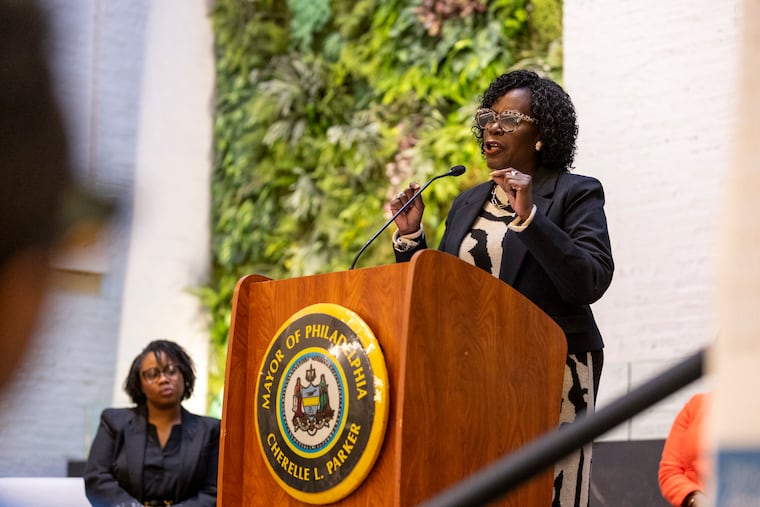
Mayor Cherelle L. Parker faced criticism last week after an Inquirer article revealed her administration had quietly eliminated racial diversity goals from city contracting in what appeared to be a preemptive concession to the conservative legal movement’s efforts to dismantle affirmative action policies.
But this week, Parker is telling her side of the story. And the mayor said she was eager to eliminate the city’s racial participation targets long before the current legal threats to the policy emerged.
“Did the Supreme Court ruling have anything to do with our decision-making? Absolutely,” Parker said Monday, referring to a 2023 ruling that eliminated race-based affirmative action. “But it wasn’t the impetus for it. I ran on providing access to economic opportunity for all here in the city of Philadelphia.”
» READ MORE: Philadelphia is halting the use of some diversity targets in city contracts as national DEI backlash grows
That case, Students for Fair Admissions v. Harvard, could mark the beginning of the end for a wide variety of government programs that seek to boost diversity or aid racial minorities.
But in her first extensive comments on the policy change — at a “roundtable” meeting she organized in Northwest Philadelphia to lay out her vision to business leaders — Parker said Monday she concluded long before the Harvard ruling that the city’s 40-year-old effort to use its contracting process to boost diverse businesses had failed. She began planning to reform the program shortly after winning the 2023 mayor’s race, she said.
“We knew the system was broken years before,” Parker, the city’s first Black female mayor, said. “Because every time we would look at the numbers and we would want to see how many Black and brown and women and disabled owned business owners were growing in the city of Philadelphia, the numbers became stagnant.”
» READ MORE: Philly Council president says Mayor Parker was ‘strategic’ in dropping diversity contracting goals
Historically disadvantaged firms win city contracts worth more than $370 million annually, and supporters of the program criticized Parker for not fighting to preserve it.
City Councilmember Kendra Brooks of the progressive Working Families Party said Parker was “caving to President Donald Trump.”
“People want to see leaders fighting for something,” Brooks said last week, “and right now we don’t see our city fighting for anything.”
But Chief Deputy Mayor Vanessa Garrett Harley said Monday that the administration examined the Office of Economic Opportunity’s registry of disadvantaged businesses that should get a leg up in city procurement opportunities, and found that only 20% were actually winning contracts.
“That means 80% of the folks in the registry were not getting the contracts. Obviously, it was not working,” Garrett Harley said. “A review of the vendors in the current OEO registry shows that the overwhelming majority will still qualify as we’re pivoting to this new program of small and local.”
Parker said that setting diversity goals was not enough to actually help women- and minority-owned businesses grow. Instead, she said, they need technical assistance, access to capital, and other tools so that they can develop to the point where they are able to regularly compete for city contracts without relying on set-asides.
Her administration is focused on providing those resources, she said, and not just “checking boxes.”
“I’m fighting,” Parker said. “But I’m fighting the fight the way I know best: to achieve the results and act and extract the tangible results that I need for the people who live in this city, who own businesses in the city.”
‘Small and local:’ A new world for city contracting
Parker on Tuesday signed an executive order detailing city’s new contracting system. As previously detailed in The Inquirer report, the city will now give preference to “small and local” firms rather than requiring participation for businesses owned by women, minorities, and people with disabilities.
The order does not set a target goal for what share of city contracting dollars should go to “small and local” businesses.
The city’s previous goal of directing 35% of contracting money to disadvantaged firms was similarly not enumerated in law. Instead, Parker’s order outlines a structure for setting benchmarks and providing assistance to firms seeking to do business with the city.
For example, it charges the Office of Economic Opportunity with setting overall contracting goals, as well as establishing “participation ranges” for individual contracts. Those ranges will be used to give contractors benchmarks for money that should be set aside for subcontractors and suppliers that are considered disadvantaged businesses.
The office is also responsible for creating department-level compliance plans, as well as maintaining a registry of small and local businesses. Firms can already register with the city as a local business enterprise. To qualify, they must either be headquartered in Philadelphia city limits, or meet two of three other criteria:
-
More than 60% of employees live in Philadelphia.
-
More than half of the business’ employees work in the city at least 60% of the time.
-
More than 75% of the business’ gross receipts came from Philadelphia.
The city does not currently have a registry of small business enterprises, and the executive order does not define them.
A risk-averse legal strategy
Parker’s elimination of racial diversity targets in city contracting — due in part to the hypothetical threat of litigation raised by City Solicitor Renee Garcia — in some ways parallels the mayor’s decision earlier this year to settle a lawsuit challenging a city tax break that primarily benefited small businesses.
In both instances, critics said that the Parker administration overstated the legal jeopardy the programs faced and gave up without a fight. But there are also key differences between Parker’s handling of the contracting goals and the tax break, which exempted firms’ first $100,000 in revenue from the business income and receipts tax, or BIRT.
If anything, there was less of an immediate threat to the city’s contracting diversity goals, which are not facing any legal challenge. The administration instead preemptively abolished its racial diversity targets due to rulings on separate issues, such as affirmative action in college admissions or the city’s project labor agreements.
The catalyst for Parker eliminating the BIRT exemption was a 2024 lawsuit filed by Massachusetts medical device manufacturer challenging the constitutionality of the tax break. Critics of Parker’s decision argued that if the city fought it out in court, the case could have been thrown out because the company may have struggled to demonstrate harm, given that the tax break actually benefited the firm.
Instead, the city settled with the company, and Parker pressed Council to remove the tax break from city law.
» READ MORE: Why a popular tax break that helped Philadelphia’s small businesses may be going away
During the debate over the BIRT exemption, Garcia said Philadelphia could potentially lose hundreds of millions of dollars in tax revenue if it didn’t cave to the legal challenge. Critics of the city’s approach cast doubt on whether that was a realistic outcome.
But in the case of the contracting DEI goals, the potential risks articulated by the administration are far less dire.
Garcia said Monday the primary financial risk involved in maintaining the contracting diversity program is that — if the city ever did get sued, and then lost a protracted court battle — it may have to pay the plaintiff’s attorney’s fees. She also cited the possibility of creating unwanted legal precedent if the hypothetical lawsuit against the city reached the U.S. Supreme Court loses — something that could still happen if a suit is filed against any of the hundreds of jurisdictions across the country that still have racial participation goals in contracting.
“This way we do it on our terms,“ Garcia said. ”We have time to build it. We have a plan.”
The most important difference between the business tax and contracting issues is that Parker was in favor of the BIRT exemption but does not support the old contracting system.
In her budget address in March, Parker said she was begrudgingly seeking to end the tax break because state judicial rulings, in the administration’s view, had forced the city’s hand. But when it comes to the city’s contracting practices, Parker’s aims in some ways align with those seeking to undo longstanding city policy on diversity in contracting.
The administration’s messaging on the issue has become somewhat mixed. On one hand, Garcia said Parker was “anguished” when she realized she had to make changes to the contracting system due to the legal environment.
“She did not want to do this,” Garcia said.
On the other hand, Parker said she has long planned to reform the contracting system. Asked if her policy goals or new legal rulings were driving the decision, Parker, said: “It’s both. It’s not either/or.”
“We are building something that does not exist here in the city of Philadelphia,” she said. “We are asking you to join the fight with us.”