
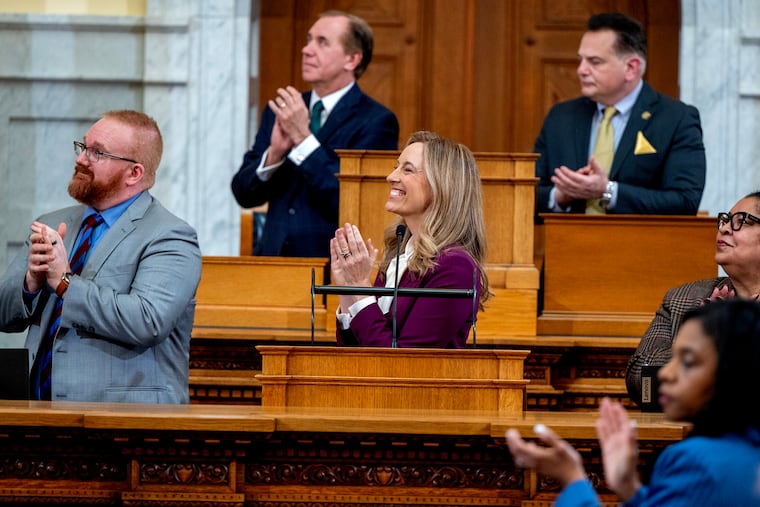
New Jersey Gov. Mikie Sherrill said she would not raise taxes on New Jerseyans, but when she made her budget pitch on Tuesday, it became clear that the promise didn’t extend to businesses.
That caught business leaders off guard.
“Prior to the budget address, the governor had said many times, ‘no new taxes, no new taxes, no new taxes,’ which was music to our ears,” said Tom Bracken, the president and CEO of the New Jersey Chamber of Commerce.
But Bracken said Sherrill “really went after the business community” in parts of her first budget proposal. The Democratic governor will be meeting with South Jersey business leaders Monday as she seeks to sell her plan to address a projected $3 billion gap.
Sherrill is seeking to address the budget deficit and direct resources to social programs that have lost federal funding under President Donald Trump. But business groups are taking issue with several of her key proposals that would cut down business tax deductions and require big companies to pay a fine if more than 50 of their employees are on Medicaid.
Some details of the proposals are unclear to business leaders in the immediate days after the governor unveiled her proposal.
Christina M. Renna, the president & CEO of the Chamber of Commerce Southern New Jersey, expressed concern about Sherrill’s proposal to require companies with 50 or more employees on Medicaid (NJ FamilyCare) to pay a fee to help fund the state-run program that’s partially funded by the federal government.
The proposal aims to incentivize businesses to offer insurance coverage and reduce how much private companies rely on public benefits, according to Sherrill’s budget documents. She’s calling the charges “Employer Healthcare Assistance Contributions” and said it can raise $145 million.
But Renna said the program could discourage companies from doing business in New Jersey.
“In a region that borders both Pennsylvania and Delaware, competitiveness is not theoretical,” she said.
Sherrill said in her budget speech that her Medicaid proposal takes aim at companies like Amazon and Walmart. Her administration did not immediately respond to questions about her proposals on Friday.
A 2024 state report found that nearly 750 companies have 50 or more employees on the state’s Medicaid program, with thousands of employees on the state’s coverage plan at Amazon and Walmart.
Sen. Troy Singleton, a Burlington County Democrat, praised Sherrill’s proposal for making large corporations “pick up their load, that frankly, is being pushed off on every taxpayer in the state of New Jersey.”
“It doesn’t seem right for those mega corporations to have their employees to have to rely on state health care programs like Medicaid in order for them to be treated fairly for their health care needs,” Singleton said.
Sherrill also wants to limit how much money businesses can deduct from their taxes for operating losses at $1 million for three years. This proposal could generate about $485 million in the coming fiscal year and would impact about 600 companies, or less than 1% of corporate taxpayers, according to Sherrill’s budget documents.
She also wants to take away a tax break from larger companies she says was meant for small businesses struggling to survive the Great Recession called the Alternative Business Calculation Adjustment tax deduction. She wants to limit the deduction to businesses with a gross income of $1 million or less, and reduce it to 25% for businesses with gross income between $500,000 and $1 million.
“The car repair shop and the diner down the block are the ones who should benefit,” she said in her speech on Tuesday. “This fix will save another $120 million a year – without taxing families a dollar more.”
Sherrill touted her budget as “the most fiscally responsible budget our state has seen in years,” because it fully funds the state’s pension system, doesn’t include uniform tax increases, and closes “corporate tax loopholes.” But it still totals nearly $61 million in spending, a record for the state.
Anthony Russo, the president of the Commerce and Industry Association of New Jersey, said business leaders were “a little surprised” by the high price tag but he’s glad there aren’t a lot of new increases.
And as certain businesses lose tax breaks, they could also do better on a federal level, he said, since it’s currently unclear how businesses’ tax bills will benefit from tax breaks in Trump’s bill as 2025 returns are processed.
“We were happy to see that she wasn’t introducing new taxes, she wasn’t introducing increased taxes, but when you cap or you eliminate deductions, to those affected parties, it’s in essence a tax increase,” Russo said.