
“Quit your job. Sell your stuff. Come home.”
That’s what Samantha Paige Rosen’s father told her when she was 29.
Rosen was living alone in Bethesda, Md., and struggling with what she called unrealistic deadlines at her copywriting job.
She liked being in the D.C. area and was reluctant to move back to her parents’ house in Bala Cynwyd. Plus, this wasn’t what adults were supposed to do, she thought. Ultimately, she decided to listen to her dad.
“My job was making me sick,” she said, referring to her deteriorating mental health.
The morning after she moved back into her childhood room, she already felt a difference. “The depression lifted. A lightness. A steady, quiet heartbeat,” she wrote in a 2022 essay, “Unlearning the Shame of Living with My Parents as an Adult,” for the literary publication Catapult.
That decision shaped the trajectory of her life.
Thanks to the care provided by her parents, she was able to get well and build a tutoring business. And her experience inspired her to pitch, sell, and edit an anthology called Living, Together: Reimagining Community in the Age of Disconnection, out last month from Beacon Press and now an indie press bestseller.
The anthology, a mix of personal essays and conversations featuring 22 writers who live in the U.S., offers a window into the experience of living outside of a nuclear family arrangement. For some, that means living in a multigenerational household, a cohousing community, or three polyamorous parents and children. The book also goes beyond just housing, to focus on building community and chosen family.
Novelist Sarah Thankam Mathews writes about her experience sustaining Bed Stuy Strong, the mutual aid organization she helped found during the pandemic. Author Rhaina Cohen explores her and her husband’s decision to live with their friends. Novelist Jonathan Escoffery talks about how his sense of community was shaped by his Jamaican immigrant parents and fellow writers of color.
When she was living with her parents, Rosen, now 36, said she didn’t know anyone who was living in a nontraditional setting and couldn’t find much writing about it. In a lot of ways, the book, she said, “was for me.” She wanted to hear about all the ways people were building homes and community.
It’s difficult to quantify the trend of alternative living arrangements because it’s such a vast term. But what is clear is that what Americans tend to think is middle-class “normal” — living with a spouse and children — is on the decline.
In 1970, 67% of Americans ages 25 to 49 were living with their spouse and one or more children under 18. Today, that number is closer to 37%, according to a 2023 Pew Research Center analysis of census data. At the same time, people are increasingly living alone or in multigenerational households.
Multigenerational and otherwise non-nuclear family living is common in several global cultures, but Rosen wanted to highlight American writers as a way to combat the thinking that more communal ways of living are suited for other countries but not here.
Living, Together fits into a growing canon of literature focused on envisioning alternative family and relationship structures. From Cohen’s best-selling 2024 The Other Significant Others: Reimagining Life with Friendship at the Center to Mathews’ 2022 novel All This Could Be Different, from Sophie Lewis’ 2022 Abolish the Family: A Manifesto for Care and Liberation to Lola Milholland’s 2024 memoir Group Living and Other Recipes, there’s a growing tide of voices calling for collectivism over individualism.
“There’s a real hunger for interdependence and people don’t know how to get it,” Rosen said. She hopes the book will open people’s eyes to what’s possible. And not just what’s great about communal living, but what’s difficult about it, too.
When Rosen lived with her parents, sometimes she’d visit friends’ places and wonder if she was doing what she should be doing “as an adult woman.” Her mom, Patty Rosen, also remembers fielding some judgment from others about her daughter’s living situation.
“When’s Sam gonna move out?” they asked.
But the Rosens said they loved living together, even with things like negotiating sound while Samantha was tutoring and dealing with her cat crying at the front door. Or being parented a little too much.
And going on dates? “She didn’t like to be asked about it,” Patty said.
They’d ask about the date’s name and profession, Rosen explained. “Then,” her father, Stuart Rosen, said, pretending to whisper behind his hand, “I would Google.”
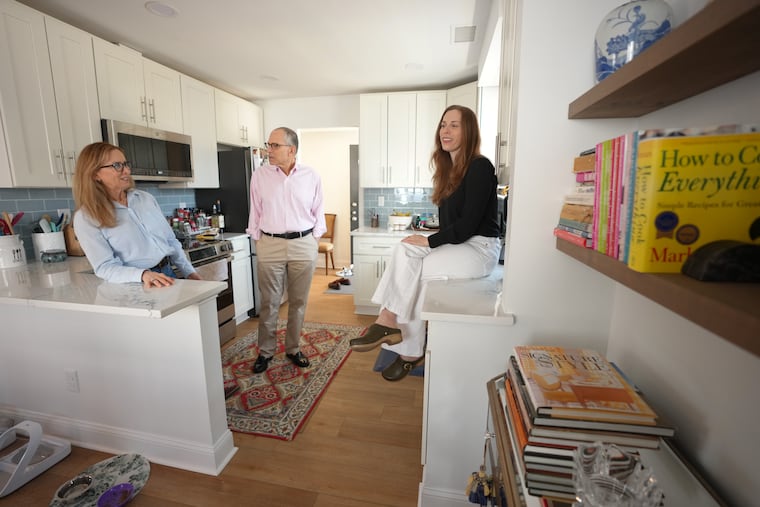
In 2025, Stuart and Patty downsized and moved into a house in Penn Valley. Rosen moved into the house across the parking lot — a house she could only afford because of the years she lived with her parents.
The shift in their family’s living situation echoes something Rosen learned while working on the book.
“Those who’ve taken communal living from an idea to reality have reframed their thinking around it again and again, or gotten rid of the frame entirely,” Rosen wrote in an email. “It can last forever or for a season of life.”
In this season of life, Rosen brings Fergal, her cat, in a backpack to her parents’ house everyday to play with their cats. Every Tuesday, she and her dad have dinner and watch a movie. Some evenings, her mom comes over after she finishes work to watch a movie in bed.
The latest iteration of their living situation — and the potential for all the other ways she might live in the future — calls to mind something Rosen wrote in her essay.
She said she wasn’t sure what she’d choose if she had complete freedom to live the way she wanted.
“But I know I’m interested in figuring out how to live beyond the boundaries society has established for me. I didn’t always believe I was capable of that, but I am. We all are.”
Samantha Paige Rosen will be speaking about her book at the Head & the Hand, 2230 Frankford Ave., Philadelphia, as part of “Hot Debut Summer” on Saturday, Aug. 22, 7 p.m.-9 p.m.
“Living, Together: Reimagining Community in the Age of Disconnection” is available in digital and physical bookstores.