
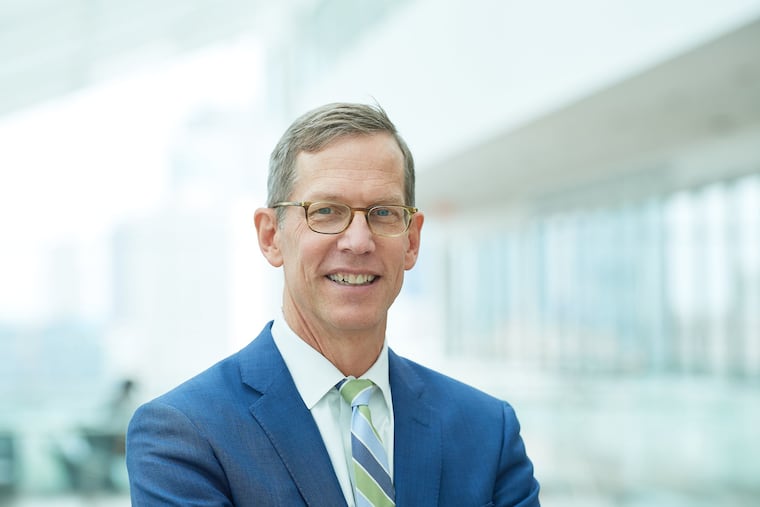
University of Pennsylvania scientist Robert Vonderheide sees cancer researchers making progress on two fronts: finding new treatments for the most challenging cancers, and studying ways to stop disease before it becomes cancer.
The newly elected president of the American Association for Cancer Research will lead the world’s largest cancer research organization, with more than 62,000 members across 143 countries and territories. Headquartered in Philadelphia, its membership includes researchers (57 being Nobel laureates), healthcare professionals, and cancer advocates.
It advocates for research and science education.
“One of the things I look forward to most is articulating what cancer research accomplishes,” Vonderheide said. “We need to double down as a country, being so much on the verge of even greater breakthroughs.”
Vonderheide starts as president-elect next month and will assume the presidency in 2027. In the unpaid position, he will lead alongside Penn immunologist E. John Wherry, who was elected to AACR’s Board of Directors.
An oncologist, Vonderheide serves as director of Penn’s Abramson Cancer Center and lead physician for the Penn health system’s cancer service. He is also well-known for research on novel cancer immunotherapies.
The Inquirer spoke with Vonderheide about the future of cancer research and what AACR hopes to accomplish, in a conversation lightly edited for length and clarity.
What inspired you to want to lead AACR?
AACR is 118 years old. It’s older than the National Cancer Institute. And it accomplishes its work by fostering collaboration, paying attention to the young trainees, and providing an unbiased way to publish our work.
When I had the opportunity to be the president and put my name out, it was really humbling.
What are key initiatives you’re looking forward to leading as president?
We are looking out at unprecedented opportunities that AACR can help drive: Drug development driven by artificial intelligence. New biology and new understanding of where cancer came from, and how we can intercept and destroy cancer before it’s cancer. Embracing the fact that many of our patients are surviving, and looking at how we can help mitigate the collateral damage that some of our therapies engender.
It’s really an opportunity to broaden our scope across the continuum of cancer care and, at every moment, bring rigorous science to guide us.
How will AACR accomplish this work?
The solution is not me. The solution is not the department chair at this institution or the cancer center director at another institution. It’s the young people, junior faculty, postdoctoral scholars, and graduate students, who are the ones who work day and night — who have the ideas and the energy.
If I could accomplish only one thing as president of AACR, it is to find a way for AACR to ensure that the future generation of cancer researchers exists and are even better than any of us are right now.
What are younger scientists worried about right now?
They’re not worried about their science. They love their science.
They’re worried about getting the funding to support themselves, to support their work, to have the freedom to explore what they think are the best ideas. They’re finding it hard to get grants. They want a secure and supportive environment to get their work done in.
If we invest in them properly, just imagine what they can accomplish in 10 years.
What does the future of cancer research look like to you?
Developments in technologies such as gene therapy, cell therapy, and mRNA therapy are producing new ways to treat cancer.
We are able to offer more and more hope.
Now we’re learning how to prevent and intercept cancers very, very early, when they’re minuscule. We’re thinking of how to find cancers when they’re a single cell — before they really have completed the cancer invasion program — and erase them and reset the clock.
What about combination therapies?
As these new technologies come forth, we ask ourselves, how can we combine them?
What we’re finding is, you get synergy. You get more impact than two different things, singly, might achieve.
The most prominent example was combining chemotherapy with immunotherapy. Originally people thought, ‘No, you can’t combine them,’ but now we know how to do that. Immune therapy with radiation therapy is being heavily studied. And sometimes we don’t just use them all at once, but rather in a sequence.
A good example is using chemotherapy to gain remission for a patient with a certain type of pancreas cancer, followed by Olaparib, which is a PARP inhibitor. When we finally had the idea of delivering one of those therapies after the other, instead of always at the same time, the tolerability went way up, and the impact was much higher.
What have been the highlights of your research career?
Trying to reveal how it is that cancer cells hide from the immune system, and what we can do to change that.
We want the immune system to wake up and destroy cancer cells and return health to folks, or prevent cancer in the first place.
We’ve identified vaccine targets. We’ve identified immune-stimulatory pathways. Probably the most fun that I’ve had is watching those basic discoveries turn into novel therapeutics.
You’re widely recognized for your research on CD40. Can you talk about that work?
CD40 is an immune ‘light switch’ that cancers try their very best to turn off.
Therapeutically, we now know how to turn it on using an antibody, for example. Once on, the immune system becomes active, and you can point it toward cancer.
It’s different than other immune therapies, which are really blocking the brakes. This is an approach to essentially step on the gas of the immune system.
It’s still a promise to be delivered in the clinic, quite frankly. We’re designing the next trial right now in patients with pancreas cancer.