
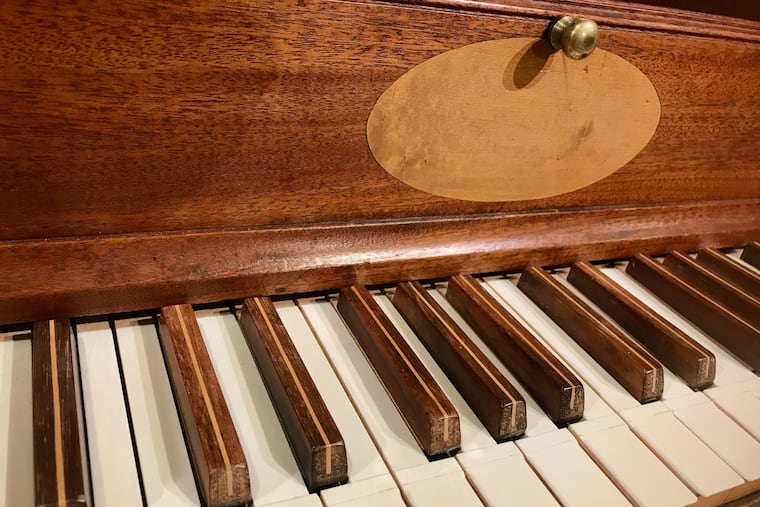
In the months before the start of the Revolutionary War, John Behrent (also spelled Berent) built the first piano sold commercially in the United States.
More than 100 years later — at the behest of composer and bandleader John Phillip Sousa — Philadelphia-based musical instrument maker James Welsh Pepper crafted the world’s first sousaphone in his shop at 8th and Locust Streets.
Both of those firsts will be celebrated Saturday at the Kimmel Center for the Performing Arts, the next installment in Philadelphia Historic District’s 52-Weeks of Firsts yearlong Firstival events. The weekly day parties honor events and discoveries that happened in Philadelphia before anywhere else in the country and often the world.
The very first piano was made in Italy around 1700. Colonists transported them across the Atlantic to the New World in the bottom of ships.
But as tensions rose before the Revolutionary War, Americans stopped importing goods from London and started to make what they needed here within the country, explained Tom Strange, curator at South Carolina’s Sigal Music Museum.
Before coming to America in 1770, Behrent studied piano making in London and Portugal. When he got to Philadelphia, he set up shop making tiny keyboard instruments; from spinet harpsichords to clavichords. In the winter of 1775, he published a notice in the newspaper advertising “an extraordinary fine instrument by the name of the piano forte.”
“That was the first time we see (in the newspapers) a piano that was unequivocally made for sale in America,” Strange said.
The first shots of the American Revolution were fired in April 1775. Musical instruments took a backseat and craftsman like Behrent moved on to making practical items like tables and chairs, Strange said. Behrent died of yellow fever in 1780.
“We thought the first piano was lost to us forever,” said Strange.
Cut to 2006, when Nicholas Giordano, a physics professor and antique keyboard collector bought an antique piano from a family in Indiana. Giordano contacted the Sigal Museum in 2021 to see if they wanted anything from his collection, especially a certain piano inscribed with the name of a John Behrent.
Strange was initially skeptical. But after studying the piano, he figured it was the real deal for these three reasons: It was fashioned from Tulip Poplar and Yellow Pine, two trees that only grow in the Northeastern United States. Its batten siding was on the right, the mark of a Portuguese craftsman. And the piano’s key board shifted from right to left.
» READ MORE: The U.S. Postal Service is among the many things we can thank Ben Franklin for
“English pianos and all the pianos that would follow shift from left to right,” Strange said. “Only Portuguese pianos are made to go in this ‘odd’ direction. Once again, elements came together that said this piano is real. This piano is important.”
The Behrent piano is part of a special Sigal Museum exhibit and will be on display through 2026.
That first American-made piano is just one Philadelphia’s musical firsts. Philadelphia’s Michael Hillegas — a wealthy merchant and first United States Treasurer — also owned and operated America’s first music store during the mid 18th century. (Sales from his musical enterprise helped finance the Revolutionary War.)
Philadelphia was one of the first American cities to welcome the opera. And although the Philadelphia Orchestra was founded in 1900, orchestra performances began gathering steam in the previous century.
Philadelphia has music in its cobblestoned bones. We were a hot bed for music.
This serious interest in music led to the city into becoming the home of the world’s first sousaphone, said David Detwiler, a tuba player, sousaphone historian, and a pastor at Manheim-based Lives Changed by Christ Church.
In 1892, popular Washington, DC-based bandleader John Philip Sousa asked Pepper to craft an instrument that would bring the bass to his concert band performances.
Pepper was eager to do it, Detwilier said, because “Sousa was as popular in his day as Taylor Swift is today.” Pepper created a wearable tuba that draped over the left shoulder and featured a belled horn pointing straight up, creating a deep, mellow, sonorous sound. He introduced it in 1895.
Today’s sousaphone’s bell points out instead of up and its mostly a band instrument. One of the country’s most popular sousaphone players today is Damon Bryson, also known as Tuba Gooding Jr. He plays the instrument for the Roots.
Like the piano, the first sousaphone was also missing for more than a century.
Pepper’s sousaphone was rediscovered in 1973 by a young musician named John Bailey who happened upon an old sousaphone in a Lancaster County flea market. Bailey bought it for $50 and kept it in his basement where it remained until 1991 until he decided to wipe it down.
“When John Philip Sousa’s head popped up [engraved on the bell of the Tuba] … I stopped,” Bailey told The Inquirer back in 2015.
It now lives on display at J.W. Pepper, now an Exton-based sheet music company that was once the 19th century instrument manufacturer.
Detwiler will play he says is the first sousaphone at this week’s Firstval.
“The sousaphone was created and birthed in downtown Philadelphia,” Detwilier said. “There was a time when every band wanted to have a sousaphone and I’m just so honored to have the opportunity to play it.”
This week’s Firstival is Saturday, May 2, 11 a.m.-1 p.m., at the Kimmel Center for the Performing Arts, 300 S. Broad Street. Each week, The Inquirer is highlighting a “first” from the Philadelphia Historic District’s 52 Weeks of Firsts program. A “52 Weeks of Firsts” podcast, produced by All That’s Good Productions, drops every Tuesday.