
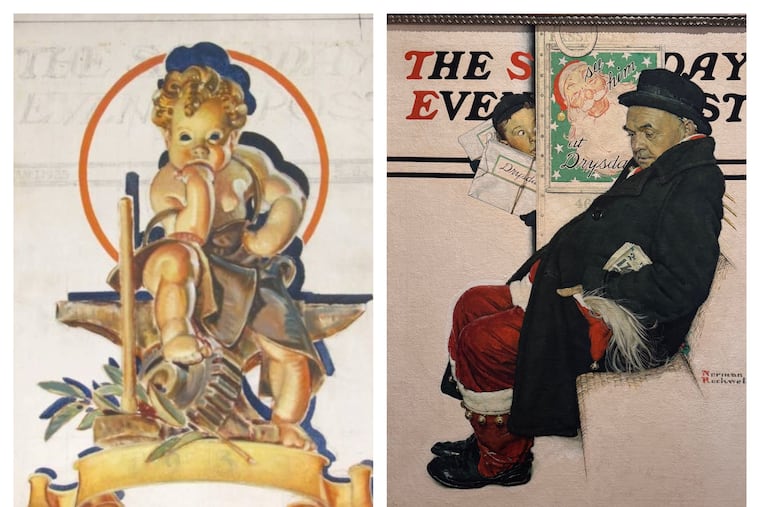
After 205 years, the Saturday Evening Post, the famed magazine that printed its first issues on Ben Franklin’s Old City printing press and whose Norman Rockwell covers defined the optics of quintessential 20th century Americana, will print its last issue early next year.
Subscribers received a letter in the September issue, which arrives in mailboxes this week, stating that the January/February 2027 issue will be the publication’s last printed edition. It will continue to publish online.
The Post, which was published from the Curtis Building at Sixth and Walnut Streets, from 1910 until 1969, was one of the standouts of 19th century Philadelphia publisher Cyrus Curtis’ portfolio.
Like many other print publications, the change in reader’s habits has impacted the Post’s bottom line.
“Advertising revenue has shifted away from print and we don’t have that 18-to-45-year-old demographic that does really well with TikTok,” said Joan SerVaas, the president and publisher of the Saturday Evening Post.
SerVaas’ father, Beurt, purchased the near bankrupt Post from the Curtis family in 1969 and moved the publication to Indianapolis.
Her mother, the late Cory SerVaas, who was a journalist and a physician, revamped the Post, adding coverage on health and wellness issues.
Joan SerVaas says she’s in talks with the University of Pennsylvania to purchase the mostly Philadelphia-centric ephemera that includes minutes from Curtis Publishing’s board of directors’ meetings dating back to 1886. Included in the collection are also correspondence from famous writers and artists including Rockwell and J.C. Leyendecker. Many of the original magazines going back to 1821 are also in the catalog.
“It’s really important to us that we preserve this history,” SerVaas said. “And Philadelphia is a wonderful place for it to be preserved because it’s the magazine’s home. Without Philadelphia, we would have no Post.”
The Post may have been based in Indianapolis for more than a half a century, but its media roots are in colonial Philadelphia’s cobblestoned streets.
In 1728, Benjamin Franklin took over the publication of the Pennsylvania Gazette, a general-interest magazine that covered politics, science, and government out of his print shop at No. 53 Market St. By the 1740s, it was the most popular publication in the colonies. Franklin retired in 1748 and the Gazette continued to publish until 1800, 10 years after his death.
By the early 1820s, Franklin’s print shop was owned by Samuel Atkinson. He, along with Charles Alexander, started a newspaper that would carry on the tone of Franklin’s Gazette but print in time to be delivered to Philadelphians in the Saturday evening mail. The Post carried news, but readers liked it because it reported on the drama including letters between ex-presidents and political enemies John Adams and Thomas Jefferson. The death of Napoleon was also a big story.
The Post also printed essays, stories, and poems written by major American writers: Edgar Allan Poe, James Fenimore Cooper, Harriet Beecher Stowe, Washington Irving, and Mark Twain. Circulation ebbed more than it flowed until 1897 when Cyrus Curtis — who transformed a farming magazine into Ladies’ Home Journal, the first magazine to reach a circulation of one million — purchased it from publisher A.W. Smythe for $1,000, about $40,000 in today’s money.
Curtis wanted the Post to be for men what Ladies’ Home Journal was for women: cutting edge, insightful, and of the moment.
In 1899, Curtis hired 32-year-old literary editor George Horace Lorimer, ushering the magazine into its 20th century heyday.
Lorimer would be one of the first editors to print the work of Joseph Conrad, O. Henry, Rudyard Kipling, and Jack London. And in 1916, when he was just 22, Rockwell received his first commission at the Post, beginning a 47-year relationship that produced 322 original cover illustrations.
Rockwell — whose most iconic paintings include the 1943 Freedom of Want of a family celebrating Thanksgiving dinner; the quirky 1953 Triple Self Portrait, and the 1963 memorial image of image of John F. Kennedy — was just one of many artists who got their break in the art world at the Post.
The Post helped fuel a community of illustrative artists most of whom lived in Philadelphia support themselves for more than 150 years, said William R. Valerio, executive director of Woodmere, the Chestnut Hill museum whose collection includes several Saturday Evening Post covers.
Rockwell’s Santa on a Train, and his Preparatory Drawing for Plumbers have both been exhibited in Woodmere’s Frances M. Maguire second floor gallery, an homage to Philadelphia-based illustrative artists. Many of whom’s work has graced the cover of the Post.
“Violet Oakley, Jesse Wilcox Smith, Robert Riggs, Benton Spruance, their work has all been in the Post,” Valerio said. “No artist works without community, and the Post helped create a vibrant community of artists in Philadelphia.”