
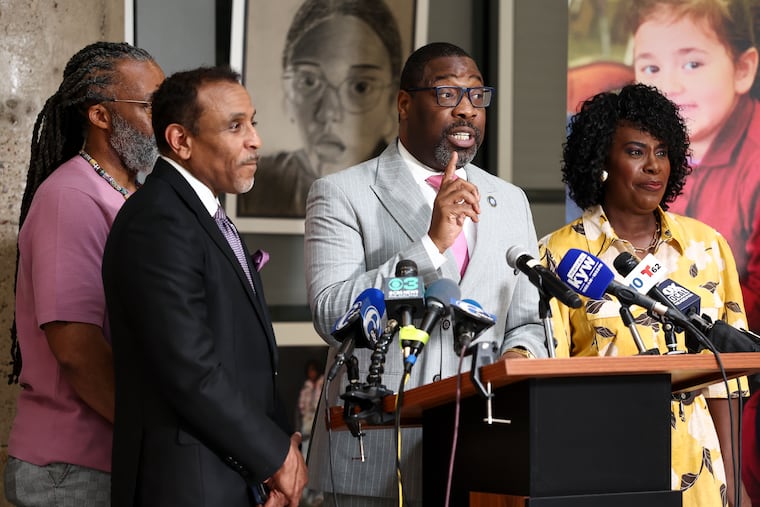
In June, Mayor Cherelle L. Parker and Council President Kenyatta Johnson gave themselves a year to find a new revenue stream for the city’s cash-strapped public schools.
Proposal No. 1 hit the table on Thursday.
Johnson unveiled legislation during Council’s meeting that would expand the city’s existing 7% tax on outdoor advertising, such as billboards, to apply to all forms of advertising that are “intended to be seen, read, or heard in Philadelphia.”
This means that anyone who purchases an ad in newspapers, on television, or online would pay the levy.
Johnson’s office estimates that the tax would generate at least $95 million a year in revenue, with about $50 million of that going to the school district every year.
That cash, Johnson said, would largely fund the 340 school-based positions that the district was set to cut earlier this year before the city stepped in.
Council in June rejected Parker’s proposed $1-per-trip rideshare tax, which she had floated as a mechanism to provide the district with reliable, recurring revenue. Instead, Council and the administration approved a $50 million infusion to the district that was seen as a one-time fix relying on budget nips and tucks.
In order for the district to stave off the job cuts over the next several years, city officials pledged $216 million to the district over four years. That would be paid from the city’s coffers — unless lawmakers could identify another funding stream.
Johnson said the expanded sales tax on advertising is that solution. He said Thursday that the measure was developed by his staff in partnership with the Parker administration, and that it would “modernize” the city’s existing tax system.
“We made a commitment,” Johnson said. “We looked at a variety of different options, and this is one of the key areas that we believe that we’re going to be able to raise the $50 million in recurring revenue to support our Philadelphia School District.”
Spokespeople for the school board and district said in a statement that they appreciated Council’s proposal and will take time to understand its potential impact.
“Every investment in public education matters, particularly when it has the potential to preserve positions that directly support students, teachers and school communities,” the statement said. “Philadelphia’s public schools need a sustainable funding strategy that allows the district to plan responsibly, maintain essential services, and keep student outcomes at the center of its decisions.”
Joe Grace, a spokesperson for Parker, issued a statement reiterating that city officials committed last spring to securing $48 million in locally generated annual revenue to prevent the school-based job cuts.
“As with any legislation, our finance and legal teams will review and evaluate the measure,” he said.
It is unclear what fate Johnson’s proposal will meet in Council. All 17 Council seats will be on the ballot next year, and incumbent members are often reticent to raise taxes so close to an election.
The bill would amend the city code around taxing outdoor advertising to apply to all types of advertising. The tax would need to be collected by the advertising or media companies and paid to the city monthly, according to the legislation.
The tax may also apply to advertising that is purchased outside Philadelphia but is viewed or heard in the city. The legislation says that the administration would be authorized to develop regulations, such as establishing a minimum number of “exposures” in the city that would subject an advertisement to the tax.
Johnson is looking to pass the legislation by end of this year, but lawmakers would have to act quickly to meet that timeline. There are only two sessions remaining on the calendar before the end of the year, meaning the legislation would have to pass out of committee in early December.
A hearing on the legislation has not yet been scheduled.