
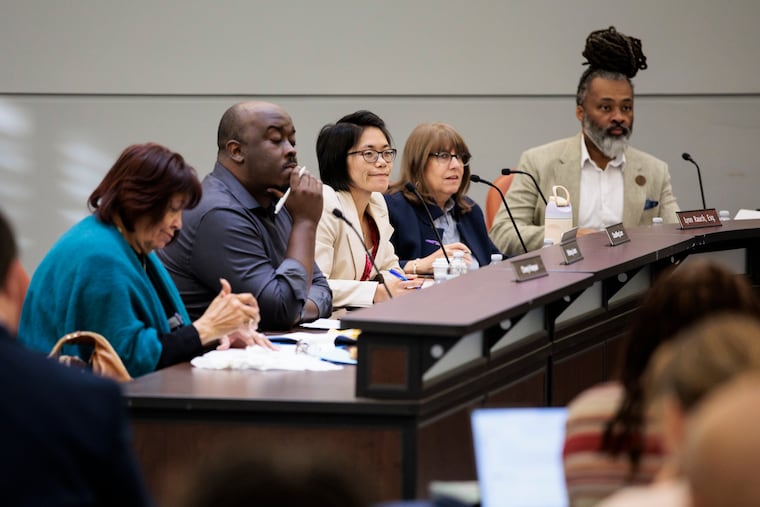
The Philadelphia school board on Thursday night greenlit spending up to $200 million on modernization projects at four city schools.
The board voted to award a contract to the Philadelphia Authority for Industrial Development, which will handle selecting firms to run the projects, deemed the district’s highest-priority renovations.
The district has budgeted spending $68 million on Bache-Martin Elementary in Fairmount, $48 million at Catharine Elementary in Southwest Philadelphia, $53 million at Patterson Elementary in Southwest, and $12 million at F.S. Edmonds in East Mount Airy.
The renovations will add 700 seats and affect 2,400 students, district officials said.
The board vote marks the first steps forward on the district’s $3 billion facilities master plan, approved in April. And while much of the public’s attention has been focused on 17 school closures — which are still being bitterly opposed by several City Council members, key district unions, and affected school communities — district officials are seeking to refocus attention on the renovation projects.
“This represents an important step in Accelerating Opportunity, our 10-year facilities master plan, from planning to implementation,” Superintendent Tony B. Watlington Sr. said at the board meeting. “It also reflects our commitment to making meaningful investments that ensure students have access to safe, healthy, and modern learning environments.”
It’s not the first time the district has used PAID for major projects. In the recent past, it’s used this kind of arrangement to build new schools at Cassidy Elementary in West Philadelphia, AMY at James Martin in Port Richmond, and Thomas Holme Elementary in the Northeast.
“The intergovernmental arrangement with PAID is expected to provide additional oversight and assistance to the school district, with the anticipated outcome of newly renovated school buildings constructed at a reasonable cost, through greater construction efficiency, and on time,” the board resolution said.
PAID will issue requests for proposal, select developers, and enter into agreements with them. It will receive administrative fees not to exceed 1% of the total paid to construction firms — up to $2 million total for all projects.
Planned at Bache-Martin are a new gym, cafeteria, and classrooms, as well as HVAC upgrades, new roof and windows, electricity, and classroom modernization. Bache-Martin is set to absorb students from two closing schools, Robert Morris and Waring.
Catharine will get a new gym and classrooms, updated heating and air conditioning systems, restroom renovations, and more. Catharine is adding grades to accommodate for the closing of Tilden Middle School.
Patterson, which is also adding grades to account for Tilden’s closure, is getting an addition, a new gym or cafeteria, an elevator, and other modernizations.
F.S. Edmonds is getting an addition, restroom renovations, and accessibility improvements.
The PAID resolution passed six to one, with board member Whitney Jones dissenting.
Jones asked how the district arrived at these four projects as their first priorities, and expressed concerns about what would happen if the district does not get its full plan funded — it can pay for $1 billion of the $3 billion price tag, and is counting on state and philanthropic help for the rest.
“Our needs are so great, we’ve got to start somewhere,” Watlington said. “These are not just random projects. These are well-thought out projects with detailed timelines.”
‘Save Our Schools’
The board vote on the projects came hours after key City Council members, students, leaders of the district’s teachers’ and principals’ union, and others rallied outside of Philadelphia School District headquarters.
Waving signs, banging drums, and chanting “Save Our Schools,” dozens again asked the district to reconsider closures, the first of which are supposed to take effect at the end of the 2026-27 school year.
City Councilmember Isaiah Thomas, chair of Council’s education committee, and Councilmember Jamie Gauthier, who helped organize the rally, have pushed hard to spare three schools in particular: Lankenau and Robeson High Schools and Overbrook Elementary School.
Thomas has said he wants the board to negotiate on closures, and publicly implored Mayor Cherelle L. Parker to get involved. The board has said if changes are necessary to its facilities plan, they will happen through public channels.
Parker has said on multiple occasions that she believes closures are necessary in Philadelphia — especially if officials expect the state to come up with more funding for schools.
Thomas later attempted to calm the waters with the board, whom he publicly screamed at, threatened to sue, and told “you’re done” when the board took its vote to close schools. He and other members of Council promised civil disobedience and shut down that meeting multiple times.
“I would also like to apologize to anybody who feels like they’ve been disrespected by members of City Council or any other legislators who’ve been passionate about the facilities issue,” Thomas said on Thursday. “This is a city of neighborhoods and we’re really connected to our schools. This is a really emotional issue.”
Thomas said he had recently personally appealed to several board members and city officials to attempt to move the needle on closures.
“If we’re serious about saving these schools and the young people that are here today, we need to make this decision now,” Thomas said. “What we do know is this, if we go forward with this decision, things will get worse. When we close schools, children die.”
Ostensibly addressing the decision to move forward with the 17 closures, board president Reginald Streater said the board stands “for uncompromising transparency and unyielding commitment to putting students’ outcomes above politics. Whether managing our district’s long-term physical health, modernizing our school facilities, or conducting fair, data-driven oversight of our schools, our responsibility to Philadelphia’s taxpayers and families, and more important to our children, is nonnegotiable.”
What advances students’ academic growth and health is the board’s North Star, Streater said, “and we will hold to that commitment no matter how complex the road may be ahead for us.”