
Citizens Bank, based in Providence, R.I., has built one of the largest U.S. commercial-banking networks by courting middle-sized U.S. companies, leaving the biggest corporations and their foreign-trade complications to the larger New York banks.
But Citizens also has found success financing two profitable, U.S.-focused private-prison contractors. One is Geo Group Inc., of Boca Raton, Fla., which runs the Moshannon Valley Processing Center in central Pennsylvania, Delaney Hall in New Jersey, and more than a dozen Immigration and Customs Enforcement prisons. The other is CoreCivic, of Brentwood, Tenn., which runs the Elizabeth Detention Center in New Jersey, among others.
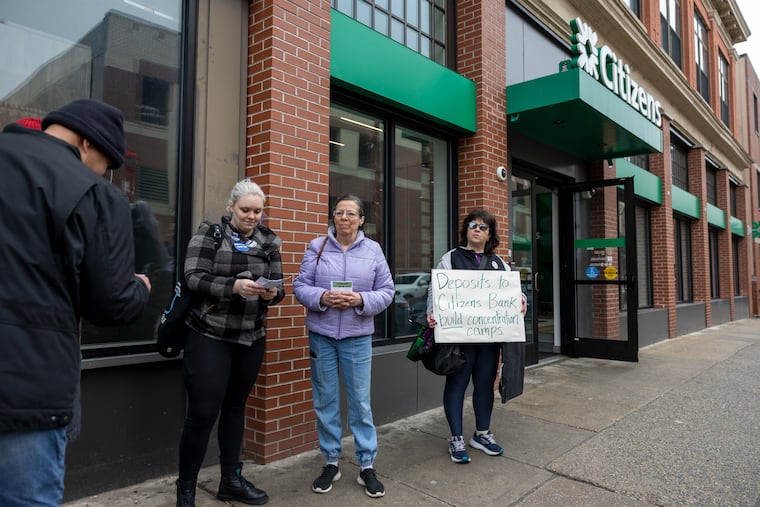
Those relationships have made the bank a target for protesters critical of the rapid growth of the federal immigration detention apparatus under President Donald Trump.
“My dad’s an immigrant. The president and vice president are married to immigrants,” Sam Kuttab, a Philadelphia advertising manager, said at a protest Saturday. “If they had stuck to arresting violent criminals, we’d have supported that. But why are they going after Latinos and other people who voted for him? This lack of compassion is not good for this country.”
Kuttab sat in his truck illuminated by a sign that said “Citizens Bank: Stop Financing U.S. Immigration and Customs Enforcement Detention Centers” outside a bank branch near Wilmington. He said protesters helped pay for the sign.
National organizers say protesters stood at more than 70 of Citizens’ 988 full-service branches, including locations in Center City and Northwest Philadelphia, in the latest hourlong demonstrations urging Citizens to stop funding the centers. Organizers included local branches of the Indivisible Project, a grassroots organization backed by Democratic Party donors .
At Citizens, “We don’t comment on specific clients” beyond stating that “we do business with organizations that conduct business in a lawful manner, and if we determine that not to be the case, we are prepared to exit those relationships,” Citizens spokesperson Peter Lucht said.
Pressured by activists, eight large U.S. banks including JPMorgan Chase & Co. and Citibank, in 2019 agreed to stop funding private prison operators.
In Pennsylvania, the State Employees’ Retirement System (SERS), whose members include prison guards, that same year refused to invest in a fund that financed another private-prison contractor, Securus, even after the state school pension fund (PSERS) had approved an investment in the same fund.
As U.S. Immigration and Customs Enforcement expanded in Trump’s second term and Republican-controlled states passed anti-blacklisting laws, Wells Fargo and Bank of America have “softened” their opposition and may resume financing private prisons, the New York Times reported last year.
In 2024, Citizens’ banking arm agreed to lead a group of lenders raising $1.3 billion for Geo Group, which operates 82 prisons for state and federal agencies, some of which house immigration detainees.
Last year, Citizens led a group of lenders, mostly smaller Southern banks, in raising $500 million for CoreCivic, a for-profit company, to pay down debt and “for general corporate purposes.” CoreCivic operates 50 U.S. private prisons, at least 18 of which are contracted to Immigration and Customs Enforcement.
Citizens also served as administrative agent and a lead banker in a group that agreed to raise up to $510 million for Geo Group, which operates 82 prisons for state and federal agencies including U.S. Immigration and Customs Enforcement. That funding was meant to help Geo Group refinance debt, pay for acquisitions, and make other corporate purchases.
“We’re really concerned about what U.S. Immigration and Customs Enforcement is doing in tearing apart families, and we’re concerned that Citizens is one of the major lenders to companies that run U.S. Immigration and Customs Enforcement detention centers,” said Lisa Jay, a spokesperson for Indivisible’s Newark, Del., chapter. “We want them to stop supporting an agency that does not respect the Constitution.”
Jay was one of about 70 who participated in Saturday’s Wilmington protest. She said a larger group had been at a demonstration in February.
She said U.S. Immigration and Customs Enforcement has not been highly visible in northern Delaware, where most of the state’s residents live. But in the past year, ICE detained more than 200 people in southern Delaware, home to chicken-processing plants and beach resorts that rely on immigrant labor, according to figures from the office of Delaware’s U.S. Sen. Lisa Blunt-Rochester, a Democrat.
“We live in a democratic society,” said Reuben Yarmus, retired former principal of Philadelphia’s Kensington High School and one of the Wilmington protesters. “I feel very strongly about the conditions of immigrants. It’s shocking to people all over the world the world how U.S. Immigration and Customs Enforcement is treating people.”
Drivers on the busy Kirkwood Highway honked frequently to show support for the protesters, who stayed along the road and didn’t attempt to block traffic into the Citizens branch.
Judi Pasino, a Citizens customer, joined the protesters. She said she plans to raise the detention-center issue with branch staff and is thinking of moving a retirement account out of the bank.
“It’s so small, they won’t miss me,” she said. “But it’s an opportunity to do something.”