
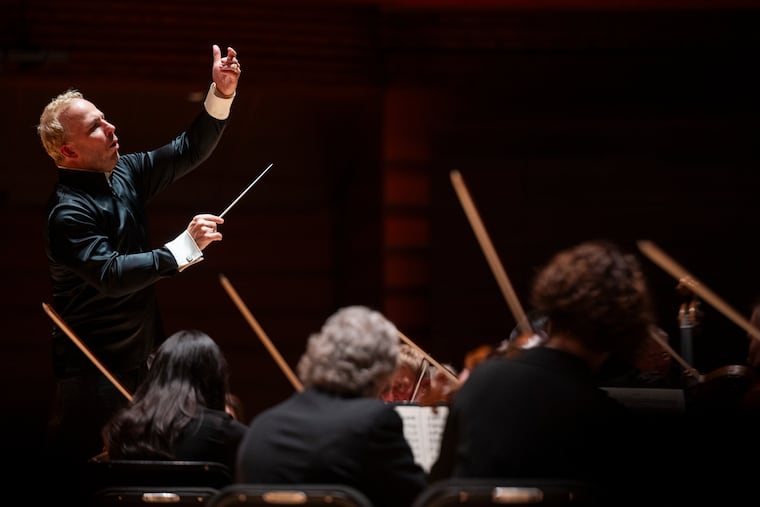
Since his arrival in Philadelphia, Yannick Nézet-Séguin has hitched his wagon no more firmly to any composer than Florence Price.
It was a recording of Price’s First and Third symphonies that brought a first Grammy win to the conductor and, astonishingly, gave the Philadelphia Orchestra its first-ever Grammy in 2022 in the best orchestral performance category.
“I’ve never really been attached to awards but this is something I really, really wanted,” the orchestra’s music and artistic director told The Inquirer in 2022, “because of what it means for Florence Price to finally be acknowledged.”
Nézet-Séguin has taken his advocacy for Price — the first Black woman to have her work performed by a major U.S. orchestra, in 1933 by the Chicago Symphony Orchestra — on the road. He recently gave her name prominence at one of classical music’s most visible events, including it on the Vienna Philharmonic’s 2026 New Year’s concert with a piece billed as Price’s Rainbow Waltz.
Now some are crying foul.
Price did write a work called Rainbow Waltz, but critics and scholars say the arrangement by Wolfgang Dörner heard on the New Year’s concert, broadcast, and recording bears so little resemblance to its purported original that it constitutes “forgery.”
The piece that was performed contained none of Price’s melodies, harmonies, rhythms or form, wrote Price scholar John Michael Cooper.
“Florence Price’s actual Rainbow Waltz is manifestly superior in melodic invention, harmonic and rhythmic language and form to the forgery that appeared under her name in Vienna under Nézet-Séguin’s baton,” wrote Cooper in a post.
Nézet-Séguin was not available for an interview, a Philadelphia Orchestra spokesperson said.
The controversy has bubbled for weeks on the Facebook and Substack of oboist and Curtis Institute of Music professor Katherine Needleman and classical music blog slippeddisc.com, and recently intensified with an article in The Guardian.
Needleman points out that the Austrian agency that tracks music rights lists the piece as composed not by Price, but simply as being a work in the public domain (“DP”).
In the meantime, the piece is racking up impressive streaming numbers.
“Hey guys, I’m asking you: is this indeed Florence Price’s music? And if so, who is getting paid?” writes Needleman. “If not, and if what we heard was just anonymous and ‘DP,’ why are the Vienna Philharmonic, Spotify, Mr. Nézet-Séguin, and Mr. Dörner using her name at all? Would that not be the definition of exploitation and misappropriation?”
To these ears, the two works have little in common.
Price’s Rainbow Waltz, written for piano in 1939, is in a distinctly American voice. It has the feel of something you might have heard in a late-19th-century parlor, with more sophisticated harmonies, and there is both magnificence and surprise in the way her harmonizations unfold.
Dörner’s piece is Viennese, or maybe more precisely, a studied view of what’s Viennese. It’s the overture Richard Rodgers would have written for a musical about Johann Strauss Jr. When the long introduction ends, you expect to hear Price’s main melody to enter — but it’s a different melody altogether.
In an earlier comment to slippeddisc.com, Nézet-Séguin explained the difference this way:
“Wolfgang Dörner’s arrangement highlighted connections to the Viennese waltz tradition, and Valerie Coleman’s emphasizes an American sonority. My hope is that these arrangements continue to promote the life and work of Price and bring her genius to audiences worldwide.”
His comment did not address the question of how much of Price’s music ended up being used in Vienna.
Vienna Philharmonic chairman Daniel Froschauer told Die Presse that Dörner “took somewhat greater liberties,” according to the piece in The Guardian, but “we never intended to mislead anyone. But perhaps we can all learn something from this discussion.”
Nézet-Séguin will have another chance at Price’s work. He will conduct the world premiere of a new Valerie Coleman orchestration of the Rainbow Waltz next season at the Philadelphia Orchestra, the group announced earlier this year. Price’s original piano work was “known for its elegant melodies that blend European Romantic style with features of her Black heritage.”
The Philadelphia Orchestra declined to comment on the Vienna Rainbow Waltz, but a spokesperson said of Coleman’s version:
“This orchestration of Florence Price’s Rainbow Waltz is a continuation of our commitment to elevating historically overlooked voices and expanding the orchestral canon.”