
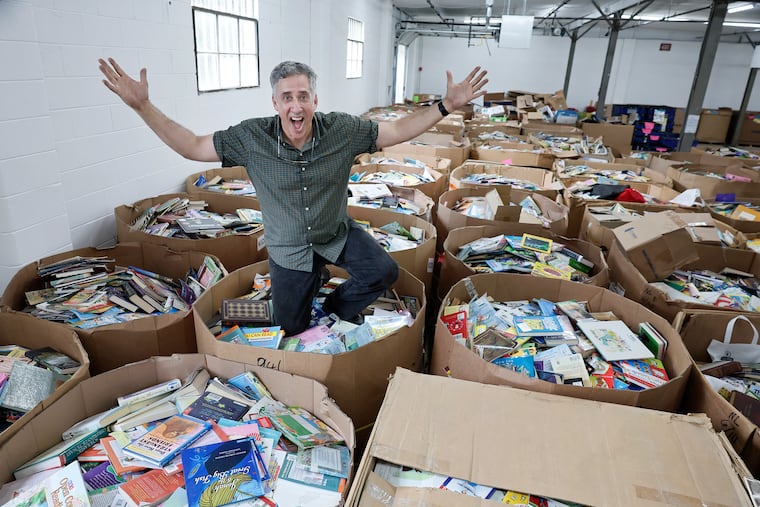
Inside a cavernous warehouse just off I-295 in Cherry Hill, Larry Abrams spread his arms, gesturing to the sea of industrial-size cardboard boxes that surrounded him.
“We’re sitting on a rocket ship,” said Abrams, a third-generation teacher.
Abrams’ rocket ship is comprised of books: thousands and thousands of them — picture books and out-of-date science textbooks, cookbooks, and battered novels. He sees them as a way to change kids’ life trajectories.
To date, BookSmiles, the nonprofit Abrams started out of his garage in 2017, has distributed five million books. It just outgrew its third location, expanding into a 14,000-square-foot space in Cherry Hill that’s formally opening this week.
Book banks are not a new idea. But Abrams believes he’s got the secret sauce.
“We’re the only book bank in America that does this — we actively trade pallets of grown-up books for pallets of upcycled gently used children’s books,” Abrams said. “Never before has there been a low-cost way to get so many beautiful, upcycled books into the homes and hands of kids who need them the most.”
‘It’s simply about a lack of book access’
Abrams served in the Navy — he was stationed on an aircraft carrier during the Persian Gulf War — and managed a copy shop. Then, he settled into a career as an English teacher, working first in Moorestown, and then in Lindenwold.
“I thought, ‘Why do most of the Lindenwold kids in my ninth grade class read at a third or fourth grade reading level?” Abrams said. “It’s simply about lack of book access. It’s not fair that some kids grow up with no access to books, and other kids have everything.”
Abrams thought long and hard about how to change that equation. What if he redistributed books from wealthy and middle-class communities to the places that didn’t have them?
He put out a social media call for children’s books, and got thousands.
There is no market for reselling used children’s books online, Abrams found — you can’t sell them and make any kind of money. So the BookSmiles concept developed.
Now, people from all over New Jersey and Pennsylvania donate books — any kind of books, from old encyclopedias to nearly new novel series. The BookSmiles team (at first, just Abrams himself, now, it’s 11 people and a growing corps of volunteers) sorts through every single book.
The organization gets books in myriad ways: from folks dropping off what they salvage after cleaning out a bookshelf, to donations of entire estates of books. BookSmiles accepts library discards and scrap paper, too.
Adult books, old textbooks, and kids’ books that aren’t in excellent condition are sold, not for cash, but for gently used children’s books that are distributed directly to teachers, daycares, and other nonprofits that get them in kids’ hands.
‘There’s a low-cost way to raise test scores’
BookSmiles grew so significantly that Abrams retired from teaching and now works full time as executive director.
But his educator hat is always on. Research shows that access to books, and books in children’s homes, is a powerful determinant of kids’ educational outcomes and economic success.
“This comes from a place of me being a teacher, and seeing there’s a low-cost way to raise test scores,” said Abrams, dipping his hand into a cardboard box and fishing out an old dictionary that will end up being recycled for paper.
The largest share of BookSmiles’ books move out through its “Teacher Take” program. Teachers pay a nominal fee — BookSmiles asks for $35 annually — and can then take hundreds of books multiple times a year, either for classroom libraries or distribution.
BookSmiles also sponsors “Fair Book Fairs,” where schools get enough books for every child to take home at least three volumes at no cost.
Schools that serve predominately students from economically disadvantaged backgrounds are asked to kick in just $200 to get a Fair Book Fair. Others pay a little more.
In 2025, BookSmiles gave away half a million books to teachers and kids in Philadelphia schools. The other 500,000 went to New Jersey teachers and schools, and the remainder, about 250,000, were sent overseas.
With libraries often on the chopping block in low-wealth school systems — Philadelphia had under five people working as full-time, certified school librarians last school year — classroom libraries are key, and teachers often need resources to build them.
“We can hook them up,” said Abrams. “I can’t give them school supplies, but I can give them books.”
Book joy
Abrams still gets struck by moments of “book joy” when he looks at the Teacher Take room, or the massive room of books waiting to be sorted or moved out.
“It’s almost like walking into Willy Wonka’s world, but it’s not candy, it’s books,” he said. “Sometimes, you can’t tell the difference between what Barnes and Noble is selling and what we’re giving away.”
BookSmiles’ new space, across the street from the PATCO Woodcrest station, just off I-295, is a level up for the organization. It will allow BookSmiles to move from distributing 1.3 million books per year to five million books per year, and can accommodate more volunteers.
Abrams, like many, is thinking of Dolly Parton a lot these days.
The music icon and humanitarian, who died Aug. 25, was an inspiration for BookSmiles and Parton a mentor to him, though he never met her.
Parton began her Imagination Library, a program that sends free books directly to children’s homes, as a tribute to her father, who never learned to read.
“I don’t know if I’ll ever get to 300 million books,” Abrams said. “But we know that if books are in the home, children will be more successful academically. We know that access to books changes equations.”
BookSmiles, 100 Melrose Ave., Cherry Hill, N.J., accepts book donations and volunteers. Its Teacher Take program resumes soon.