
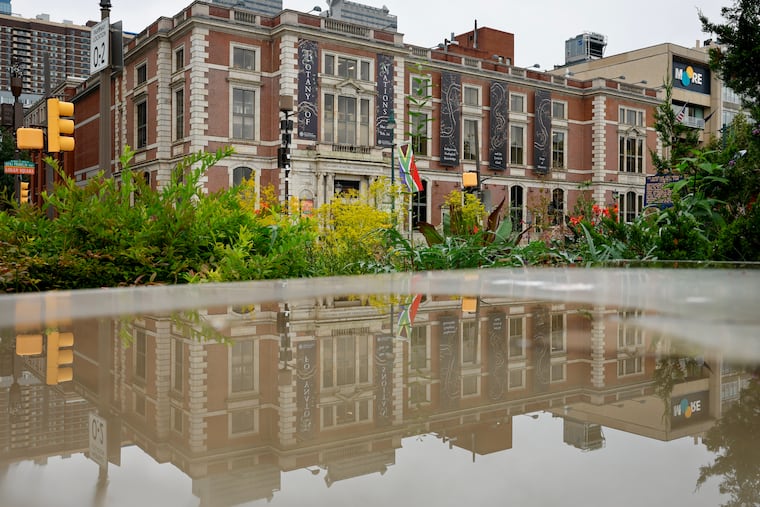
Even the Preservation Alliance for Greater Philadelphia was surprised that the Benjamin Franklin Parkway building that houses the Academy of Natural Sciences of Drexel University is not historically protected.
It learned after the academy announced its museum was closing that the building is “alone among the historic cultural institutions on the Parkway” as not designated historic by the city, said Paul Steinke, executive director of the Preservation Alliance.
The academy’s 150-year-old building houses the country’s first natural history museum. But it is not listed on the Philadelphia Register of Historic Places, a status that comes with protections against major alterations and demolition.
The museum is scheduled to close at the end of the month, and the academy plans to eventually relocate its collections and sell its building. The property’s zoning allows for low-rise, low-density residential buildings, such as townhouses or small apartment buildings. According to city records, the property’s assessed value is more than $28.7 million.
» READ MORE: The Academy of Natural Sciences is closing its museum after nearly two centuries
According to the Philadelphia Historical Commission, the academy considered pursuing historic designation for the building in the late 1980s but ultimately did not. On Wednesday, a spokesperson for the commission said it does not have a nomination from anyone in hand.
City Councilmember Jeffery Young Jr., whose 5th District includes the academy, said his office is looking into possible zoning changes to “protect and preserve that Parkway district,” including the academy’s building.
“We want to be able to utilize every tool we have available if necessary” to “preserve that public good in that area,” Young said.
Why hasn’t the building been designated historic yet?
“It wasn’t thought to be threatened, for one,” Steinke said. Designation happens only when someone takes the initiative to submit a nomination to the city, he noted, and that is commonly spurred by threats of redevelopment.
He pointed to another iconic Philadelphia spot that most people assumed was historically protected until a developer made plans to redevelop it: Jewelers Row, the oldest diamond district in the country.
In late 2019, Toll Bros. demolished several buildings on the 700 block of Sansom Street to build a 24-story housing tower that did not materialize. Developer Pearl Properties, which later took over the site, started making visible progress on its own housing tower this summer following years of delays.
For the academy’s building, Steinke said, the Preservation Alliance is looking into what it would take to do the necessary research, write and submit a nomination, and take it through the city’s historic designation process, which includes review by historical commission staff and public consideration by the commission and its committee on historic designation.
“We think it clearly qualifies for local designation,” Steinke said.
» READ MORE: The first complete dinosaur skeleton on view to the public made its debut at Philly’s Academy of Natural Sciences
The start of Philly’s museum mile
The academy moved to its current location on the Parkway in 1876, when the building opened for the Centennial. The building was designed by James Hamilton Windrim, an architect most famous for designing the Masonic Temple across from City Hall.
In the early 1900s, the academy building’s facade was redesigned in the Georgian style by the well-known Philadelphia firm Wilson Brothers & Co. Defining features of this architectural style include heavy use of red brick, symmetrical facades, centered entrances, and simple decorative elements, according to Steinke.
The academy said financial pressures and low attendance drove its decision to close the museum after nearly two centuries.
But Steinke said he hopes the outpouring of love and support people have been showing the museum since the closure was announced can help keep it where it is. When he visited on Sunday, he said, he “was heartened by the crowds of people, the families enjoying it.”
“It would be a real loss to lose that museum at the start of the museum mile,” Steinke said, referring to the section of the Parkway that hosts institutions such as the Rodin Museum, Calder Gardens, and the Philadelphia Museum of Art.
On Thursday, Councilmembers Young and Nina Ahmad plan to introduce a resolution that calls for Council hearings on the museum’s closure. They are also planning a rally to protest the closure at City Hall that morning.