
This week’s Shackamaxon covers local housing debates, the city’s struggle to “turn the key” on Land Bank projects, SEPTA’s new quality of life initiative, and the mayor’s budget address.
Little borough, big ambitions
Last week, I questioned whether any of the politicians who expound on housing would make the right choices. Thanks to reporting from The Inquirer’s Local team, I now know of one place that’s considering a plan that would actually work: Narberth Borough in Montgomery County.
While the Main Line has been synonymous with affluence for generations, Narberth has traditionally been one of its more affordable areas. Homes are now appreciating faster than the county average. While that’s a win for homeowner equity, it is a challenge for families seeking to settle down in town. Some residents and members of the borough council want to change that, and have proposed rezoning. The hope is that additional foot traffic will also help revitalize the downtown shopping district.
The rezoning plan is not yet a sure thing. Some residents and council members still have questions, particularly around height and density. In such a compact area, taller and denser structures are essential to lowering the per person costs. Council member Michael Gaudini, one of the supporters of the plan, told me that “housing diversity has always been important to Narberth.” He cites his own family as a great example of that, having moved to the borough’s existing rowhouse stock as immigrants in the 1950s.
When those homes were built, some questioned whether such an urban housing style really belonged in the borough. Decades later, they fit in just fine.
Much ado about rowhouses
You might think that building rowhouses would be less controversial in 21st century Philadelphia than it was in early 20th century Narberth. You’d be wrong.
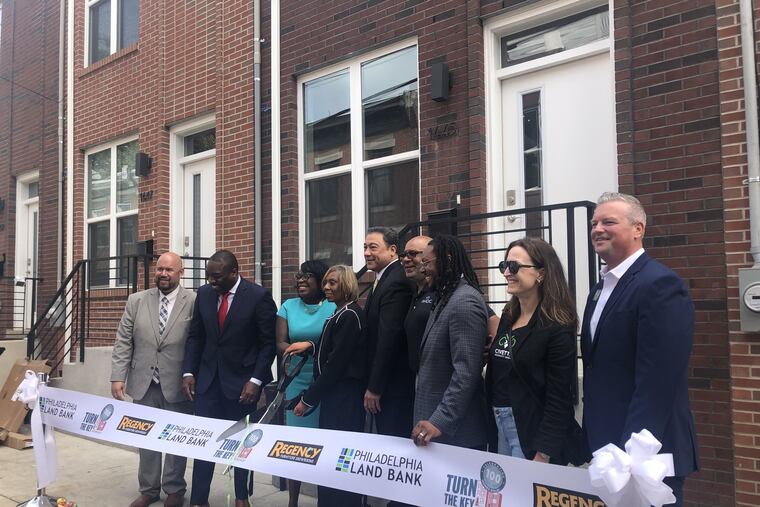
At least when it comes to 30 proposed sales in the 7th District through the city’s Turn the Key affordable housing program. After years of debate, the project finally cleared the Land Bank board earlier this month. Now it’ll almost certainly sit in Councilmember Quetcy Lozada’s inbox indefinitely. Lozada’s support is required for the development to go forward, and she’s declared her resolute opposition.
Lozada has cited community opposition and fears of displacement as reasons not to proceed.
Residential displacement is a serious problem, but there is no evidence that I’ve seen showing that Turn The Key projects have caused any. The program leverages city-owned land to provide workforce housing to first-time homeowners at roughly $1,300 a month. That’s a steal in today’s housing market, especially for new construction.
Residents have to stay for 15 years, which eliminates anyone with a more fleeting interest in the neighborhood. Data from a similar project in Strawberry Mansion showed that most buyers came from the neighborhood. Lozada also recently supported another proposal with very similar income restrictions. The construction costs are over $600,000 per unit, twice what buyers will pay for the proposed rowhouses.
It is true that the project has faced pushback at community meetings. Lozada told me that she will “support projects when residents are meaningfully included in shaping the outcome and when the proposal reflects those concerns.”
Of course, some of Lozada’s critics may question where that commitment was when she voted for the proposed Market Street Sixers arena, a much bigger project that garnered even more community opposition.
SEPTA is watching
For years, SEPTA riders have asked why the transit agency doesn’t have more officers patrolling trains or watching the tens of thousands of cameras deployed across the system. On Monday, I visited SEPTA headquarters at 1234 Market, where they are trying to do exactly that.
The agency has deployed two new initiatives, both enabled by a surge in officer hiring and aimed at improving quality of life for riders. Officers will be assigned to ride and patrol trains to discourage smoking, loud music, seat hogging, door blocking, and other problematic behaviors. There’s also a civilian team assigned to watching the cameras, 24 hours a day. This allows SEPTA to advise officers about incidents before their arrival and identify and track offenders as complaints come in.
The new patrols are made possible by SEPTA’s success in recruiting and retaining police officers. SEPTA police had been reluctant to divert any resources from fare enforcement, which data show has a major impact on serious crime. Police Chief Chuck Lawson and Deputy James Zuggi said that when fare evasion enforcement falls off, violent crime surges.
They pointed to the first quarter of 2025, which was otherwise the safest year in decades. Crimes like robbery and aggravated assault increased, as did reports of smoking and drug usage. This corresponded with an operational decision to shift away from fare enforcement to tackle quality of life problems. Now, the agency has sufficient resources to do both. Despite the headwinds in Harrisburg and a pandemic-induced drop in ridership, SEPTA can honestly tell folks “we’re getting there” once again.
Big words, small policies
Philadelphia Mayor Cherelle L. Parker is known for speaking at length. Last week’s budget address was no different. The mayor spoke for a little over two hours. Mayor Jim Kenney’s last budget speech in 2023 took roughly a half hour. What’s remarkable is that despite the additional length, Parker’s policy objectives are still quite modest.
The address rattled off a series of relatively small-bore investments — a couple million here, a few hundred thousand there. Some of the ideas — like taxing rideshare and delivery services — make sense. Others, like providing the kind of financial planning assistance readily available for free online, are more questionable. The mayor is taking aim at one of the city’s core problems, which is a lack of economic mobility. She has yet to challenge the biggest obstacle to progress there, her former colleagues on City Council. Until she does, all the extra talking is for naught.