
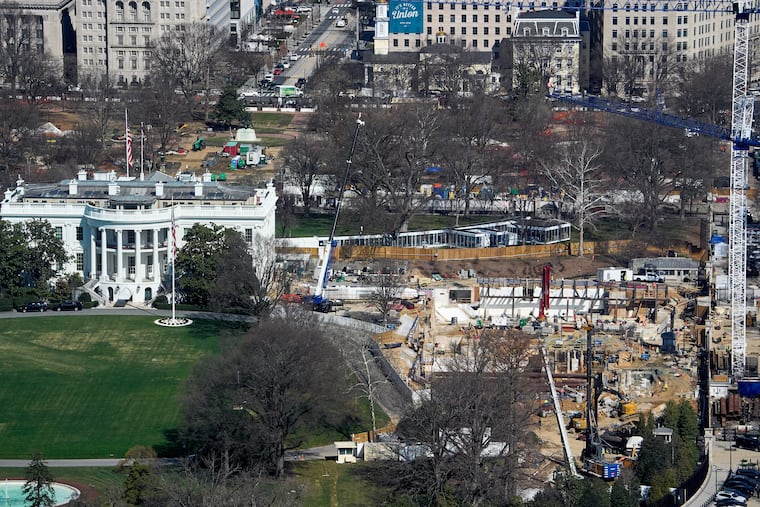
A federal appeals court said the White House can temporarily continue construction on President Donald Trump’s planned White House ballroom while punting a central question — if pausing the $400 million project threatens the president, as Trump claims — back to the federal judge who halted the project last month.
In its order issued Saturday, a three-judge panel at the U.S. Court of Appeals for the D.C. Circuit ruled 2-1 that U.S. District Judge Richard Leon should clarify a series of national security-related questions that could affect ongoing construction. The panel also said that the White House could keep working on the project until April 17, granting the administration three extra days before Leon’s pause takes effect.
Leon, an appointee of President George W. Bush, ruled last month that Trump’s ballroom project could not continue until the president obtains approval from Congress, but he also permitted further work to ensure “the safety and security of the White House.” Trump has argued that Leon’s order allows him to keep building the ballroom, citing his plans to add bulletproof glass, bomb shelters, and other security features to the building.
“This is positive for us,” Trump told reporters last month, insisting that work could continue.
The National Trust for Historic Preservation, the organization that sued to block the ballroom construction last year, disputed Trump’s interpretation of Leon’s order and asked Leon to clarify the scope of his injunction. Leon has yet to do so.
The appeals panel Saturday said that it had its own questions, noting that Leon’s order to pause construction came after Trump tore down the White House’s East Wing and began a multiyear effort to build a replacement.
“It is unclear … how a potential delay to the construction imposes additional harm beyond the expected and consciously undertaken risks of a lengthy and major construction project of the White House,” wrote Judges Patricia Ann Millett, an appointee of President Barack Obama, and Bradley Garcia, an appointee of President Joe Biden.
Millett and Garcia also wrote that they were uncertain whether pausing construction on the aboveground ballroom also affected belowground work that the White House has said is necessary for national security, noting the Trump administration’s shifting arguments about whether the projects were linked.
Judge Neomi Rao, a Trump appointee, dissented from the panel’s order, arguing that the National Trust, a nonprofit charged by Congress with helping to preserve historic buildings, lacked the standing to sue. She also suggested that Trump had the authority to build the ballroom, a question that Millett and Garcia did not engage with in their order.
In a statement, the National Trust said it remained committed to its mission of “honoring the historic significance of the White House.” The organization has faced persistent attacks from Trump since bringing its lawsuit last year.
“We appreciate the court of appeals acting quickly and await further clarification from the district court,” National Trust CEO Carol Quillen said.
The White House praised the panel’s ruling.
“We are glad the DC Circuit further extended the stay of the district court’s untenable injunction; we are pleased that Judge Rao understands the need to put this charade to an end; and we look forward to total and complete vindication,” White House spokesman Davis Ingle said in a statement.
Saturday’s ruling is the latest development in the extended legal battle over Trump’s desired 90,000-square-foot addition to the White House, which he has identified as a top priority for his second term. Trump initially characterized the project as an entertainment venue, saying that an expansive ballroom was necessary to host VIP guests, but administration officials have increasingly framed the project as a priority to protect the president.
The pause “gravely threatens national security,” Justice Department lawyers wrote in a filing Thursday, saying that halting work on the project would imperil Trump, his family, and White House staff. They have argued that the planned ballroom building is being designed to defend against “hostile attacks via drones, ballistic missiles, bullets, biohazards,” and other potential threats.
Trump has also said that the military was building a “massive complex” under the ballroom. The White House has declined to offer additional details about the underground construction beyond the president’s remarks, but it has long been known that the area underneath the former East Wing contains secure facilities that the president and staff members could use in an emergency.
In the order issued Saturday, Millett and Garcia wrote that “it remains unclear whether and to what extent the development of certain aspects of the proposed ballroom is necessary to ensure the safety and security of those below-ground national security upgrades, or otherwise to ensure the safety of the White House and its occupants while the appeal proceeds.”
The National Trust has criticized the administration’s national security claims and cited the White House’s shifting arguments about whether the aboveground ballroom and the belowground military project must be constructed concurrently.
“It is difficult to believe that even Defendants really think the absence of a massive White House ballroom jeopardizes national security,” lawyers for the National Trust wrote in a filing Wednesday.
In her dissent issued Saturday, Rao argued that the federal government “has demonstrated a strong likelihood of success on the merits because the National Trust for Historic Preservation lacks standing to sue and because the construction project is authorized by a statute that allows the President to undertake ‘improvement[s]’ to the White House.