
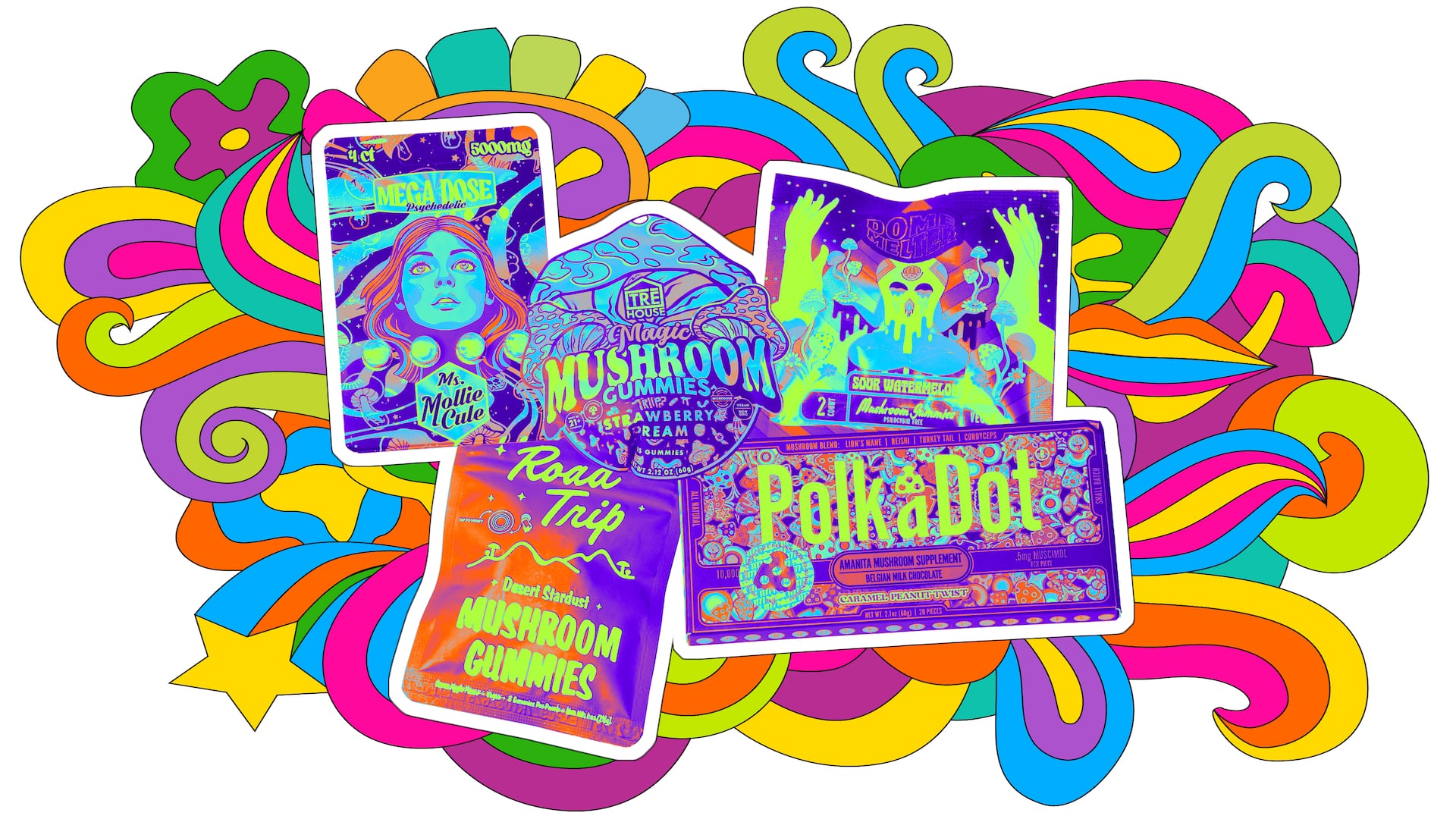
At a smoke shop in suburban Bryn Mawr, the four-pack of Ms. Mollie Cule tablets promises an “otherworldly” high for just $29.99.
The package sports a starry-eyed woman, surrounded by floating technicolor mushrooms. Inside is a 5,000-milligram “proprietary blend” with “natural binders and fillers,” according to the fine print. The sole quality assurance comes from an appended lab report that states only what drugs are not present in the lozenges — along with a warning that the U.S. Food and Drug Administration had not tested them.
But The Inquirer did.
Lab testing commissioned by the news organization shows the product contained an obscure compound that comes from the same chemical family as gamma-hydroxybutyrate, or GHB, a central nervous system depressant and “date rape” drug that is illegal to consume. Chemists said it’s not clear what this related compound does when taken.
Ms. Mollie Cule is one of 20 unregulated products marketed as psychedelic drugs that The Inquirer purchased from smoke shops around the Philadelphia region. Subsequent lab tests reveal a marketplace that often misleads consumers about what these products actually contain.
The Inquirer’s examination found:
-
While many products carry lab reports suggesting they are legal, three products contained actual psilocybin or its relative, psilocin, both hallucinogens banned by federal law.
-
Two products, including Ms. Mollie Cule, fabricated those lab tests. Two others cropped legitimate lab reports to conceal the presence of toxins such as salmonella, solvents, and heavy metals.
-
Two samples contained only THC, the main psychoactive ingredient in marijuana or other cannabinoids.
-
Eleven were synthetic compounds like ethacetin and metocin, engineered with slight molecular differences from outlawed substances like psilocybin, but whose health effects are far less known.
-
Seventeen of the 20 products failed to clearly state any active ingredients on the packaging.
Psilocybin, a hallucinogen found in certain mushrooms that produces hours-long mental and visual effects, has been an illegal Schedule I drug in the United States since 1970.
Yet, fringe chemists now import chemicals — substances that are often legal or loosely regulated — and turn them into potent designer drugs sold as pills, gummies, chocolate bars, liquid shots, and candy ice cream cones.
These synthetic substances exist in a legal gray area, engineered to differ slightly from banned hallucinogens in ways that may allow them to skirt drug laws, fueling a multibillion-dollar nationwide market for unregulated psychedelics.
“They’re just buying some powder from China,” said Bjorn Fritzsche, a chemist with the Portland-based Rose City Labs, which tests psychedelic drugs for Oregon’s legal psilocybin program and tested 10 samples for The Inquirer. “They’re essentially changing the third molecule and altering it just enough so that it’s no longer scheduled.”
Production of unregulated psychedelics has expanded in parallel with increasing scientific interest in psilocybin’s potential to treat depression and other complex mental health conditions. Lab-made imitations have not undergone the same clinical studies.
Yet, they’re ubiquitous.
» READ MORE: Pennsylvania’s Wild West of unregulated weed
As state and federal lawmakers dither over how to respond to other unregulated smoke shop products, like hemp-based THC and the addictive 7-OH kratom, psychedelics are openly sold at hundreds of smoke shops and gas stations — from the Main Line to Abington strip malls to the historic district around Independence Mall.
Boosters of the drugs, like Caulen Lauria of the Austin, Texas-based psychedelics company Magic Medicinal, argue that these synthetic hallucinogens are still safe, offering many of the same therapeutic benefits that health officials have studied in psilocybin.
“The awareness of mushrooms is really only now starting to reach critical mass,” said Lauria, whose products The Inquirer did not test. “The country is demanding psychedelic products.”
Most of the active ingredients uncovered by The Inquirer tests have not been linked to major health scares. But two years ago, one unregulated psychedelic led to widespread poisoning.
In 2024, the U.S. Food and Drug Administration prompted a recall of “Diamond Shruumz” products after linking the brand to 180 illnesses, 70 hospitalizations, and three potential deaths in 34 states, with symptoms including seizures, vomiting, and loss of consciousness. Five cases of severe illness were reported in Pennsylvania and New Jersey.
Government testing found a cocktail of compounds inside their chocolates and gummies: psilocin, DMT analogs, kava, and Pregabalin, a prescription drug used to treat neuropathic pain — none of which were disclosed on the label.
“Even a trace contamination could prove devastating.”
The products also contained muscimol, an extract of the Amanita muscaria mushroom that has hallucinogenic properties but is also a neurotoxin. The naturally occurring fungus is still advertised on chocolates made by PolkaDot, a prominent psychedelic brand.
Health officials in Colorado and California seized shipments of the brand within the last year, citing concerns about the toxic mushroom, particularly for children.
David Olson, director of the Institute for Psychedelics and Neurotherapeutics at the University of California Davis, said without adequate testing, there is no way for consumers to know if drugs made by self-regulated “clandestine chemists” are free from toxins.
“Even a trace contamination,” he said, “could prove devastating.”
The shroom boom
Beneath pulsing lights and thumping dance music, a former LSD dealer, a Utah real estate investor, and a New York City firefighter hawked psychedelic drugs to local business owners on a recent March morning in Atlantic City — all under the watchful eyes of local police.
The trio of business owners had booths on the floor of the CHAMPS, a business-to-business trade show for the smoke shop industry, which drew thousands to the resort city’s convention center.
“It’s all natural mushroom extract, very high-end [and] nothing illegal,” said Ryan Johnston, the FDNY firefighter. “You cannot have a bad trip.”
Johnston said mushrooms helped him recover from decades of alcoholism. He’s now an evangelist for mushroom-themed chocolate and gummies under the name “Captain Shroomz.” Sample packs at the show were adorned with a Maltese cross logo found on fire department crests — but no mention of active ingredients.
The scene at the convention center was a far cry from the 1960s societal panic over psychedelics like psilocybin, DMT, and LSD that led to their ban under the Controlled Substances Act.
When lab-made designer drugs first emerged as a potentially legal alternative, Congress passed the 1986 Federal Analogue Act, which was meant to empower the U.S. Drug Enforcement Agency to combat imitation psychedelics.
But the 2018 Farm Bill that legalized hemp created a loosely regulated market for cannabinoids, opening a gap that some entrepreneurs quickly exploited to sell unscheduled psychedelics alongside CBD products.
Even in Oregon and Colorado, the two states with state-administered psilocybin programs, there is still a market for unregulated psychedelics. Government-approved psilocybin in Oregon can cost hundreds or thousands of dollars and must be taken in a supervised setting. Meanwhile, unregulated products can cost between $5 and $70 per package and can be consumed as soon as you leave the smoke shop.
Three former hemp industry sellers told The Inquirer that they pivoted to less-scrutinized psilocybin alternatives amid a nationwide crackdown on hemp-based THC and kratom, two of the more common smoke shop staples on display at the business expo. They added that they were further emboldened by mixed signals coming from Washington, D.C., concerning the sale of hallucinogenic products.
Judd Weiss, a former LSD dealer in Los Angeles who makes and sells unscheduled hallucinogens through his company, Voyager Labs, pointed to comments from U.S. Health and Human Services Secretary Robert F. Kennedy Jr. that he is open to adding psychedelic medicine under his “Make America Healthy Again” movement.
Weiss said the Federal Analogue Act was “effectively dead,” citing U.S. Supreme Court Justice Neil Gorsuch’s past critiques of the law as too vague. And Weiss noted federal drug enforcement agents are preoccupied with combating more deadly drugs like fentanyl — not psychedelics.
“Agents are focused on racking up wins,” Weiss said. “They’re not focused on mushroom chocolate bars.”
Retailers in the Philadelphia region have been right so far to assume they have little to fear, as law enforcement agencies largely appear to be in the dark about the products.
The Pennsylvania State Police declined to provide any enforcement data on psychedelics, but noted the agency began to target smoke shops selling hemp-based THC in the Philadelphia suburbs last year. New Jersey lawmakers are now weighing whether to legalize psilocybin, though the state police did not respond to a request for comment on the unregulated psychedelic market.
And, although unregulated hallucinogens are widely available in Philadelphia, the city’s police department said they were unaware of their presence.
“We have not encountered magic mushrooms while serving warrants at stores or establishments,” said a PPD spokesperson. “We continue to focus on fentanyl distribution and sales due to the negative impact it has on our communities.”
‘The ghost compound’
Weiss criticized the unregulated psychedelics industry as rife with intentional mislabeling. Manufacturers use potentially dangerous compounds without disclosing them on the packaging, which he called unacceptable.
Waging what he called a “clarity crusade,” Weiss openly markets both his new lab by name and the active ingredient of his flagship product, XÜM tablets. His packaging clearly states his product contains the “unscheduled psychedelic” metocin, a synthetic compound similar to psilocybin. It also includes a warning about the side effects of overconsumption.
“For decades, we had to hide to provide,” he said of black market psychedelic dealers like himself who have transitioned into legitimate retail. “[But] it’s all sketch. It’s people protecting themselves, instead of protecting their consumers.”
At one point, many of the nation’s unregulated hallucinogens were coming from a single lab, Weiss said, which used a chemical mix so secretive it was discussed even internally only as “the ghost compound.” He said retailers were required to keep the lab’s name and the exact compound off product packaging, describing them only as “proprietary mushroom blends.”
But practitioners like Weiss are the outliers.
Research into unlabeled hallucinogens published last year produced results mirroring The Inquirer’s testing: One third of the products tested in the study contained synthesized hallucinogens similar to psilocin, while the rest contained a grab bag of other substances ranging from cannabinoids to kava to caffeine.
“I’m sure that, for each one that does [lab test], there’s a hundred that don’t.”
Fritzsche, the Portland chemist who copublished that research, said he tested a batch of chemicals for one manufacturer that contained xylazine, an animal tranquilizer often mixed on the streets with illicit fentanyl.
He said that while some producers may be well-intentioned, in a self-regulated industry, there is always a risk of unscrupulous actors.
“I’m sure that, for each one that does [lab test], there’s a hundred that don’t,” Fritzsche said.
Hidden owners
The entities behind many psychedelic products are limited liability corporations with no listed address or identifiable owners. Three products The Inquirer tested could not be traced to any legitimate or identifiable company.
The package for the Ms. Mollie Cule tablets does not list a company name, manufacturer, or website. Instead, a QR code links to a lab report that shows the product is free from psilocybin and other psychoactive compounds.
But the lab report — which did not mention the GHB-related compound detected by The Inquirer’s testing — was faked: a representative for SD PharmLabs, the lab listed on the report, confirmed it had not tested that product.
The phony lab test came from a Dropbox account belonging to “Seth Bitzer.” Public records and social media indicate Bitzer is a 35-year-old Delaware man who was previously involved in the hemp-based THC industry. In 2023, Bitzer posted a picture of himself on Instagram at a Las Vegas trade show wearing a vendor badge and a sweatshirt branded with the logo for a THC company.
According to public business filings and Bitzer’s LinkedIn page, he was the executive director of a drug-treatment center in Orange County, Calif.
Reached by phone, Bitzer said he was no longer working with the rehab facility. He declined to discuss the Ms. Mollie Cule tablets.
Two chemists who reviewed The Inquirer’s test results were alarmed by the compound found in the product — an analog of gamma-butyrolactone, or GBL, an industrial solvent that converts in the body to GHB.
The owner of Urban Puff, the Main Line smoke shop that sold the Ms. Mollie Cule tablets, did not return a request for comment.
There are no testing requirements for unregulated psychedelics. Many companies voluntarily screen for select drug compounds — and in some cases, foodborne toxins and other contaminants — to show the products are both legal and safe. Nonetheless, forging lab tests is not uncommon among synthetic recreational drugmakers, as The Inquirer found in an investigation of hemp-based THC products last year.
Many drug-testing labs embed a QR code on their reports that links back to the official document for verification. By using those codes and contacting lab owners, The Inquirer found two lab tests for psychedelic products that were outright fraudulent and two cases where the lab tests shown to consumers differed from the full verified results.
In another case, TRE House cited two different labs to show a clean batch of Strawberry Dream gummies. But the company omitted two pages from one lab’s testing panel that showed levels of salmonella that federal regulations deem unsafe, as well as trace levels of arsenic and lead. Instead, the company appended another lab’s test results, conducted four months later, that showed a batch of product free from those toxins.
TRE House did not respond to a request for comment.
Another company, billing itself as Trippy Tips Cones, openly marketed a psilocybin-infused candy ice cream cone, which reporters purchased at a shop in Old City, three blocks from the Liberty Bell. A website for the brand states it is based in San Francisco, though no company under that name exists in California corporate registries.
The company’s phone number is shared by a Los Angeles-based liquor store, two cannabis vape companies, and a smoke shop in San Francisco’s Japantown neighborhood.
A man — who would identify himself only as William — answered the phone and said Trippy Tips stopped distribution of the cones a year ago, and that any product that isn’t purchased from their website is “a counterfeit.”
He declined to provide further information about the company.
“It would be really good if we, as a responsible public could figure out the responsible dosing without people getting hurt.”
Carl Hart, a neuroscience professor at Columbia University, said it was likely only a matter of time before law enforcement took enforcement into their own hands. He advocated for the establishment of a legal, recreational system for psychedelics.
“It would be really good if we, as a responsible public,” he said, “could figure out the responsible dosing without people getting hurt.”
This article was supported by the Fund for Investigative Journalism.