
Earlier this week, with no particular fanfare, Philadelphia Ballet reached a historic milestone it has chased for two decades:
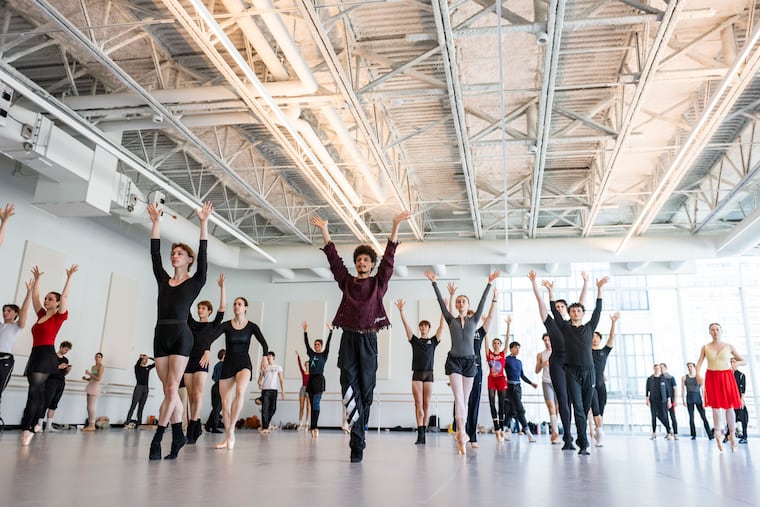
Dancers danced at the company’s new North Broad Street building for the first time.
Even as construction workers continued their own choreography of spackling and power-driving screws, company dancers could be seen in a large, glassy, sunlight-filled studio working out movements for an upcoming run of Romeo and Juliet.
Philadelphia Ballet artistic director Angel Corella on Monday was positively ecstatic.
“When we were walking around when it was being built, it felt unreal and unbelievable that it was actually going to be ours,” he said.
And yet, Corella added, “as soon as I started teaching classes, something happened. It was like, boom, I’ve always been here, and it was a very strange feeling, like, ‘Oh, this feels comfortable. This is our home.’”
Getting home has been a struggle. The ballet acquired the site in 2007, and various plans came and went.
“It’s been quite the mountain to climb,” said company CEO Shelly Power of the effort, which has been the ballet’s most ambitious ever. Along the way came administrative and artistic turnover (before Power’s arrival), financial challenges, a pandemic that damaged arts attendance, a delay involving project financing, a 2023 fire in the ballet’s existing building on the site, and inflation and increases in the project’s total price tag, which has now reached about $45 million.
Even today, much work remains. Fundraising to date stands at $33 million, though Power feels confident that, with the company and school’s building finally real, donors will be inspired.
“I can hear donors in my mind from years back saying, ‘Well, let’s see how this goes,’ and ‘Let’s see the building.’”
The company is hoping for $2.5 million from the state on top of $6.7 million that has already been awarded. Hard-hat tours with several dozen potential donors in recent months have yielded about $3 million in gifts, she said.
“I believe it’s going to inspire a lot of people that have been waiting to see it,” said Power. “Seeing is believing.”
Naming rights to the building are still available, either in perpetuity or perhaps on a rolling basis to a corporation.
The building on North Broad Street just south of Callowhill is connected to the ballet’s existing low-slung building set back from the street, which will now undergo renovations. The facade of the new five-story structure designed by Philadelphia’s Varenhorst Architects is faced in stainless steel subtly etched at the bottom with silhouettes of dancers.
Even during move-in this week, elements of construction and fit-out remained to be completed. An LED display at one corner of the building is expected to be in place by July, artwork for the lobby is on the way, the music library had no scores or parts as of Monday. The blackbox theater on the first floor — named for company founder Barbara Weisberger — was just getting its seating.
But already, a walk-through suggests an environment that’s quite different from the ballet’s existing tight warren of offices and studios.
The new studio on the building’s top floor has two walls of glass, providing passersby with views of dancers warming up on barres. The size and dimensions of the space replicate those of the Academy of Music stage, so the transition from rehearsal to performance space will be more seamless than before.
Reminders of what it’s all about sometimes greet visitors in surprising ways.
Walking down a corridor of doors, one passes a low window opening a view into a studio below, where by chance on this day two dancers were working out a section of Romeo and Juliet with a rehearsal pianist.
The wardrobe department is lined with windows, and administrative and meeting spaces are filled with sunlight.
“I feel like we’re already thinking differently now that we’re in a space where we’re not climbing over each other,” said wardrobe manager Jennifer Tierney, whose wardrobe space is double of what it had been in the old building.
While the building won’t be a public one, it will often invite in the public in a way the old space could not. Performances in the blackbox theater are planned, but perhaps the dance center will also host wellness programs for neighbors, after-school story-telling relating to Swan Lake, or yoga classes for the public.
“We’re not trying to be the YMCA,” said Power. “We want to keep it within the arts and keep it within what we know we can do well. That’s why we’re taking our time to figure it out. We hope to attract a lot of people that maybe don’t know about the ballet. The way our [other] building was situated, people didn’t even know where we were.”
Construction is expected to last through June — finishing in time for the start of the School of Philadelphia Ballet’s summer intensive — with an official opening slated for September.
Corella said the new building remedies a disconnect between the ambition and scale of the company, and the stature of the facilities it has occupied.
“We’re one of the main ballet companies in the United States and around the world. Now we have a building that actually matches that.”